Pharmaceutics
Detailed Answers1. Write a note on "Pharmacy as a Career" describing the scope in various sectors.
• Pharmacy is a professional field related to the preparation, dispensing, and safe use of medicines.
• A pharmacist plays an important role in the healthcare system.
• They ensure that patients receive the correct medicines.
• They also guide patients regarding proper use of medicines.
• Pharmacy offers excellent career opportunities in both government and private sectors.
Scope of Pharmacy in Various Sectors:
I. Community Pharmacy (Retail Pharmacy):
• Community pharmacists work in retail medical stores.
• They dispense medicines according to prescriptions.
• They advise patients about dosage, storage, and side effects.
II. Hospital Pharmacy:
• Hospital pharmacists work in hospitals and nursing homes.
• They maintain medicine stocks.
• They prepare sterile products.
• They help doctors in selecting suitable medicines.
III. Pharmaceutical Industry:
• The pharmaceutical industry provides jobs in many departments:
- Production and Manufacturing
- Quality Control (QC)
- Quality Assurance (QA)
- Research and Development (R&D)
- Packaging and Labeling
- Regulatory Affairs
IV. Drug Inspection:
• Pharmacists can become Drug Inspectors.
• They inspect pharmaceutical companies and medical stores.
• They ensure compliance with the Drugs and Cosmetics Act.
V. Government Services:
• Pharmacists are recruited in various government organizations:
- Railways
- ESIC Hospitals
- CGHS
- State Government Hospitals
- Defence Services
- Public Sector Undertakings
VI. Research and Development:
• Pharmacists work in research laboratories.
• They develop new drugs.
• They improve existing formulations.
• They conduct stability studies.
VII. Clinical Pharmacy:
• Clinical pharmacists work closely with doctors and patients.
• They monitor drug therapy.
• They help prevent adverse drug reactions.
VIII. Academics and Teaching:
• Pharmacists can become lecturers and professors after higher studies.
• They teach in pharmacy colleges and universities.
IX. Sales and Marketing:
• Pharmacists can work as Medical Representatives.
• They promote pharmaceutical products to doctors and hospitals.
• They may also become Product Managers or Sales Managers.
X. Pharmacovigilance:
• This field deals with monitoring adverse drug reactions.
• It helps ensure medicine safety.
XI. Entrepreneurship:
• Registered pharmacists can start their own business:
- Retail Pharmacy
- Wholesale Drug Store
- Manufacturing Unit
- Online Pharmacy
XII. Higher Education and Specialization:
• Pharmacists can pursue advanced courses:
- B.Pharm
- M.Pharm
- Pharm.D
- MBA
- Ph.D
2. What is a Pharmacopoeia? Describe the history and salient features of the Indian Pharmacopoeia.
Definition of Pharmacopoeia:
• A Pharmacopoeia is an official book of drug standards.
• It contains information about the identity, purity, strength, and quality of drugs.
• It also provides test methods and specifications for pharmaceutical substances.
History of Indian Pharmacopoeia:
• 1868: The Pharmacopoeia of India was first published during British rule.
• 1948: The Government of India formed the Indian Pharmacopoeia Committee under Dr. B. N. Ghosh.
• 1955: The first edition of the Indian Pharmacopoeia was published.
• 1966: The second edition was published.
• 1985: The third edition was published.
• 1996: The fourth edition was published.
• 2007: The fifth edition was published.
• 2010: The sixth edition was published.
• 2014: The seventh edition was published.
• 2018: The eighth edition was published.
• 2022: The ninth edition was published.
Indian Pharmacopoeia Commission (IPC):
• The Indian Pharmacopoeia is published by the Indian Pharmacopoeia Commission.
• The commission functions under the Ministry of Health and Family Welfare, Government of India.
Salient Features of Indian Pharmacopoeia:
• It is the official book of drug standards in India.
• It contains monographs for drug substances and dosage forms.
• It specifies identification, purity, and assay tests.
• It includes general chapters and appendices.
• It provides limits for impurities and contaminants.
• It includes microbial quality requirements.
• It uses modern analytical techniques such as HPLC and GC.
• It is revised and updated periodically.
• It is legally recognized under the Drugs and Cosmetics Act, 1940.
• It is published in multiple volumes.
3. Classify the types of glass used in pharmaceutical packaging. Discuss their advantages, disadvantages, and selection criteria.
Definition of Pharmaceutical Glass:
• Glass is one of the most widely used materials for pharmaceutical packaging.
• It is used for bottles, vials, ampoules, and containers.
• Glass is chemically inert and protects the product from contamination.
Classification of Glass Used in Pharmaceutical Packaging:
I. Type I Glass (Borosilicate Glass):
• It contains silica, boric oxide, aluminum oxide, and small amounts of alkali.
• It has very high chemical resistance.
• It is highly resistant to thermal shock.
Uses:
• Injectable preparations.
• Vaccines.
• Sensitive pharmaceutical products.
Advantages:
• Excellent chemical resistance.
• Suitable for all types of products.
• Can withstand sterilization.
Disadvantages:
• Expensive.
• Difficult to manufacture.
II. Type II Glass (Treated Soda-Lime Glass):
• It is ordinary soda-lime glass treated with sulfur dioxide.
• The treatment improves its chemical resistance.
Uses:
• Acidic and neutral aqueous preparations.
• Large volume parenterals.
Advantages:
• Less expensive than Type I glass.
• Good chemical resistance after treatment.
Disadvantages:
• Not suitable for alkaline preparations.
• Surface treatment may deteriorate over time.
III. Type III Glass (Soda-Lime Glass):
• It contains silica, sodium oxide, and calcium oxide.
• It has moderate chemical resistance.
Uses:
• Oral liquids.
• Tablets and capsules.
Advantages:
• Cheap and easily available.
• Easy to mold into various shapes.
Disadvantages:
• Lower chemical resistance.
• Not suitable for injections.
IV. Type NP Glass (General Purpose Glass):
• NP stands for Non-Parenteral glass.
• It is used only for products not intended for injection.
Uses:
• Syrups.
• Ointments.
• External preparations.
Advantages:
• Economical.
• Suitable for general packaging.
Disadvantages:
• Poor chemical resistance.
• Not suitable for sterile products.
Selection Criteria for Pharmaceutical Glass:
• Nature of the drug product.
• pH of the formulation.
• Route of administration.
• Requirement of sterilization.
• Sensitivity to alkali.
• Storage conditions.
• Cost of packaging material.
Summary of Selection:
• Type I Glass: Used for all parenteral and sensitive products.
• Type II Glass: Used for acidic and neutral injections.
• Type III Glass: Used for oral and topical preparations.
• Type NP Glass: Used for non-parenteral products only.
4. Explain the principle, construction, and working of a Ball Mill.
Definition of Ball Mill:
• Ball Mill is a size reduction equipment used for grinding solid materials into fine powder.
• It is widely used in pharmaceutical, chemical, and mineral industries.
Principle:
• Ball Mill works on the principle of impact and attrition.
• The balls inside the mill fall on the material and break it by impact.
• Grinding also occurs by rubbing action between balls and the material.
Construction:
• It consists of a hollow cylindrical shell.
• The shell is made of metal or porcelain.
• The inner surface may be lined with rubber or porcelain.
• The cylinder is mounted horizontally on bearings.
• It is partially filled with steel, flint, or porcelain balls.
• A motor rotates the cylinder at a suitable speed.
Working:
• The material to be ground is placed inside the cylinder.
• The cylinder is rotated by a motor.
• The balls are lifted upward due to centrifugal force.
• At a certain height, the balls fall on the material.
• The material is crushed by impact and attrition.
• Fine powder is collected after grinding.
Critical Speed:
• Critical speed is the speed at which the balls stick to the wall of the mill.
• Above this speed, grinding does not occur effectively.
• Formula: Nc = 42.3 / √D
• Where:
• Nc = Critical speed in rpm.
• D = Diameter of the mill in meters.
Uses:
• Grinding of drugs and excipients.
• Preparation of fine powders.
• Mixing of solid materials.
Advantages:
• Suitable for both wet and dry grinding.
• Produces very fine powder.
• Can be used for toxic materials in a closed system.
Disadvantages:
• Time-consuming process.
• High energy consumption.
• Wear and tear of balls may contaminate the product.
5. Describe the construction and working of a Hammer Mill.
Principle:
• Hammer Mill works on the principle of impact.
• The material is broken into smaller particles by repeated blows of rapidly moving hammers.
Construction:
• It consists of a strong metal casing enclosing a central shaft.
• Several swinging hammers are attached to the shaft.
• The shaft is connected to an electric motor.
• A feed hopper is provided at the top.
• A perforated screen is fitted at the bottom.
• A discharge outlet is provided below the screen.
Working:
• The material is fed into the hopper.
• The motor rotates the shaft at high speed.
• The hammers swing outward due to centrifugal force.
• The material is struck by the hammers repeatedly.
• The particles are reduced in size by impact.
• Fine particles pass through the screen.
• Oversized particles remain inside until they are sufficiently reduced.
Uses:
• It is used for coarse to moderately fine grinding.
• It is used for grinding crude drugs, chemicals, and excipients.
Advantages:
• Simple construction.
• High production rate.
• Suitable for a wide variety of materials.
Disadvantages:
• Not suitable for sticky materials.
• Generates heat and noise.
• Wear and tear of hammers may occur.
6. Write a short note on the Cyclone Separator and its principle of operation.
Principle:
• Cyclone Separator works on the principle of centrifugal force.
• Particles of different sizes are separated due to differences in mass and density.
Construction:
• It consists of a cylindrical vessel with a conical base.
• A tangential inlet is provided near the top.
• A central outlet pipe is provided at the top.
• A dust collecting chamber is present at the bottom.
Working:
• Dust-laden air enters tangentially into the separator.
• The air moves in a spiral path at high velocity.
• Heavier particles are thrown to the wall by centrifugal force.
• These particles slide downward into the collecting chamber.
• Clean air moves upward through the central outlet pipe.
Uses:
• It is used to separate fine particles from air streams.
• It is used in milling and drying operations.
• It is used for dust collection.
Advantages:
• No moving parts.
• Low maintenance cost.
• Simple and efficient design.
Disadvantages:
• Less effective for extremely fine particles.
• Efficiency decreases at low air velocity.
7. Discuss the construction and working of the Silverson Mixer Homogenizer.
Principle:
• Silverson Mixer Homogenizer works on the principle of high shear mixing.
• Intense mechanical shear reduces particle size and produces uniform dispersions.
Construction:
• It consists of a high-speed motor.
• A vertical shaft is connected to the motor.
• A rotor is attached to the lower end of the shaft.
• The rotor rotates inside a stationary stator.
• The stator contains perforations or slots.
Working:
• The material is placed in the mixing vessel.
• The motor rotates the rotor at very high speed.
• The material is drawn into the rotor-stator head.
• It is subjected to intense shear and turbulence.
• The material is forced through the stator openings.
• Uniform mixing and homogenization are achieved.
Uses:
• Preparation of emulsions.
• Preparation of suspensions.
• Mixing of creams and lotions.
• Homogenization of liquid and semi-solid products.
Advantages:
• Produces very fine dispersions.
• Fast and efficient mixing.
• Suitable for both small and large batches.
Disadvantages:
• High equipment cost.
• May generate heat during operation.
8. Describe the process of Freeze Drying and its applications.
Definition:
• Freeze Drying is also known as Lyophilization.
• It is a process in which water is removed from a frozen product by sublimation under vacuum.
Principle:
• Water in the frozen state changes directly into vapor without passing through the liquid state.
• This process is called sublimation.
Steps in Freeze Drying:
I. Freezing:
• The product is frozen at very low temperature.
• Water present in the product is converted into ice.
II. Primary Drying (Sublimation):
• Vacuum is applied to the system.
• Heat is supplied carefully.
• Ice converts directly into water vapor.
• Most of the moisture is removed in this stage.
III. Secondary Drying:
• Remaining bound water is removed.
• The final moisture content is reduced to a very low level.
Applications:
• Drying of vaccines such as BCG vaccine.
• Drying of antibiotics and biological products.
• Preservation of blood products and enzymes.
• Preparation of heat-sensitive pharmaceutical products.
Advantages:
• Suitable for thermolabile substances.
• Preserves stability and potency.
• Produces porous products that dissolve rapidly.
• Increases shelf life.
Disadvantages:
• Expensive process.
• Requires specialized equipment.
• Takes a longer processing time.
9. Discuss the Different Methods of Tablet Manufacturing.
• Tablets are solid dosage forms containing one or more drugs with suitable excipients.
• Tablets are manufactured by compressing powders or granules.
• The choice of manufacturing method depends on the properties of the drug and excipients.
Methods of Tablet Manufacturing:
I. Direct Compression:
• In this method, powders are compressed directly into tablets without granulation.
• The drug and excipients are blended and compressed.
• It is the simplest and fastest method.
Requirements:
• Good flow properties.
• Good compressibility.
• Uniform particle size.
Advantages:
• Fewer processing steps.
• Lower production cost.
• Suitable for moisture- and heat-sensitive drugs.
• Less chance of drug degradation.
Disadvantages:
• Not suitable for drugs with poor flow properties.
• Requires special directly compressible excipients.
II. Wet Granulation:
• This is the most widely used method of tablet manufacturing.
• Powders are mixed and converted into granules using a binder solution.
Steps Involved:
• Mixing of drug and excipients.
• Preparation of binder solution.
• Wet massing.
• Screening of wet mass.
• Drying of granules.
• Sizing of dried granules.
• Lubrication.
• Compression into tablets.
Advantages:
• Improves flow properties.
• Improves compressibility.
• Ensures uniform drug distribution.
Disadvantages:
• Time-consuming process.
• Not suitable for moisture- and heat-sensitive drugs.
III. Dry Granulation:
• Granules are prepared without using any liquid binder.
• Suitable for drugs sensitive to moisture and heat.
Methods of Dry Granulation:
• Slugging.
• Roller Compaction.
Steps Involved:
• Mixing of ingredients.
• Compression into slugs or sheets.
• Milling to form granules.
• Lubrication.
• Compression into tablets.
Advantages:
• No heat or moisture is used.
• Suitable for unstable drugs.
Disadvantages:
• Requires heavy-duty equipment.
• May produce more dust.
10. Explain the Different Types of Mechanical and Cosmetic Defects that Occur During Tablet Manufacturing and Provide Their Remedies.
• Tablet defects are problems that occur during compression or after manufacturing.
• These defects affect the appearance, strength, and quality of tablets.
Mechanical and Cosmetic Defects of Tablets:
I. Capping:
• Partial or complete separation of the top or bottom portion of a tablet.
• It occurs due to air entrapment or improper compression.
Remedies:
• Remove excess fines.
• Increase moisture content.
• Optimize compression force.
• Use proper binders.
II. Lamination:
• Separation of a tablet into two or more layers.
• It is caused by air entrapment or over-compression.
Remedies:
• Reduce compression force.
• Use suitable binders.
• Improve granule properties.
III. Cracking:
• Fine cracks appear on the surface of tablets.
• It occurs when granules are too dry or tablets expand after compression.
Remedies:
• Increase moisture content.
• Use proper binders.
• Adjust compression pressure.
IV. Chipping:
• Breaking of tablet edges.
• It is caused by weak granules or worn punches.
Remedies:
• Improve binder concentration.
• Replace worn punches and dies.
V. Sticking:
• Granules adhere to the punch faces.
• It occurs due to excess moisture or low melting ingredients.
Remedies:
• Dry the granules properly.
• Add lubricants and anti-adherents.
VI. Picking:
• Material sticks to embossed letters or logos on punches.
• It is a special form of sticking.
Remedies:
• Reduce moisture content.
• Polish punch surfaces.
• Use suitable lubricants.
VII. Binding:
• Tablets stick to the die wall and are difficult to eject.
• It results in scratches on tablet sides.
Remedies:
• Increase lubricant concentration.
• Dry granules properly.
VIII. Mottling:
• Uneven distribution of color on the tablet surface.
• It is mainly a cosmetic defect.
Remedies:
• Use suitable colorants.
• Improve mixing.
• Dry granules uniformly.
IX. Double Impression:
• Duplicate embossing appears on the tablet surface.
• It occurs due to free rotation of punches.
Remedies:
• Use anti-turning devices.
• Tighten punch guides.
11. Define Injections and Explain the Mandatory Quality Control Tests for Parenteral Products with a Detailed Focus on Sterility Test and Pyrogen Test.
Definition of Injections:
• Injections are sterile preparations intended for administration into the body through a needle and syringe.
• They are administered by intravenous, intramuscular, subcutaneous, or intradermal routes.
• Injections must be free from microorganisms, pyrogens, and visible particulate matter.
Mandatory Quality Control Tests for Parenteral Products:
• Sterility Test.
• Pyrogen Test.
• Bacterial Endotoxin Test (BET).
• Clarity Test.
• Particulate Matter Test.
• Leak Test.
• pH Determination.
• Assay of Active Ingredient.
• Volume in Container Test.
• Uniformity of Content.
• Isotonicity Test.
Sterility Test:
Principle:
• The sterility test is performed to confirm that the product is free from viable microorganisms.
• The sample is incubated in suitable culture media.
• If microorganisms are present, they grow and cause turbidity in the medium.
Culture Media Used:
• Fluid Thioglycollate Medium (FTM): Used for the detection of anaerobic and some aerobic bacteria.
• Soybean-Casein Digest Medium (SCDM): Used for the detection of fungi and aerobic bacteria.
Methods of Sterility Test:
I. Membrane Filtration Method:
• Suitable for aqueous and filterable preparations.
• The sample is passed through a sterile membrane filter with pore size 0.45 µm.
• Microorganisms are retained on the membrane.
II. Direct Inoculation Method:
• Used for products that cannot be filtered.
• A specified quantity of the sample is directly inoculated into both culture media.
Interpretation:
• No turbidity indicates that the product passes the sterility test.
• Turbidity indicates microbial growth and failure of the test.
Pyrogen Test:
Definition:
• Pyrogens are fever-producing substances.
• They are mainly bacterial endotoxins derived from Gram-negative bacteria.
Principle:
• Pyrogens, if present in the injection, cause a rise in body temperature when administered to rabbits.
• The increase in rectal temperature is measured and compared with pharmacopeial limits.
Procedure:
• Healthy rabbits are selected and kept under controlled conditions.
• Their initial rectal temperatures are recorded.
• The test sample is warmed to body temperature.
• The sample is injected into the marginal ear vein of each rabbit.
• Rectal temperatures are recorded every 30 minutes for 3 hours.
• The rise in temperature is calculated for each rabbit.
Interpretation:
• The product passes the test if the temperature rise is within the official permissible limits.
• Excessive rise in temperature indicates the presence of pyrogens.
12. Describe the detailed, step-by-step manufacturing and preparation process for the BCG vaccine and the Smallpox vaccine.
BCG Vaccine:
• BCG stands for Bacillus Calmette-Guérin.
• It is a live attenuated vaccine.
• It is prepared from a weakened strain of Mycobacterium bovis.
• It is used for protection against tuberculosis (TB).
Step-by-Step Preparation of BCG Vaccine:
I. Selection of Seed Culture:
• A pure and attenuated strain of Mycobacterium bovis is selected.
• The strain is maintained under controlled conditions.
II. Preparation of Culture Medium:
• Sauton's medium is commonly used.
• The medium contains glycerol, asparagine, citric acid, magnesium sulfate, and mineral salts.
• The pH is adjusted and the medium is sterilized.
III. Inoculation:
• The selected seed culture is inoculated into the sterile medium.
• Strict aseptic conditions are maintained.
IV. Incubation:
• The inoculated medium is incubated at 37°C.
• Incubation is continued for several weeks until sufficient growth occurs.
V. Harvesting of Culture:
• The bacterial growth is collected from the surface of the medium.
• The culture is separated carefully.
VI. Homogenization:
• The harvested culture is ground and homogenized.
• A uniform suspension is prepared.
VII. Standardization:
• The number of viable organisms is adjusted to the required concentration.
• Stabilizers such as sodium glutamate may be added.
VIII. Filling into Vials:
• The standardized suspension is filled into sterile glass vials.
• Each vial contains a fixed dose.
IX. Freeze Drying (Lyophilization):
• The filled vials are frozen.
• Water is removed under vacuum by sublimation.
• This increases stability and shelf life.
X. Sealing and Labeling:
• The vials are sealed under sterile conditions.
• Labels are attached with batch details and expiry date.
XI. Quality Control Tests:
• Sterility test.
• Potency test.
• Viability test.
• Safety test.
XII. Storage:
• The vaccine is stored at 2°C to 8°C.
• It must be protected from light.
Smallpox Vaccine:
• The Smallpox vaccine is prepared from live Vaccinia virus.
• It provides immunity against smallpox.
Step-by-Step Preparation of Smallpox Vaccine:
I. Selection of Virus Strain:
• A suitable strain of Vaccinia virus is selected.
• The strain is tested for purity and potency.
II. Selection of Host:
• Healthy calves are traditionally used.
• The skin of the animal is cleaned and disinfected.
III. Inoculation of Virus:
• The Vaccinia virus is inoculated into scarified areas of the skin.
• Multiple inoculation sites are used.
IV. Incubation:
• The animal is maintained for several days.
• Characteristic lesions develop at inoculated sites.
V. Collection of Pulp:
• The infected skin material is scraped off.
• The material is called vaccine pulp.
VI. Grinding and Homogenization:
• The pulp is ground into a fine paste.
• Glycerin is added as a preservative and stabilizer.
VII. Purification:
• The material is filtered to remove unwanted particles.
• A purified viral suspension is obtained.
VIII. Standardization:
• The viral content is adjusted to the required potency.
IX. Filling into Containers:
• The vaccine is filled into sterile ampoules or vials.
X. Freeze Drying:
• The vaccine is lyophilized to improve stability.
XI. Quality Control Tests:
• Sterility test.
• Potency test.
• Safety test.
XII. Storage:
• The vaccine is stored in a refrigerated condition.
• It is protected from heat and moisture.
13. Explain briefly about QC & QA.
Quality Control (QC):
• Quality Control (QC) is a part of Good Manufacturing Practice (GMP).
• It deals with testing and checking of raw materials, intermediate products, and finished products.
• It ensures that products meet the required specifications and standards.
• QC is mainly product-oriented.
Objectives of Quality Control:
• To verify the identity, purity, strength, and quality of materials and products.
• To detect defects and deviations in manufacturing.
• To ensure that only approved products are released for sale.
Functions of Quality Control:
• Sampling of raw materials and finished products.
• Performing physical, chemical, and microbiological tests.
• Maintaining analytical records.
• Approving or rejecting materials and products.
• Stability testing of pharmaceutical products.
Examples of QC Tests:
• Assay test.
• Dissolution test.
• Sterility test.
• Weight variation test.
• Disintegration test.
Quality Assurance (QA):
• Quality Assurance (QA) is a broad system that ensures quality is built into the product from the beginning.
• It covers all activities involved in manufacturing, testing, packaging, storage, and distribution.
• QA is mainly process-oriented.
Objectives of Quality Assurance:
• To ensure consistent production of high-quality products.
• To prevent errors rather than detect them later.
• To maintain compliance with GMP and regulatory requirements.
Functions of Quality Assurance:
• Preparation and approval of Standard Operating Procedures (SOPs).
• Validation of equipment and processes.
• Review of batch manufacturing records.
• Conducting internal audits.
• Handling deviations, complaints, and recalls.
• Training of personnel.
14. Define NDDS. Classify them with examples and list their advantages over conventional dosage forms.
Definition of NDDS:
• NDDS stands for Novel Drug Delivery System.
• It is a system designed to deliver a drug to the desired site in the body.
• It releases the drug at a controlled rate for a specified period.
• It improves therapeutic effectiveness and reduces side effects.
Classification of NDDS with Examples:
I. Sustained Release Systems:
• These systems release the drug slowly over a long period.
• Example: Sustained release tablets of Metformin.
II. Controlled Release Systems:
• These systems release the drug at a predetermined rate.
• Example: Controlled release tablets of Theophylline.
III. Targeted Drug Delivery Systems:
• These systems deliver the drug to a specific organ or tissue.
• Example: Liposomal Doxorubicin.
IV. Transdermal Drug Delivery Systems:
• Drugs are delivered through the skin.
• Example: Nitroglycerin transdermal patch.
V. Liposomes:
• These are microscopic vesicles made of phospholipids.
• Example: Liposomal Amphotericin B.
VI. Niosomes:
• These are vesicles prepared from non-ionic surfactants.
• Example: Niosomal formulations of Diclofenac.
VII. Microspheres and Nanoparticles:
• These are tiny carrier systems used for controlled delivery.
• Example: Nanoparticles containing Paclitaxel.
VIII. Osmotic Drug Delivery Systems:
• Drug release occurs through osmotic pressure.
• Example: OROS tablets of Nifedipine.
IX. Implantable Drug Delivery Systems:
• Drug-containing implants are placed inside the body.
• Example: Levonorgestrel implant.
Advantages of NDDS Over Conventional Dosage Forms:
• Provides controlled and sustained drug release.
• Maintains constant drug concentration in the body.
• Reduces frequency of dosing.
• Improves patient compliance.
• Minimizes side effects and toxicity.
• Enhances bioavailability.
• Allows site-specific drug targeting.
• Protects unstable drugs from degradation.
• Reduces fluctuations in plasma drug levels.
15. Write the Key Differences Between the Following Pairs.
I. Hard Gelatin Capsules vs Soft Gelatin Capsules:
| Hard Gelatin Capsules | Soft Gelatin Capsules |
|---|---|
| • Made of two separate parts: a body and a cap. | • Made of a single-piece shell. |
| • Prepared from gelatin and water. | • Prepared from gelatin, plasticizer (glycerin or sorbitol), and water. |
| • Suitable for powders, granules, and pellets. | • Suitable for oils, liquids, and semi-solid fills. |
| • Manufactured separately and filled later. | • Formed, filled, and sealed in one operation. |
| • Generally cylindrical in shape. | • Available in oval, round, oblong, and tube shapes. |
| • More rigid and less flexible. | • Soft, elastic, and flexible. |
| • Not hermetically sealed. | • Hermetically sealed. |
| • Lower manufacturing cost. | • Higher manufacturing cost. |
| • Example: Amoxicillin capsules. | • Example: Vitamin E capsules. |
II. Emulsion vs Suspension:
| Emulsion | Suspension |
|---|---|
| • A biphasic system of two immiscible liquids. | • A biphasic system of insoluble solid particles dispersed in a liquid. |
| • One liquid is dispersed as droplets in another liquid. | • Solid particles are dispersed throughout the liquid medium. |
| • Requires an emulsifying agent. | • Requires a suspending agent. |
| • Appears milky or creamy. | • Appears cloudy or opaque. |
| • Problems include creaming and cracking. | • Problems include sedimentation and caking. |
| • Example: Cod liver oil emulsion. | • Example: Paracetamol suspension. |
III. Syrup vs Elixir:
| Syrup | Elixir |
|---|---|
| • Concentrated aqueous solution of sugar with or without medicinal substances. | • Clear, sweetened hydroalcoholic solution containing medicinal substances. |
| • Contains a high concentration of sucrose. | • Contains alcohol and water. |
| • More viscous. | • Less viscous. |
| • Suitable for children because it is alcohol-free. | • Not preferred for children due to alcohol content. |
| • Suitable for water-soluble drugs. | • Suitable for drugs soluble in both alcohol and water. |
| • Example: Cough syrup. | • Example: Digoxin elixir. |
IV. Cream vs Ointment:
| Cream | Ointment |
|---|---|
| • Semi-solid emulsion for external use. | • Greasy semi-solid preparation for external application. |
| • Contains both water and oil. | • Contains mainly oily bases. |
| • Less greasy and easily washable. | • More greasy and not easily washable. |
| • Better cosmetic acceptability. | • Lower cosmetic acceptability. |
| • Suitable for moist or weeping lesions. | • Suitable for dry and scaly lesions. |
| • Provides less occlusive effect. | • Provides greater occlusive effect. |
| • Example: Clotrimazole cream. | • Example: Zinc oxide ointment. |
Pharmaceutical Chemistry
Detailed AnswersThe detailed answers for Pharmaceutical Chemistry are currently being compiled.
Please check back later for the complete solutions.
Pharmacognosy
Detailed AnswersQ.1 Define Pharmacognosy. Discuss in detail the history and scope of Pharmacognosy.
Definition :
Pharmacognosy is the branch of pharmaceutical science that deals with the study of crude drugs obtained from natural sources such as plants, animals, minerals and marine organisms. It includes identification, cultivation, collection, processing, evaluation and therapeutic uses of natural drugs.
Origin of the Term Pharmacognosy :
- Pharmakon = Drug
- Gnosis = Knowledge
- The term Pharmacognosy means "Knowledge of Drugs".
- The term was first used by C.A. Seydler in the year 1815.
History of Pharmacognosy :
I. Ancient Period :
- Natural products were the primary source of medicines in ancient civilizations.
- Medicinal plants were extensively used in India, China, Egypt and Greece.
- Ayurvedic literature contains detailed descriptions of medicinal plants.
- Charaka and Sushruta made significant contributions to herbal medicine.
- The Ebers Papyrus of Egypt contains information regarding hundreds of medicinal plants.
II. Greek and Roman Period :
- Dioscorides wrote the famous book De Materia Medica.
- The book described approximately 600 medicinal plants and their uses.
- Galen developed many pharmaceutical preparations known as Galenicals.
- Greek physicians systematically documented medicinal plants and natural products.
III. Medieval Period :
- Arab scholars preserved and expanded the knowledge of medicinal plants.
- New extraction and purification methods were developed.
- Trade routes facilitated the exchange of medicinal materials between different countries.
- Many herbal formulations became popular during this period.
IV. Modern Period :
- Scientific investigation of medicinal plants increased significantly.
- Active constituents were isolated from crude drugs.
- Morphine was isolated from Opium by Friedrich Sertürner.
- Quinine was isolated from Cinchona bark.
- Digitalis glycosides were isolated from Digitalis leaves.
- Modern Pharmacognosy now includes phytochemistry, biotechnology and quality control studies.
Scope of Pharmacognosy :
I. Study of Crude Drugs :
- Pharmacognosy deals with drugs obtained from plants, animals and minerals.
- It helps in the identification and authentication of crude drugs.
II. Cultivation of Medicinal Plants :
- It includes cultivation, collection and preservation of medicinal plants.
- Proper cultivation ensures better quality and yield of crude drugs.
III. Evaluation of Crude Drugs :
- It helps in determining the identity, purity and quality of drugs.
- Organoleptic, microscopic and chemical methods are used for evaluation.
IV. Phytochemical Studies :
- It involves isolation and characterization of active chemical constituents.
- Important constituents include alkaloids, glycosides, tannins, volatile oils and resins.
V. Drug Discovery :
- Many modern medicines have been developed from natural sources.
- Pharmacognosy plays an important role in the discovery of new therapeutic agents.
VI. Quality Control and Standardization :
- It helps in detecting adulteration and substitution.
- It ensures safety, efficacy and quality of herbal medicines.
VII. Herbal Drug Industry :
- Pharmacognosy provides scientific support for herbal formulations.
- It contributes to the growth of herbal pharmaceutical industries.
VIII. Biotechnology :
- Plant tissue culture techniques are used for the production of valuable medicinal compounds.
- Biotechnology helps in conservation of endangered medicinal plants.
IX. Nutraceuticals and Herbal Cosmetics :
- Pharmacognosy contributes to the development of nutraceutical products.
- It also supports the formulation of herbal cosmetics and personal care products.
Q.2 Write the importance of Pharmacognosy in modern pharmacy practice.
Introduction :
Pharmacognosy is an important branch of pharmaceutical science that deals with drugs obtained from natural sources. It plays a significant role in modern pharmacy because a large number of medicines are either directly obtained from natural products or developed from naturally occurring compounds.
Importance of Pharmacognosy in Modern Pharmacy Practice :
I. Source of Medicinal Agents :
- Many important drugs are obtained from natural sources.
- Morphine is obtained from Opium.
- Digoxin is obtained from Digitalis.
- Quinine is obtained from Cinchona.
- Vincristine and Vinblastine are obtained from Vinca.
II. Identification of Crude Drugs :
- Pharmacognosy helps in proper identification of crude drugs.
- It prevents the use of incorrect or inferior quality materials.
- It ensures the authenticity of medicinal products.
III. Detection of Adulteration :
- Pharmacognosy helps in detecting adulterated and substituted drugs.
- It protects patients from ineffective and unsafe medicines.
- It ensures maintenance of quality standards.
IV. Quality Control and Standardization :
- Pharmacognostic evaluation ensures consistency in herbal products.
- It helps in establishing standards for crude drugs.
- It improves the safety and efficacy of medicines.
V. Development of Herbal Medicines :
- Herbal medicines are widely used throughout the world.
- Pharmacognosy provides scientific validation for herbal products.
- It supports formulation and development of herbal drugs.
VI. Discovery of New Drugs :
- Natural products serve as a valuable source for new drug discovery.
- Researchers investigate medicinal plants to identify new bioactive compounds.
- Several life-saving drugs have been developed from natural products.
VII. Support to Traditional Systems of Medicine :
- Pharmacognosy provides scientific support to Ayurveda, Siddha and Unani systems.
- It helps in validating traditional medicinal claims.
- It promotes evidence-based use of herbal remedies.
VIII. Industrial Applications :
- Pharmacognosy supports pharmaceutical, cosmetic and nutraceutical industries.
- Natural products are used in manufacturing medicines, cosmetics and health supplements.
- It contributes significantly to the herbal market.
IX. Research and Biotechnology :
- Pharmacognosy plays an important role in medicinal plant research.
- Biotechnological methods help in production of valuable phytoconstituents.
- Plant tissue culture techniques are widely used for conservation and production of medicinal plants.
X. Public Health Benefits :
- Natural medicines are often economical and easily available.
- Herbal products contribute to preventive healthcare.
- Pharmacognosy promotes rational and safe use of natural medicines.
Q.3 Name the methods for classification of natural drugs and discuss chemical and pharmacological classifications with examples.
Introduction :
Classification of natural drugs is the systematic arrangement of crude drugs into different groups based on their characteristics, source, chemical constituents or pharmacological actions. Proper classification helps in easy identification, study and understanding of crude drugs.
Methods of Classification of Natural Drugs :
I. Alphabetical Classification :
- Drugs are arranged alphabetically according to their names.
- This method is simple and convenient.
- Example : Aloe, Belladonna, Clove, Digitalis.
II. Morphological Classification :
- Drugs are classified according to their external form or plant part used.
- Example : Leaves, roots, bark, flowers, fruits and seeds.
- Digitalis is classified as a leaf drug.
- Cinchona is classified as a bark drug.
III. Taxonomical Classification :
- Drugs are classified according to botanical relationships.
- Plants belonging to the same family are grouped together.
- Example : Solanaceae family includes Belladonna, Datura and Hyoscyamus.
IV. Chemical Classification :
- Drugs are classified according to their major chemical constituents.
- This is one of the most important classifications in Pharmacognosy.
V. Pharmacological Classification :
- Drugs are grouped according to their pharmacological actions.
- This classification is useful in therapeutics.
VI. Chemotaxonomical Classification :
- This method combines chemical and taxonomical characteristics.
- Plants producing similar chemical constituents are grouped together.
VII. Biosynthetic Classification :
- Drugs are classified according to biosynthetic pathways of active constituents.
- It is useful in advanced phytochemical studies.
Chemical Classification of Drugs :
In this method, drugs are classified according to their major chemical constituents.
I. Alkaloids :
- Contain nitrogen-containing basic compounds.
- Examples : Belladonna, Rauwolfia, Opium.
II. Glycosides :
- Contain sugar and non-sugar portions.
- Examples : Digitalis, Senna, Aloe.
III. Tannins :
- Contain polyphenolic compounds.
- Examples : Catechu and Tea.
IV. Volatile Oils :
- Contain aromatic oils.
- Examples : Clove, Fennel, Coriander and Peppermint.
V. Resins :
- Contain resinous substances.
- Examples : Podophyllum and Colophony.
VI. Carbohydrates and Mucilage :
- Contain polysaccharides.
- Examples : Acacia and Ispaghula.
Advantages of Chemical Classification :
- Provides information about active constituents.
- Useful in phytochemical studies.
- Helpful in drug extraction and isolation.
Pharmacological Classification of Drugs :
In this method, drugs are classified according to their therapeutic or pharmacological actions.
I. Laxatives :
- Used to relieve constipation.
- Examples : Senna, Aloe and Ispaghula.
II. Cardiotonics :
- Used in heart disorders.
- Example : Digitalis.
III. Antihypertensives :
- Used to reduce blood pressure.
- Example : Rauwolfia.
IV. Carminatives :
- Used to relieve flatulence and indigestion.
- Examples : Fennel, Coriander, Ginger and Clove.
V. Antitussives :
- Used to suppress cough.
- Example : Vasaka.
VI. Analgesics :
- Used to relieve pain.
- Example : Opium.
Advantages of Pharmacological Classification :
- Easy to understand from therapeutic point of view.
- Useful for physicians and pharmacists.
- Helps in selection of drugs for treatment.
Q.4 Define adulteration and explain different types of adulteration with examples.
Definition :
Adulteration may be defined as the practice of substituting or mixing genuine crude drugs with inferior, spurious, exhausted or harmful substances resulting in deterioration of quality, purity and therapeutic value.
Introduction :
Adulteration is a major problem in crude drug trade. It may occur intentionally for economic gain or unintentionally due to lack of proper knowledge during collection and processing.
Types of Adulteration :
I. Intentional Adulteration :
- This type of adulteration is done deliberately for financial profit.
- Inferior or cheaper substances are mixed with genuine drugs.
- The quality of the drug is reduced significantly.
Examples :
- Clove mixed with clove stalks.
- Black pepper mixed with papaya seeds.
- Coffee mixed with chicory.
II. Unintentional Adulteration :
- This occurs accidentally due to lack of proper knowledge.
- It may happen during collection, storage or transportation.
- Closely related species may be collected mistakenly.
Examples :
- Collection of incorrect medicinal plant species.
- Mixing of foreign organic matter during harvesting.
III. Substitution with Inferior Commercial Varieties :
- Genuine drugs are replaced by cheaper commercial varieties.
- The substituted material may resemble the original drug.
Examples :
- Cassia substituted for Cinnamon.
- Indian Senna substituted for Alexandrian Senna.
IV. Substitution with Artificially Manufactured Materials :
- Artificial materials are used to imitate natural drugs.
- These materials lack therapeutic value.
Examples :
- Artificial beeswax sold as genuine beeswax.
- Synthetic vanillin sold as natural vanilla.
V. Adulteration with Exhausted Drugs :
- Drugs from which active constituents have already been removed are sold again.
- Such drugs possess little or no medicinal value.
Examples :
- Exhausted ginger.
- Exhausted cloves.
- Exhausted fennel fruits.
VI. Adulteration with Foreign Matter :
- Foreign materials are mixed intentionally or accidentally.
- These materials increase weight and reduce quality.
Examples :
- Sand mixed with crude drugs.
- Stones mixed with seeds.
- Dust and soil contamination.
Methods to Prevent Adulteration :
- Proper identification of crude drugs.
- Collection from authentic sources.
- Application of pharmacognostic evaluation techniques.
- Proper storage and handling.
- Strict quality control procedures.
Q.5 Describe the various methods of evaluation of crude drugs, focusing on organoleptic, microscopic and physical evaluation.
Definition :
Evaluation of crude drugs is the process of determining the identity, purity, quality and strength of crude drugs by using different methods.
Introduction :
Evaluation of crude drugs is essential to ensure the safety, efficacy and quality of medicinal products. Various methods are employed depending upon the nature of the drug.
Methods of Evaluation of Crude Drugs :
I. Organoleptic Evaluation :
Organoleptic evaluation is carried out using sensory organs. It is the simplest and most commonly used method of crude drug evaluation.
Parameters Evaluated :
- Colour
- Odour
- Taste
- Size
- Shape
- Texture
- Fracture characteristics
Examples :
- Clove possesses a characteristic aromatic odour.
- Ginger possesses a pungent taste.
- Cinnamon possesses a characteristic spicy odour.
Advantages :
- Simple and economical.
- Rapid method of identification.
- Does not require sophisticated instruments.
II. Microscopic Evaluation :
Microscopic evaluation involves the study of internal structures and cellular components of crude drugs using a microscope.
Characters Studied :
- Stomata.
- Trichomes.
- Fibres.
- Vessels.
- Calcium oxalate crystals.
- Starch grains.
Leaf Constants :
- Stomatal Number.
- Stomatal Index.
- Palisade Ratio.
- Vein Islet Number.
- Vein Termination Number.
Applications :
- Identification of powdered drugs.
- Detection of adulteration.
- Authentication of crude drugs.
III. Physical Evaluation :
Physical evaluation is based on determination of physical parameters of crude drugs.
Parameters Evaluated :
- Moisture content.
- Ash value.
- Extractive value.
- Foreign organic matter.
- Volatile oil content.
- Specific gravity.
- Viscosity.
- Melting point.
- Refractive index.
Importance of Physical Evaluation :
- Helps in quality control.
- Ensures purity of crude drugs.
- Useful in standardization.
- Helps in detecting adulteration.
Q.6 Define Alkaloids. Give their methods of extraction, chemical tests used for identification and uses.
Definition :
Alkaloids are naturally occurring organic compounds containing one or more nitrogen atoms. They are basic in nature and possess significant physiological and pharmacological activities.
General Method of Extraction of Alkaloids :
I. Powdering of Drug :
- The crude drug is dried and converted into coarse powder.
II. Extraction with Dilute Acid :
- The powdered drug is treated with dilute hydrochloric acid or sulfuric acid.
- Alkaloids are converted into water-soluble alkaloidal salts.
III. Filtration :
- The solution is filtered to remove insoluble impurities.
IV. Basification :
- The filtrate is treated with ammonia or sodium carbonate.
- Alkaloidal salts are converted into free alkaloids.
V. Solvent Extraction :
- Free alkaloids are extracted using organic solvents such as chloroform, ether or benzene.
VI. Purification :
- The solvent is evaporated.
- Pure alkaloids are obtained after crystallization and purification.
Chemical Tests for Identification of Alkaloids :
I. Mayer's Test :
- Mayer's reagent is added to the extract.
- Cream coloured precipitate indicates the presence of alkaloids.
II. Dragendorff's Test :
- Dragendorff's reagent is added to the extract.
- Orange or reddish-brown precipitate indicates the presence of alkaloids.
III. Wagner's Test :
- Wagner's reagent is added to the extract.
- Reddish-brown precipitate confirms the presence of alkaloids.
IV. Hager's Test :
- Hager's reagent is added to the extract.
- Yellow precipitate indicates the presence of alkaloids.
V. Tannic Acid Test :
- Tannic acid solution is added to the extract.
- Buff coloured precipitate is produced.
Uses of Alkaloids :
I. Analgesic Uses :
- Morphine is used as a powerful analgesic.
II. Antimalarial Uses :
- Quinine is used in the treatment of malaria.
III. Antihypertensive Uses :
- Reserpine is used for management of hypertension.
IV. Antispasmodic Uses :
- Atropine is used as an antispasmodic agent.
V. Local Anaesthetic Uses :
- Cocaine acts as a local anaesthetic.
Q.7 Write the general method of isolation and the specific chemical tests used for Glycosides.
Definition :
Glycosides are naturally occurring organic compounds composed of a sugar portion known as glycone and a non-sugar portion known as aglycone or genin linked together by a glycosidic bond.
General Characteristics of Glycosides :
- They are generally crystalline substances.
- Most glycosides are colourless.
- They undergo hydrolysis to produce sugar and aglycone.
- They possess important medicinal properties.
General Method of Isolation of Glycosides :
I. Collection and Drying :
- The crude drug is collected and dried properly.
II. Powdering :
- The dried drug is converted into coarse powder.
III. Extraction :
- The powdered drug is extracted using suitable solvents such as alcohol or water.
- The extraction process removes glycosides from plant tissues.
IV. Filtration :
- The extract is filtered to remove unwanted materials.
V. Concentration :
- The filtrate is concentrated under controlled conditions.
VI. Purification :
- Impurities are removed by suitable purification techniques.
- Pure glycosides are obtained after crystallization.
Specific Chemical Tests for Glycosides :
I. Borntrager's Test :
- Used for Anthraquinone Glycosides.
- The drug extract is hydrolysed and extracted with benzene.
- Ammonia solution is added.
- Pink to red colour in the ammoniacal layer indicates the presence of anthraquinone glycosides.
II. Modified Borntrager's Test :
- Used for C-Glycosides.
- The extract is treated with ferric chloride and hydrochloric acid.
- Development of pink or red colour confirms the presence of C-glycosides.
III. Keller-Killiani Test :
- Used for Cardiac Glycosides.
- The extract is treated with glacial acetic acid containing ferric chloride.
- Concentrated sulfuric acid is carefully added.
- A brown ring at the junction indicates the presence of deoxy sugars of cardiac glycosides.
IV. Legal Test :
- Used for Cardiac Glycosides.
- The extract is treated with sodium nitroprusside and pyridine.
- Sodium hydroxide is added.
- Pink to red colour indicates the presence of cardiac glycosides.
V. Baljet Test :
- Used for Cardiac Glycosides.
- The extract is treated with sodium picrate solution.
- Orange colour indicates the presence of cardiac glycosides.
VI. Foam Test :
- Used for Saponin Glycosides.
- The extract is shaken vigorously with water.
- Persistent foam indicates the presence of saponins.
Importance of Glycosides :
- Many glycosides possess cardiotonic activity.
- Several glycosides act as laxatives.
- Some glycosides exhibit expectorant and anti-inflammatory properties.
- They are widely used in pharmaceutical preparations.
Q.8 Define Tannins. Provide the methods of extraction, chemical tests for identification and uses of Tannins.
Definition :
Tannins are non-nitrogenous, high molecular weight polyphenolic compounds capable of precipitating proteins, alkaloids and gelatin from their solutions.
General Characteristics of Tannins :
- Tannins are generally amorphous substances.
- They possess an astringent taste.
- They are soluble in water and alcohol.
- They form precipitates with proteins and alkaloids.
- They are widely distributed in plants.
Sources of Tannins :
- Catechu.
- Tea.
- Nutgall.
- Amla.
- Pomegranate bark.
Methods of Extraction of Tannins :
I. Preparation of Drug :
- The crude drug is collected, dried and powdered.
II. Solvent Extraction :
- The powdered drug is extracted using water, aqueous alcohol or acetone-water mixture.
- Tannins dissolve in the extraction solvent.
III. Filtration :
- The extract is filtered to remove insoluble materials.
IV. Concentration :
- The filtrate is concentrated under reduced pressure.
V. Purification :
- Impurities are removed to obtain purified tannin extract.
Chemical Tests for Identification of Tannins :
I. Ferric Chloride Test :
- Ferric chloride solution is added to the extract.
- Blue-black or greenish-black colour indicates the presence of tannins.
II. Gelatin Test :
- Gelatin solution containing sodium chloride is added.
- White precipitate indicates the presence of tannins.
III. Lead Acetate Test :
- Lead acetate solution is added to the extract.
- Bulky white precipitate confirms the presence of tannins.
IV. Potassium Dichromate Test :
- Potassium dichromate solution is added.
- Yellow or brown precipitate is produced.
V. Goldbeater's Skin Test :
- The skin is treated with tannin solution and ferric sulfate solution.
- Brown or black colour confirms the presence of tannins.
Uses of Tannins :
I. Astringent Uses :
- Tannins are used as astringent agents in diarrhoea and minor bleeding.
II. Antidiarrhoeal Uses :
- Tannins reduce intestinal secretions and help in controlling diarrhoea.
III. Wound Healing Uses :
- Tannins promote healing of wounds and ulcers.
IV. Antioxidant Uses :
- Tannins exhibit antioxidant properties.
V. Pharmaceutical Uses :
- Tannins are used in mouthwashes, gargles and topical preparations.
VI. Industrial Uses :
- Tannins are used in leather tanning and dye industries.
Q.9 Define Resins and Resin Combinations. Discuss their general properties and extraction methods.
Definition of Resins :
Resins are amorphous, solid or semi-solid plant products produced naturally or obtained as exudates from plants. They are generally insoluble in water but soluble in organic solvents such as alcohol, ether and chloroform.
Introduction :
- Resins are complex mixtures of resin acids, resin alcohols, resinotannols and esters.
- They are produced as secondary metabolites by plants.
- Resins protect plants against insects, microorganisms and physical injury.
- They are widely used in medicine, cosmetics, paints and varnishes.
Resin Combinations :
Resins are often associated with other plant constituents and form resin combinations.
I. Oleoresins :
- Combination of resin and volatile oil.
- Examples : Turpentine, Ginger and Capsicum.
II. Gum Resins :
- Combination of resin and gum.
- Examples : Gamboge and Myrrh.
III. Oleo-Gum Resins :
- Combination of resin, gum and volatile oil.
- Examples : Asafoetida and Olibanum.
IV. Glycoresins :
- Combination of resin and glycosides.
- Examples : Jalap and Scammony.
General Properties of Resins :
I. Physical Properties :
- Amorphous in nature.
- Solid or semi-solid substances.
- Usually transparent or translucent.
- Hard and brittle when dry.
- Become soft on heating.
- Produce characteristic odour.
II. Solubility :
- Insoluble in water.
- Soluble in alcohol.
- Soluble in ether.
- Soluble in chloroform and other organic solvents.
III. Chemical Properties :
- Burn with smoky flame.
- Contain carbon, hydrogen and oxygen.
- Undergo oxidation on exposure to air.
- Form resin soaps with alkalis.
Methods of Extraction of Resins :
I. Natural Exudation Method :
- Resins ooze out naturally from cracks and injuries in plants.
- The exuded resin is collected and purified.
II. Tapping Method :
- Incisions are made on stems or bark.
- Resin flowing out is collected in suitable containers.
- Commonly used for pine resins.
III. Solvent Extraction Method :
- Plant material is treated with suitable organic solvents.
- Resin dissolves in the solvent.
- Solvent is removed by evaporation.
- Pure resin remains after evaporation.
IV. Distillation Method :
- Mainly used for oleoresins.
- Volatile oil is separated by distillation.
- Resin remains as residue.
Uses of Resins :
- Used as cathartics and purgatives.
- Used in preparation of ointments and plasters.
- Used in cosmetics and perfumes.
- Used in paints, varnishes and adhesives.
- Used as antimicrobial and anti-inflammatory agents.
Q.10 Define Herbal Cosmetics and give the biological source, chemical constituents and uses of Aloe vera gel, Rosemary oil and Sandalwood oil.
Definition of Herbal Cosmetics :
Herbal cosmetics are cosmetic preparations containing active ingredients obtained from natural plant sources and used for beautification, cleansing, protection and maintenance of skin, hair and body.
Advantages of Herbal Cosmetics :
- Less toxic than synthetic cosmetics.
- Generally produce fewer side effects.
- Environment friendly.
- Provide nourishment to skin and hair.
- Widely accepted by consumers.
I. Aloe Vera Gel :
Biological Source :
- Aloe vera gel is obtained from the fresh leaves of Aloe barbadensis Miller.
- Family : Liliaceae (Asphodelaceae).
Chemical Constituents :
- Aloin.
- Aloe-emodin.
- Polysaccharides.
- Vitamins.
- Minerals.
- Amino acids.
- Enzymes.
Uses :
- Used as skin moisturizer.
- Used in treatment of burns and wounds.
- Used in anti-aging products.
- Used in sunscreens and face creams.
- Produces soothing and cooling effects.
II. Rosemary Oil :
Biological Source :
- Rosemary oil is obtained from fresh flowering tops of Rosmarinus officinalis.
- Family : Lamiaceae.
Chemical Constituents :
- Cineole.
- Camphor.
- Borneol.
- Pinene.
- Rosmarinic acid.
Uses :
- Used in hair oils and shampoos.
- Promotes hair growth.
- Used as fragrance ingredient.
- Possesses antimicrobial activity.
- Used in massage preparations.
III. Sandalwood Oil :
Biological Source :
- Sandalwood oil is obtained from heartwood of Santalum album.
- Family : Santalaceae.
Chemical Constituents :
- Alpha-santalol.
- Beta-santalol.
- Sesquiterpene alcohols.
Uses :
- Used in perfumes.
- Used in face creams and lotions.
- Used in aromatherapy.
- Possesses antiseptic properties.
- Produces cooling and soothing effects on skin.
Q.11 Define and write the therapeutic applications of Nutraceuticals, Antioxidants, Probiotics and Prebiotics.
Introduction :
Nutraceuticals, antioxidants, probiotics and prebiotics play an important role in health promotion and disease prevention. These products are widely used as dietary supplements and functional foods.
I. Nutraceuticals :
Definition :
Nutraceuticals are food products or food components that provide health benefits in addition to their nutritional value and help in prevention or treatment of diseases.
Examples :
- Omega-3 fatty acids.
- Dietary fibre.
- Soy proteins.
- Vitamins and minerals.
Therapeutic Applications :
- Prevention of cardiovascular diseases.
- Improvement of immune function.
- Management of diabetes mellitus.
- Reduction of cholesterol levels.
- Promotion of overall health and wellness.
- Support in cancer prevention.
II. Antioxidants :
Definition :
Antioxidants are substances that protect cells from damage caused by free radicals and reactive oxygen species.
Examples :
- Vitamin C.
- Vitamin E.
- Beta-carotene.
- Selenium.
- Flavonoids.
Therapeutic Applications :
- Prevention of oxidative stress.
- Delay in aging process.
- Reduction of risk of cardiovascular diseases.
- Protection against cancer development.
- Improvement of immune response.
- Protection of cellular structures.
III. Probiotics :
Definition :
Probiotics are live microorganisms which when administered in adequate amounts provide health benefits to the host.
Examples :
- Lactobacillus species.
- Bifidobacterium species.
- Saccharomyces boulardii.
Therapeutic Applications :
- Maintenance of intestinal microflora.
- Management of diarrhea.
- Improvement of digestion.
- Reduction of gastrointestinal infections.
- Enhancement of immune function.
- Management of lactose intolerance.
IV. Prebiotics :
Definition :
Prebiotics are non-digestible food ingredients that selectively stimulate growth and activity of beneficial microorganisms in the intestine.
Examples :
- Inulin.
- Fructooligosaccharides.
- Galactooligosaccharides.
Therapeutic Applications :
- Promotion of beneficial gut bacteria.
- Improvement of intestinal health.
- Enhancement of calcium absorption.
- Improvement of digestive function.
- Reduction of constipation.
- Support of immune system.
Difference Between Probiotics and Prebiotics :
- Probiotics are beneficial living microorganisms.
- Prebiotics are food substances that nourish beneficial microorganisms.
- Probiotics directly increase microbial population.
- Prebiotics indirectly increase microbial population by providing nutrients.
Q.12 What are surgical dressings? Discuss the biological source, preparation, evaluation and uses of absorbent cotton, silk and surgical catgut.
Definition of Surgical Dressings :
Surgical dressings are materials used to protect wounds, absorb blood and exudates, prevent infection and promote healing of injured tissues.
Functions of Surgical Dressings :
- Protection of wounds from contamination.
- Absorption of blood and wound secretions.
- Prevention of microbial infection.
- Promotion of wound healing.
- Support to damaged tissues.
I. Absorbent Cotton :
Biological Source :
- Absorbent cotton is obtained from the hairs of seeds of Gossypium herbaceum, Gossypium arboreum and other species of family Malvaceae.
Preparation :
- Raw cotton is collected from cotton plants.
- Seeds and impurities are removed.
- The fibres are treated with alkali to remove fatty matter.
- The material is thoroughly washed.
- Bleaching is carried out using suitable bleaching agents.
- The cotton is washed again and dried.
- Finally, sterilization and packaging are performed.
Evaluation :
- Determination of absorbency.
- Determination of whiteness.
- Test for water-soluble substances.
- Test for foreign matter.
- Measurement of moisture content.
Uses :
- Used for dressing wounds.
- Used for cleaning wounds.
- Used in surgical operations.
- Used as protective padding.
- Used for absorption of blood and exudates.
II. Silk :
Biological Source :
- Silk is obtained from the cocoon of the silkworm Bombyx mori.
- It belongs to family Bombycidae.
Preparation :
- Cocoons are collected from silkworms.
- Cocoons are softened by hot water treatment.
- Silk fibres are reeled from the cocoon.
- Degumming is carried out to remove sericin.
- The fibres are sterilized and processed into surgical sutures.
Evaluation :
- Determination of tensile strength.
- Uniformity of fibres.
- Sterility testing.
- Flexibility testing.
- Examination for impurities.
Uses :
- Used as non-absorbable surgical sutures.
- Used in wound closure.
- Used in ligation of blood vessels.
- Used in various surgical procedures.
III. Surgical Catgut :
Biological Source :
- Surgical catgut is prepared from collagen obtained from the submucosal layer of intestines of healthy sheep and goats.
Preparation :
- Intestines are collected from healthy animals.
- The submucosal layer is separated.
- The material is cleaned thoroughly.
- Fibres are twisted to form threads.
- Chemical treatment and polishing are carried out.
- Sterilization is performed before packaging.
Evaluation :
- Determination of tensile strength.
- Sterility testing.
- Uniformity testing.
- Absorption testing.
- Freedom from microbial contamination.
Uses :
- Used as absorbable surgical sutures.
- Used in internal surgical procedures.
- Used for ligation of tissues.
- Used where removal of sutures is not desirable.
Q.13 Write in detail about phytochemical tests used for Glycosides and Carbohydrates.
Introduction :
Phytochemical tests are chemical reactions used for the identification and detection of various classes of chemical constituents present in crude drugs. These tests help in preliminary screening and evaluation of medicinal plants.
Phytochemical Tests for Glycosides :
Glycosides are compounds consisting of a sugar portion called glycone and a non-sugar portion called aglycone or genin.
I. Borntrager's Test :
Principle :
- This test is used for identification of anthraquinone glycosides.
Procedure :
- Boil the drug with dilute sulphuric acid.
- Cool and filter the solution.
- Extract with benzene or chloroform.
- Add ammonia solution to the organic layer.
Observation :
- Pink, red or rose-red colour develops in the ammoniacal layer.
Inference :
- Presence of anthraquinone glycosides.
II. Keller-Killiani Test :
Principle :
- This test is used for cardiac glycosides containing deoxy sugars.
Procedure :
- Add glacial acetic acid containing ferric chloride to the extract.
- Carefully add concentrated sulphuric acid along the side of the test tube.
Observation :
- A brown ring appears at the junction of two layers.
- A bluish-green colour may appear in the upper layer.
Inference :
- Presence of cardiac glycosides.
III. Legal Test :
Procedure :
- Treat the extract with sodium nitroprusside solution.
- Add pyridine followed by sodium hydroxide solution.
Observation :
- Pink to deep red colour develops.
Inference :
- Presence of cardiac glycosides.
IV. Baljet Test :
Procedure :
- Treat the extract with sodium picrate solution.
Observation :
- Orange to yellow colour develops.
Inference :
- Presence of cardiac glycosides.
V. Foam Test :
Procedure :
- Shake the extract vigorously with water.
Observation :
- Persistent froth remains for several minutes.
Inference :
- Presence of saponin glycosides.
Phytochemical Tests for Carbohydrates :
Carbohydrates are polyhydroxy aldehydes or ketones and their derivatives. Various tests are used for their identification.
I. Molisch Test :
Procedure :
- Add a few drops of Molisch reagent to the extract.
- Carefully add concentrated sulphuric acid along the side of the test tube.
Observation :
- A violet or purple ring appears at the junction.
Inference :
- Presence of carbohydrates.
II. Fehling's Test :
Procedure :
- Mix Fehling's solution A and B.
- Add the extract and heat.
Observation :
- Brick-red precipitate is formed.
Inference :
- Presence of reducing sugars.
III. Benedict's Test :
Procedure :
- Add Benedict's reagent to the extract.
- Heat the mixture.
Observation :
- Green, yellow, orange or red precipitate develops.
Inference :
- Presence of reducing sugars.
IV. Barfoed's Test :
Procedure :
- Add Barfoed's reagent to the extract.
- Heat gently.
Observation :
- Red precipitate appears within a few minutes.
Inference :
- Presence of monosaccharides.
V. Seliwanoff's Test :
Procedure :
- Add Seliwanoff's reagent to the extract.
- Heat gently.
Observation :
- Cherry-red colour develops rapidly.
Inference :
- Presence of ketose sugars.
VI. Iodine Test :
Procedure :
- Add iodine solution to the sample.
Observation :
- Blue colour develops.
Inference :
- Presence of starch.
Q.14 Write the biological source, chemical constituents and therapeutic uses of Laxatives(Aloe,Senna,Ispaghula), Cardiotonic(Digitalis), Carminatives/G.I. Regulators(Coriander,Fennel,Cinnamon,Ginger,Clove), Anti-hypertensive(Rauwolfia) and Anti-tumour drugs(Vinca).
Introduction :
Medicinal plants are important sources of therapeutic agents. Various crude drugs are used as laxatives, cardiotonics, carminatives, antihypertensives and antitumour agents. These drugs contain specific chemical constituents responsible for their pharmacological activities.
I. Laxatives :
Laxatives are drugs that promote bowel movement and are used in the treatment of constipation.
A. Senna :
Biological Source :
- Senna consists of the dried leaflets and pods of Cassia angustifolia or Cassia acutifolia.
- Family : Fabaceae.
Chemical Constituents :
- Sennosides A and B.
- Anthraquinone glycosides.
- Flavonoids.
- Mucilage.
Therapeutic Uses :
- Used as a stimulant laxative.
- Used in constipation.
- Used for bowel evacuation before surgery and diagnostic procedures.
B. Aloe :
Biological Source :
- Aloe is the dried juice obtained from the leaves of Aloe barbadensis, Aloe ferox and related species.
- Family : Liliaceae.
Chemical Constituents :
- Aloin.
- Barbaloin.
- Anthraquinone glycosides.
- Resins.
Therapeutic Uses :
- Used as a powerful purgative.
- Used in chronic constipation.
- Used in bowel cleansing preparations.
C. Ispaghula :
Biological Source :
- Ispaghula consists of dried seeds and seed husks of Plantago ovata.
- Family : Plantaginaceae.
Chemical Constituents :
- Mucilage.
- Polysaccharides.
- Fixed oil.
- Proteins.
Therapeutic Uses :
- Used as a bulk-forming laxative.
- Used in chronic constipation.
- Used for maintaining bowel regularity.
II. Cardiotonic Drugs :
Cardiotonic drugs increase the force of contraction of heart muscles and improve cardiac efficiency.
Digitalis :
Biological Source :
- Digitalis consists of dried leaves of Digitalis purpurea and Digitalis lanata.
- Family : Plantaginaceae.
Chemical Constituents :
- Digoxin.
- Digitoxin.
- Gitoxin.
- Cardiac glycosides.
Therapeutic Uses :
- Used in congestive heart failure.
- Used in atrial fibrillation.
- Improves cardiac output.
- Increases force of myocardial contraction.
III. Carminatives and G.I. Regulators :
Carminatives are drugs that relieve flatulence and gastrointestinal discomfort. They also improve digestion and appetite.
A. Coriander :
Biological Source :
- Coriander consists of dried ripe fruits of Coriandrum sativum.
- Family : Apiaceae.
Chemical Constituents :
- Volatile oil.
- Linalool.
- Fixed oil.
Therapeutic Uses :
- Used as a carminative.
- Used in dyspepsia.
- Used as a flavouring agent.
B. Fennel :
Biological Source :
- Fennel consists of dried ripe fruits of Foeniculum vulgare.
- Family : Apiaceae.
Chemical Constituents :
- Anethole.
- Fenchone.
- Volatile oil.
Therapeutic Uses :
- Used as a carminative.
- Used in flatulence.
- Used in digestive disorders.
C. Ginger :
Biological Source :
- Ginger consists of dried rhizomes of Zingiber officinale.
- Family : Zingiberaceae.
Chemical Constituents :
- Gingerol.
- Shogaol.
- Volatile oil.
Therapeutic Uses :
- Used in indigestion.
- Used in nausea and vomiting.
- Used as a carminative.
D. Cinnamon :
Biological Source :
- Cinnamon consists of dried bark of Cinnamomum zeylanicum.
- Family : Lauraceae.
Chemical Constituents :
- Cinnamaldehyde.
- Eugenol.
- Volatile oil.
Therapeutic Uses :
- Used as a stomachic.
- Used as a carminative.
- Used as a flavouring agent.
E. Clove :
Biological Source :
- Clove consists of dried flower buds of Syzygium aromaticum.
- Family : Myrtaceae.
Chemical Constituents :
- Eugenol.
- Acetyl eugenol.
- Volatile oil.
Therapeutic Uses :
- Used as a carminative.
- Used in toothache.
- Used as a flavouring agent.
IV. Anti-hypertensive Drugs :
Rauwolfia :
Biological Source :
- Rauwolfia consists of dried roots of Rauwolfia serpentina.
- Family : Apocynaceae.
Chemical Constituents :
- Reserpine.
- Rescinnamine.
- Ajmaline.
- Indole alkaloids.
Therapeutic Uses :
- Used in hypertension.
- Used as a sedative.
- Helps in reducing blood pressure.
V. Anti-tumour Drugs :
Vinca :
Biological Source :
- Vinca consists of dried leaves and aerial parts of Catharanthus roseus.
- Family : Apocynaceae.
Chemical Constituents :
- Vincristine.
- Vinblastine.
- Vindoline.
- Indole alkaloids.
Therapeutic Uses :
- Used in leukemia.
- Used in Hodgkin's disease.
- Used in lymphomas.
- Used as an anticancer drug.
Q.15 Write the biological source, chemical constituents and therapeutic uses of drugs acting on nervous system(Hyoscyamus,Belladona,Opium), anti-tussive(Vasaka), diuretic(Gokhru), antiseptics/disinfectants(Neem,Turmeric)and vitamins(Cod liver oil,Shark liver oil).
Introduction :
Natural drugs play an important role in the treatment and prevention of various diseases. Many crude drugs obtained from plants and animal sources are used for their action on the nervous system, respiratory system, urinary system and for nutritional supplementation. These drugs contain specific chemical constituents responsible for their therapeutic activities.
I. Drugs Acting on Nervous System :
A. Hyoscyamus :
Biological Source :
- Hyoscyamus consists of the dried leaves and flowering tops of Hyoscyamus niger.
- It belongs to family Solanaceae.
Chemical Constituents :
- Hyoscyamine.
- Hyoscine (Scopolamine).
- Atropine.
- Tropane alkaloids.
Therapeutic Uses :
- Used as antispasmodic agent.
- Used in gastrointestinal disorders.
- Used to reduce excessive secretions.
- Used as sedative in certain conditions.
B. Belladonna :
Biological Source :
- Belladonna consists of dried leaves and roots of Atropa belladonna.
- It belongs to family Solanaceae.
Chemical Constituents :
- Atropine.
- Hyoscyamine.
- Scopolamine.
- Tropane alkaloids.
Therapeutic Uses :
- Used as antispasmodic.
- Used in intestinal colic.
- Used in peptic ulcer therapy.
- Used to dilate pupils during eye examination.
- Used in motion sickness preparations.
C. Opium :
Biological Source :
- Opium is the dried latex obtained from the unripe capsules of Papaver somniferum.
- It belongs to family Papaveraceae.
Chemical Constituents :
- Morphine.
- Codeine.
- Papaverine.
- Narcotine.
- Thebaine.
Therapeutic Uses :
- Used as powerful analgesic.
- Used in severe pain management.
- Codeine is used as cough suppressant.
- Used as sedative.
- Used in certain gastrointestinal disorders.
II. Anti-Tussive Drug :
Vasaka :
Biological Source :
- Vasaka consists of fresh or dried leaves of Adhatoda vasica.
- It belongs to family Acanthaceae.
Chemical Constituents :
- Vasicine.
- Vasicinone.
- Essential oils.
- Resins.
Therapeutic Uses :
- Used as anti-tussive agent.
- Used in cough and cold preparations.
- Acts as expectorant.
- Useful in bronchitis.
- Useful in asthma.
- Helps in removal of mucus from respiratory tract.
III. Diuretic Drug :
Gokhru :
Biological Source :
- Gokhru consists of dried ripe fruits of Tribulus terrestris.
- It belongs to family Zygophyllaceae.
Chemical Constituents :
- Steroidal saponins.
- Diosgenin.
- Flavonoids.
- Fixed oils.
Therapeutic Uses :
- Used as diuretic.
- Increases urine output.
- Useful in urinary tract disorders.
- Used in kidney stone management.
- Used in genitourinary disorders.
IV. Antiseptics and Disinfectants :
A. Neem :
Biological Source :
- Neem consists of leaves, bark and seed oil of Azadirachta indica.
- It belongs to family Meliaceae.
Chemical Constituents :
- Azadirachtin.
- Nimbin.
- Nimbidin.
- Essential oils.
- Flavonoids.
Therapeutic Uses :
- Used as antiseptic.
- Used in skin infections.
- Used in wound healing.
- Used in oral hygiene preparations.
- Possesses antibacterial and antifungal activity.
B. Turmeric :
Biological Source :
- Turmeric consists of dried rhizomes of Curcuma longa.
- It belongs to family Zingiberaceae.
Chemical Constituents :
- Curcumin.
- Volatile oil.
- Turmerone.
- Zingiberene.
Therapeutic Uses :
- Used as antiseptic.
- Used in wound healing.
- Used as anti-inflammatory agent.
- Used in skin diseases.
- Possesses antimicrobial activity.
V. Vitamins :
A. Cod Liver Oil :
Biological Source :
- Cod liver oil is obtained from the fresh liver of cod fish.
- Main species include Gadus morhua and related species.
Chemical Constituents :
- Vitamin A.
- Vitamin D.
- Omega-3 fatty acids.
- Triglycerides.
Therapeutic Uses :
- Used in Vitamin A deficiency.
- Used in Vitamin D deficiency.
- Promotes bone growth.
- Prevents rickets.
- Improves vision and immunity.
B. Shark Liver Oil :
Biological Source :
- Shark liver oil is obtained from the liver of various shark species.
Chemical Constituents :
- Vitamin A.
- Vitamin D.
- Squalene.
- Alkylglycerols.
Therapeutic Uses :
- Used as nutritional supplement.
- Used in vitamin deficiency disorders.
- Supports immune function.
- Promotes general health.
- Used as health restorative agent.
Human Anatomy & Physiology
Detailed AnswersThe detailed answers for Human Anatomy & Physiology are currently being compiled.
Please check back later for the complete solutions.
Social Pharmacy
Detailed AnswersThe detailed answers for Social Pharmacy are currently being compiled.
Please check back later for the complete solutions.
Pharmacology
Detailed AnswersQ.1 Classify the various routes of drug administration. Discuss the advantages and disadvantages of the Oral and Parenteral (IV/IM) routes.
Definition :
Drug administration is the process of introducing a drug into the body to produce a therapeutic effect. The route of drug administration is selected depending upon the condition of the patient, nature of the drug and the desired onset of action.
Classification of Routes of Drug Administration :
I. Enteral Route :
- Drugs are administered through the gastrointestinal tract.
- This is the most common route of drug administration.
Types :
- Oral Route (By mouth)
- Sublingual Route (Under the tongue)
- Buccal Route (Between cheek and gum)
- Rectal Route (Through rectum)
II. Parenteral Route :
- Drugs are administered by injection.
- This route bypasses the gastrointestinal tract.
Types :
- Intravenous (IV)
- Intramuscular (IM)
- Subcutaneous (SC)
- Intradermal (ID)
- Intrathecal
- Intra-arterial
- Intra-articular
III. Topical Route :
- Drugs are applied directly to the skin or mucous membrane.
- Mainly used for local action.
Examples :
- Creams
- Ointments
- Lotions
- Eye drops
- Ear drops
IV. Inhalational Route :
- Drugs are administered through the respiratory tract.
- This route produces rapid absorption because of the large surface area of the lungs.
Examples :
- Salbutamol inhaler
- General anaesthetic gases
V. Transdermal Route :
- Drugs are absorbed through intact skin using transdermal patches.
- This route provides prolonged drug action.
Examples :
- Nitroglycerin patch
- Nicotine patch
- Fentanyl patch
Oral Route :
Definition :
In the oral route, the drug is administered through the mouth and absorbed mainly from the stomach and intestine. It is the most commonly used route because it is simple, safe and convenient.
Advantages :
- It is the safest and most convenient route of administration.
- It is painless and acceptable to most patients.
- It can be self-administered without medical supervision.
- It is economical and suitable for long-term therapy.
- It has a lower risk of infection compared to injections.
- Accidental overdose can sometimes be managed by gastric lavage or activated charcoal.
- A wide variety of dosage forms such as tablets, capsules and syrups are available.
Disadvantages :
- Drug absorption may be slow and variable.
- Not suitable for unconscious or vomiting patients.
- Not suitable during emergency conditions.
- Some drugs undergo first-pass metabolism in the liver.
- Some drugs are destroyed by gastric acid or digestive enzymes.
- Food may interfere with drug absorption.
- Drugs causing gastric irritation cannot be administered orally.
Parenteral Route :
Parenteral administration refers to the administration of drugs by injection. It provides rapid drug action and is commonly used when oral administration is not possible.
I. Intravenous (IV) Route :
Definition :
In the intravenous route, the drug is injected directly into a vein. The drug immediately enters the systemic circulation and produces a rapid effect.
Advantages :
- Produces the fastest onset of action.
- Provides 100% bioavailability.
- Suitable for emergency conditions.
- Large volumes of fluids can be administered.
- Drug dose can be accurately controlled.
- Useful for administration of irritant drugs after proper dilution.
- Suitable for unconscious patients.
Disadvantages :
- Requires trained healthcare professionals.
- Risk of infection if aseptic technique is not maintained.
- May cause thrombophlebitis.
- Drug cannot be withdrawn once administered.
- Overdose may produce severe adverse effects.
- Requires sterile equipment and proper precautions.
II. Intramuscular (IM) Route :
Definition :
In the intramuscular route, the drug is injected into skeletal muscles such as the deltoid, gluteal or vastus lateralis muscles. Drugs are absorbed through the muscle blood supply.
Advantages :
- Produces faster absorption than oral administration.
- Suitable for depot preparations.
- Useful for drugs destroyed in the gastrointestinal tract.
- Moderate volumes of drugs can be administered.
- Suitable for unconscious patients.
- Avoids first-pass metabolism.
Disadvantages :
- Injection may be painful.
- Risk of infection and abscess formation.
- Possibility of nerve injury.
- Not suitable for patients receiving anticoagulant therapy.
- Requires sterile technique and trained personnel.
- Repeated injections may damage muscle tissue.
Q.2 Define Biotransformation. Explain different types of biotransformation with examples.
Definition :
Biotransformation is the biochemical process by which drugs are chemically converted into more water-soluble metabolites to facilitate their elimination from the body. It is also known as drug metabolism.
Types of Biotransformation :
I. Phase I (Non-Synthetic Reactions) :
Phase I reactions introduce or expose functional groups such as -OH, -NH2 and -COOH. These reactions generally increase the polarity of drugs.
Types of Phase I Reactions :
A. Oxidation :
- Most common metabolic reaction.
- Catalyzed mainly by Cytochrome P450 enzymes.
- Increases water solubility of drugs.
Examples :
- Phenytoin.
- Diazepam.
- Propranolol.
B. Reduction :
- Occurs mainly in anaerobic conditions.
- Reduction of nitro and azo compounds takes place.
Examples :
- Chloramphenicol.
- Warfarin.
C. Hydrolysis :
- Drugs containing ester or amide bonds undergo hydrolysis.
- Hydrolysis is catalyzed by esterases and amidases.
Examples :
- Aspirin.
- Procaine.
- Lidocaine.
II. Phase II (Synthetic or Conjugation Reactions) :
Phase II reactions involve conjugation of drugs or their metabolites with endogenous substances to produce highly water-soluble compounds.
Types of Phase II Reactions :
A. Glucuronide Conjugation :
- Most common conjugation reaction.
- Drug combines with glucuronic acid.
Examples :
- Morphine.
- Paracetamol.
B. Sulphate Conjugation :
- Drug combines with sulphate ions.
Examples :
- Paracetamol.
- Steroid hormones.
C. Acetylation :
- Drug combines with acetyl group.
Examples :
- Isoniazid.
- Sulphonamides.
D. Methylation :
- Drug combines with methyl group.
Examples :
- Adrenaline.
- Histamine.
E. Glycine Conjugation :
- Drug combines with glycine.
Example :
- Salicylic acid.
Factors Affecting Biotransformation :
- Age.
- Genetic factors.
- Liver diseases.
- Drug interactions.
- Diet and nutrition.
- Smoking and alcohol consumption.
- Enzyme induction.
- Enzyme inhibition.
Q.3 Discuss the General Mechanism of Drug Action.
Definition :
The mechanism of drug action refers to the manner in which a drug produces its pharmacological effect by interacting with specific targets in the body.
Introduction :
- Most drugs produce their effects by interacting with receptors, enzymes, ion channels or transport proteins.
- Some drugs produce their effects through physical or chemical actions without involving receptors.
- The intensity of drug action depends upon the dose, receptor affinity and patient factors.
General Mechanisms of Drug Action :
I. Action Through Receptors :
- Most drugs act by binding to specific receptors.
- Drug-receptor interaction initiates a biological response.
- Receptors are proteins present on the cell membrane or inside the cell.
Types of Drug-Receptor Interaction :
- Agonists activate receptors and produce a response.
- Antagonists bind to receptors but do not activate them.
- Partial agonists produce a weaker response than full agonists.
Examples :
- Salbutamol stimulates β2 receptors.
- Atropine blocks muscarinic receptors.
- Morphine stimulates opioid receptors.
II. Action Through Enzymes :
- Some drugs inhibit enzymes.
- Some drugs activate enzymes.
- Enzyme inhibition alters biochemical reactions.
Examples :
- Aspirin inhibits Cyclooxygenase (COX).
- Neostigmine inhibits Acetylcholinesterase.
- ACE inhibitors inhibit Angiotensin Converting Enzyme.
III. Action Through Ion Channels :
- Some drugs open ion channels.
- Some drugs block ion channels.
- Alteration of ion movement changes cellular activity.
Examples :
- Amlodipine blocks calcium channels.
- Lidocaine blocks sodium channels.
IV. Action Through Transporters :
- Some drugs inhibit transport proteins.
- This alters movement of neurotransmitters or ions.
Examples :
- Fluoxetine inhibits serotonin reuptake.
- Digoxin inhibits Na+/K+-ATPase pump.
V. Physical Action :
- Some drugs act by their physical properties.
- No receptor interaction is involved.
Examples :
- Mannitol produces osmotic diuresis.
- Activated charcoal adsorbs poisons.
- Liquid paraffin acts as lubricant laxative.
VI. Chemical Action :
- Some drugs produce their effects by direct chemical reaction.
- They neutralize or combine with harmful substances.
Examples :
- Antacids neutralize gastric acid.
- EDTA chelates heavy metals.
- Protamine neutralizes heparin.
VII. Replacement Action :
- Some drugs replace deficient endogenous substances.
- They restore normal physiological function.
Examples :
- Insulin in diabetes mellitus.
- Thyroxine in hypothyroidism.
- Vitamin B12 in pernicious anaemia.
VIII. Cytotoxic Action :
- Some drugs selectively destroy microorganisms or cancer cells.
- These drugs interfere with cell growth and multiplication.
Examples :
- Penicillin kills bacteria.
- Cyclophosphamide destroys cancer cells.
- Methotrexate inhibits DNA synthesis.
Factors Influencing Drug Action :
- Dose of the drug.
- Route of administration.
- Age of the patient.
- Body weight.
- Genetic factors.
- Liver and kidney function.
- Drug interactions.
- Presence of disease.
- Tolerance and hypersensitivity.
Q.4 Classify Cholinergic drugs. Discuss the pharmacological actions, therapeutic uses and contraindications of Acetylcholine or Pilocarpine.
Definition :
Cholinergic drugs, also known as parasympathomimetic drugs, are drugs that produce effects similar to acetylcholine by stimulating cholinergic receptors either directly or indirectly.
Classification of Cholinergic Drugs :
I. Direct-Acting Cholinergic Agonists :
- These drugs directly stimulate muscarinic or nicotinic receptors.
A. Choline Esters :
- Acetylcholine.
- Methacholine.
- Carbachol.
- Bethanechol.
B. Alkaloids :
- Pilocarpine.
- Muscarine.
- Arecoline.
II. Indirect-Acting Cholinergic Drugs (Anticholinesterase Agents) :
- These drugs inhibit the enzyme acetylcholinesterase and increase the concentration of acetylcholine at cholinergic receptors.
A. Reversible Anticholinesterase Agents :
- Neostigmine.
- Physostigmine.
- Pyridostigmine.
- Edrophonium.
- Donepezil.
B. Irreversible Anticholinesterase Agents :
- Echothiophate.
- Organophosphorus compounds.
Acetylcholine :
Definition :
Acetylcholine is a naturally occurring neurotransmitter and a direct-acting cholinergic agonist. It stimulates both muscarinic and nicotinic receptors and produces effects similar to stimulation of the parasympathetic nervous system.
Mechanism of Action :
- Acetylcholine directly stimulates muscarinic and nicotinic cholinergic receptors.
- It mimics the action of endogenous acetylcholine released from cholinergic nerve endings.
- It produces parasympathetic effects on smooth muscles, glands and the heart.
- It is rapidly hydrolysed by acetylcholinesterase; therefore, its duration of action is very short.
Pharmacological Actions :
I. Actions on Eye :
- Produces constriction of the pupil (Miosis).
- Causes contraction of the ciliary muscle.
- Facilitates drainage of aqueous humour.
- Reduces intraocular pressure.
II. Actions on Cardiovascular System :
- Produces vasodilation through endothelial nitric oxide release.
- Causes fall in blood pressure.
- Decreases heart rate (Bradycardia).
- Reduces force of cardiac contraction.
- Slows conduction through the atrioventricular (AV) node.
III. Actions on Respiratory System :
- Produces bronchoconstriction.
- Increases bronchial secretions.
IV. Actions on Gastrointestinal Tract :
- Increases gastrointestinal motility.
- Increases secretion of gastric and intestinal juices.
- Produces relaxation of gastrointestinal sphincters.
- May cause abdominal cramps and diarrhoea.
V. Actions on Urinary System :
- Contracts the detrusor muscle of the urinary bladder.
- Relaxes the trigone and urinary sphincter.
- Facilitates micturition.
VI. Actions on Exocrine Glands :
- Increases salivary secretion.
- Increases lacrimal secretion.
- Increases sweating.
- Increases bronchial and gastric secretions.
VII. Actions on Skeletal Muscle :
- Stimulates nicotinic receptors at the neuromuscular junction.
- Produces skeletal muscle contraction.
Therapeutic Uses :
- Used to produce rapid miosis during ophthalmic surgery.
- Used during cataract surgery to constrict the pupil.
- Mainly used for diagnostic and surgical ophthalmic procedures.
- Rarely used systemically because it is rapidly destroyed by acetylcholinesterase.
Contraindications :
- Bronchial asthma.
- Chronic obstructive pulmonary disease (COPD).
- Peptic ulcer disease.
- Bradycardia.
- Hypotension.
- Coronary artery disease.
- Hyperthyroidism.
- Mechanical obstruction of the gastrointestinal tract.
- Mechanical obstruction of the urinary tract.
Adverse Effects :
- Excessive salivation.
- Excessive sweating.
- Lacrimation.
- Bronchospasm.
- Bradycardia.
- Hypotension.
- Nausea and vomiting.
- Abdominal cramps.
- Diarrhoea.
- Increased urinary frequency.
Dosage Forms :
- Intraocular ophthalmic solution for surgical use.
- Not administered orally because it is rapidly destroyed in the gastrointestinal tract.
OR
Pilocarpine :
Definition :
Pilocarpine is a naturally occurring direct-acting muscarinic agonist obtained from the leaves of Pilocarpus species. It mainly stimulates muscarinic receptors and produces parasympathetic effects.
Mechanism of Action :
- Pilocarpine directly stimulates muscarinic receptors.
- It mimics the action of acetylcholine on parasympathetic organs.
- It causes contraction of smooth muscles and increases glandular secretions.
- It produces miosis and reduces intraocular pressure.
Pharmacological Actions :
I. Actions on Eye :
- Produces constriction of the pupil (Miosis).
- Causes contraction of ciliary muscle.
- Facilitates drainage of aqueous humour.
- Reduces intraocular pressure.
- Improves aqueous outflow through the canal of Schlemm.
II. Actions on Salivary Glands :
- Stimulates salivary secretion.
- Relieves dryness of mouth (Xerostomia).
III. Actions on Sweat Glands :
- Increases sweating.
- Produces profuse perspiration in higher doses.
IV. Actions on Gastrointestinal Tract :
- Increases gastrointestinal motility.
- Increases secretion of digestive juices.
- May cause abdominal cramps.
V. Actions on Urinary Bladder :
- Contracts the detrusor muscle.
- Facilitates urination.
VI. Actions on Respiratory System :
- Produces bronchoconstriction.
- Increases bronchial secretions.
VII. Actions on Cardiovascular System :
- Produces slight fall in blood pressure.
- May cause reflex tachycardia in some patients.
Therapeutic Uses :
I. Ophthalmic Uses :
- Used in open-angle glaucoma.
- Used in acute angle-closure glaucoma.
- Used to reduce intraocular pressure.
- Used to produce miosis after eye surgery.
II. Salivary Gland Disorders :
- Used in xerostomia.
- Used in dry mouth caused by radiotherapy.
- Used in Sjögren's syndrome.
III. Diagnostic Uses :
- Used in certain ophthalmic diagnostic procedures.
Contraindications :
- Bronchial asthma.
- Chronic obstructive pulmonary disease (COPD).
- Peptic ulcer disease.
- Bradycardia.
- Hypotension.
- Coronary artery disease.
- Mechanical obstruction of gastrointestinal tract.
- Mechanical obstruction of urinary tract.
Adverse Effects :
- Excessive salivation.
- Sweating.
- Lacrimation.
- Nausea and vomiting.
- Abdominal cramps.
- Diarrhoea.
- Bronchospasm.
- Blurred vision.
- Headache.
- Bradycardia.
- Hypotension.
Dosage Forms :
- Eye drops.
- Oral tablets.
- Oral solution.
Q.5 Classify Anticholinergic agents. Describe the pharmacological actions, therapeutic uses and adverse effects of Atropine.
Definition :
Anticholinergic drugs, also known as parasympatholytic drugs, are drugs that block the action of acetylcholine at muscarinic receptors. These drugs inhibit parasympathetic activity and produce effects opposite to those of cholinergic drugs.
Classification of Anticholinergic Agents :
I. Natural Alkaloids :
- Atropine.
- Hyoscine (Scopolamine).
II. Semi-Synthetic Derivatives :
- Homatropine.
- Hyoscine Butylbromide.
III. Synthetic Anticholinergic Agents :
- Dicyclomine.
- Propantheline.
- Glycopyrrolate.
- Tropicamide.
- Cyclopentolate.
- Ipratropium Bromide.
- Tiotropium.
- Pirenzepine.
Atropine :
Definition :
Atropine is a naturally occurring antimuscarinic alkaloid obtained from the plant Atropa belladonna. It competitively blocks muscarinic receptors and inhibits the actions of acetylcholine on parasympathetic organs.
Mechanism of Action :
- Atropine competitively blocks muscarinic receptors.
- It prevents acetylcholine from binding to muscarinic receptors.
- It suppresses parasympathetic nervous system activity.
- It produces effects opposite to cholinergic stimulation.
Pharmacological Actions :
I. Actions on Eye :
- Produces dilatation of pupil (Mydriasis).
- Produces paralysis of accommodation (Cycloplegia).
- Increases intraocular pressure.
- Causes photophobia.
II. Actions on Heart :
- Increases heart rate.
- Improves atrioventricular conduction.
- Prevents vagal slowing of the heart.
III. Actions on Respiratory System :
- Produces bronchodilation.
- Reduces bronchial secretions.
- Helps maintain a clear airway during anaesthesia.
IV. Actions on Salivary and Sweat Glands :
- Reduces salivary secretion.
- Reduces sweat secretion.
- Produces dryness of mouth.
- May increase body temperature due to reduced sweating.
V. Actions on Gastrointestinal Tract :
- Reduces gastric secretion.
- Decreases gastrointestinal motility.
- Relieves intestinal spasm.
- Produces relaxation of smooth muscles.
VI. Actions on Urinary System :
- Relaxes urinary bladder.
- Causes urinary retention in susceptible individuals.
VII. Actions on Central Nervous System :
- Produces mild CNS stimulation at therapeutic doses.
- High doses may cause excitement, restlessness and delirium.
Therapeutic Uses :
I. Pre-Anaesthetic Medication :
- Reduces salivary and bronchial secretions before surgery.
- Prevents vagal bradycardia during anaesthesia.
II. Sinus Bradycardia :
- Used to increase heart rate.
- Used in symptomatic bradycardia.
III. Organophosphorus Poisoning :
- Acts as the antidote for organophosphorus insecticide poisoning.
- Reverses excessive muscarinic effects of acetylcholine.
IV. Ophthalmic Uses :
- Produces mydriasis for eye examination.
- Produces cycloplegia for refraction testing.
- Used in iritis and uveitis to prevent adhesions.
V. Gastrointestinal Disorders :
- Relieves intestinal colic.
- Relieves biliary colic.
- Relieves renal colic.
- Used as an antispasmodic.
VI. Respiratory Disorders :
- Reduces bronchial secretions.
- Ipratropium and Tiotropium derivatives are widely used in COPD and bronchial asthma.
Adverse Effects :
- Dryness of mouth.
- Blurred vision.
- Mydriasis.
- Photophobia.
- Tachycardia.
- Constipation.
- Urinary retention.
- Difficulty in micturition.
- Decreased sweating.
- Flushing of skin.
- Hyperthermia.
- Restlessness.
- Confusion.
- Hallucinations at higher doses.
Q.6 Classify Beta-Adrenergic Blockers. Write a note on the pharmacology of Propranolol.
Definition :
Beta-adrenergic blockers, also known as beta blockers, are drugs that competitively block beta-adrenergic receptors (β1 and β2) and inhibit the actions of adrenaline and noradrenaline on these receptors. They are mainly used in cardiovascular disorders.
Classification of Beta-Adrenergic Blockers :
I. Non-Selective Beta Blockers :
- These drugs block both β1 and β2 receptors.
- Propranolol.
- Timolol.
- Nadolol.
- Pindolol.
- Sotalol.
II. Selective Beta1 Blockers (Cardioselective) :
- These drugs predominantly block β1 receptors present in the heart.
- Atenolol.
- Metoprolol.
- Bisoprolol.
- Esmolol.
- Nebivolol.
III. Beta Blockers with Alpha Blocking Activity :
- These drugs block both β receptors and α1 receptors.
- Carvedilol.
- Labetalol.
Propranolol :
Definition :
Propranolol is a non-selective beta-adrenergic blocker that blocks both β1 and β2 receptors. It is widely used in the treatment of hypertension, angina pectoris, cardiac arrhythmias and several other cardiovascular disorders.
Mechanism of Action :
- Propranolol competitively blocks β1 and β2 adrenergic receptors.
- It reduces the effects of adrenaline and noradrenaline.
- It decreases heart rate and force of cardiac contraction.
- It reduces cardiac output.
- It decreases renin secretion from the kidneys.
- It lowers blood pressure by reducing cardiac workload and peripheral effects.
Pharmacological Actions :
I. Actions on Heart :
- Decreases heart rate (Negative chronotropic effect).
- Decreases force of contraction (Negative inotropic effect).
- Reduces cardiac output.
- Decreases myocardial oxygen demand.
- Slows atrioventricular conduction.
II. Actions on Blood Pressure :
- Produces gradual reduction in blood pressure.
- Reduces renin secretion from kidneys.
- Helps in long-term control of hypertension.
III. Actions on Blood Vessels :
- Produces little direct effect on blood vessels.
- Reduces blood pressure mainly by decreasing cardiac output.
IV. Actions on Respiratory System :
- Blocks β2 receptors in bronchial smooth muscles.
- May produce bronchoconstriction.
- Can aggravate bronchial asthma.
V. Actions on Eye :
- Reduces formation of aqueous humour.
- Helps in reducing intraocular pressure.
VI. Actions on Central Nervous System :
- Crosses the blood-brain barrier.
- May reduce anxiety and tremors.
- Useful in prevention of migraine.
Therapeutic Uses :
I. Cardiovascular Disorders :
- Hypertension.
- Angina pectoris.
- Cardiac arrhythmias.
- Myocardial infarction.
- Hypertrophic cardiomyopathy.
II. Neurological Disorders :
- Migraine prophylaxis.
- Essential tremor.
- Performance anxiety.
III. Endocrine Disorders :
- Hyperthyroidism.
- Thyrotoxicosis.
IV. Other Uses :
- Pheochromocytoma (along with alpha blockers).
- Portal hypertension.
- Glaucoma (Timolol is preferred, but propranolol has similar pharmacological action).
Contraindications :
- Bronchial asthma.
- Chronic obstructive pulmonary disease (COPD).
- Severe bradycardia.
- Heart block.
- Cardiogenic shock.
- Severe hypotension.
- Uncontrolled heart failure.
- Hypersensitivity to beta blockers.
Adverse Effects :
- Bradycardia.
- Hypotension.
- Fatigue.
- Dizziness.
- Cold hands and feet.
- Bronchospasm.
- Sleep disturbances.
- Depression.
- Nausea and vomiting.
- Masking of symptoms of hypoglycaemia in diabetic patients.
Q.7 Classify General Anaesthetics. Explain the stages of anaesthesia.
Definition :
General anaesthetics are drugs that produce reversible loss of consciousness along with loss of pain sensation, reflexes and muscle tone. These drugs are mainly used during surgical procedures to perform operations without pain and discomfort.
Classification of General Anaesthetics :
I. Inhalational General Anaesthetics :
These anaesthetics are administered through the lungs by inhalation.
A. Gaseous Anaesthetics :
- Nitrous Oxide.
B. Volatile Liquid Anaesthetics :
- Ether.
- Halothane.
- Isoflurane.
- Sevoflurane.
- Desflurane.
- Enflurane.
II. Intravenous General Anaesthetics :
These anaesthetics are administered through intravenous injection and produce rapid induction of anaesthesia.
- Thiopentone Sodium.
- Propofol.
- Ketamine.
- Etomidate.
- Midazolam.
Stages of General Anaesthesia (Guedel's Classification) :
I. Stage of Analgesia :
- This stage begins with the administration of anaesthetic.
- The patient remains conscious.
- Pain sensation gradually disappears.
- The patient experiences analgesia with partial amnesia.
- Protective reflexes are present.
- Respiration remains normal.
- This stage ends with loss of consciousness.
II. Stage of Delirium (Excitement Stage) :
- The patient becomes unconscious.
- Excitement and restlessness are commonly observed.
- Irregular respiration occurs.
- Breath holding may be present.
- Pupil becomes dilated.
- Muscle movements become exaggerated.
- Reflexes remain active.
- Vomiting, coughing or laryngospasm may occur.
- Pulse rate and blood pressure may increase.
III. Stage of Surgical Anaesthesia :
- This is the desired stage for performing surgery.
- The patient is completely unconscious.
- Pain sensation is completely absent.
- Skeletal muscles become relaxed.
- Regular and quiet respiration is present.
- Protective reflexes disappear.
- Blood pressure remains relatively stable.
- Pupils become moderately constricted initially.
Planes of Surgical Anaesthesia :
- Plane I – Loss of eyelid reflex with regular respiration.
- Plane II – Adequate muscle relaxation suitable for most surgical procedures.
- Plane III – Deep muscle relaxation with depressed reflexes.
- Plane IV – Severe respiratory depression indicating excessive anaesthesia.
IV. Stage of Medullary Paralysis :
- This stage occurs due to overdose of anaesthetic.
- Respiratory centre becomes severely depressed.
- Vasomotor centre fails.
- Blood pressure falls markedly.
- Pulse becomes weak.
- Pupils become widely dilated.
- Respiration may completely stop.
- Death may occur if immediate treatment is not provided.
Q.8 Classify Sedatives and Hypnotics. Discuss the pharmacology of Benzodiazepines.
Definition :
Sedatives are drugs that reduce anxiety, excitement and produce a calming effect without causing sleep. Hypnotics are drugs that induce and maintain sleep. At higher doses, most sedatives act as hypnotics.
Classification of Sedatives and Hypnotics :
I. Benzodiazepines :
- Diazepam.
- Lorazepam.
- Alprazolam.
- Nitrazepam.
- Clonazepam.
- Temazepam.
- Midazolam.
- Oxazepam.
II. Barbiturates :
- Phenobarbital.
- Pentobarbital.
- Thiopentone Sodium.
- Secobarbital.
III. Non-Benzodiazepine Hypnotics :
- Zolpidem.
- Zopiclone.
- Zaleplon.
IV. Miscellaneous Drugs :
- Chloral Hydrate.
- Paraldehyde.
- Meprobamate.
- Ramelteon.
Benzodiazepines :
Definition :
Benzodiazepines are sedative-hypnotic drugs that depress the central nervous system by enhancing the action of Gamma-Aminobutyric Acid (GABA). They are widely used for the treatment of anxiety, insomnia, seizures and muscle spasm.
Mechanism of Action :
- Benzodiazepines act on GABAA receptors present in the brain.
- They increase the affinity of GABA for its receptor.
- They increase the frequency of opening of chloride ion channels.
- Chloride ions enter the neuron causing hyperpolarization.
- Hyperpolarization decreases neuronal excitability.
- The overall effect is depression of the central nervous system.
Pharmacological Actions :
I. Actions on Central Nervous System :
- Produce sedation and calming effect.
- Reduce anxiety.
- Produce hypnosis at higher doses.
- Cause dose-dependent CNS depression.
II. Anti-Anxiety Action :
- Reduce fear, tension and emotional stress.
- Widely used in anxiety disorders.
III. Hypnotic Action :
- Decrease sleep latency.
- Increase total duration of sleep.
- Reduce night-time awakening.
- Produce relatively normal sleep pattern.
IV. Anticonvulsant Action :
- Suppress seizure activity.
- Useful in epilepsy and status epilepticus.
V. Muscle Relaxant Action :
- Produce skeletal muscle relaxation.
- Useful in muscle spasm.
VI. Amnesic Action :
- Produce anterograde amnesia.
- Useful before surgical and diagnostic procedures.
Therapeutic Uses :
I. Anxiety Disorders :
- Used for generalized anxiety disorder.
- Used for panic disorder.
- Used for acute anxiety states.
II. Insomnia :
- Used for short-term treatment of insomnia.
- Improve sleep quality.
III. Epilepsy :
- Diazepam is used in status epilepticus.
- Clonazepam is useful in certain seizure disorders.
IV. Muscle Spasm :
- Used in painful muscle spasm.
- Used in spastic disorders.
V. Premedication :
- Used before surgery.
- Reduce anxiety before diagnostic procedures.
- Produce conscious sedation.
VI. Alcohol Withdrawal Syndrome :
- Used in the management of alcohol withdrawal symptoms.
- Prevent withdrawal seizures.
Contraindications :
- Hypersensitivity to benzodiazepines.
- Myasthenia gravis.
- Severe respiratory depression.
- Sleep apnea syndrome.
- Severe hepatic impairment.
- Acute narrow-angle glaucoma.
- Pregnancy and lactation should be avoided unless clearly indicated.
Adverse Effects :
- Drowsiness.
- Dizziness.
- Fatigue.
- Confusion.
- Impaired coordination.
- Muscle weakness.
- Memory impairment.
- Slurred speech.
- Respiratory depression at high doses.
- Tolerance on prolonged use.
- Dependence with long-term therapy.
- Withdrawal symptoms after sudden discontinuation.
Advantages of Benzodiazepines over Barbiturates :
- Produce less respiratory depression.
- Have a wider margin of safety.
- Lower risk of fatal overdose.
- Cause less disturbance of sleep architecture.
- Produce less enzyme induction.
- Safer for long-term clinical use under medical supervision.
Q.9 Classify Anticonvulsant drugs. Write the pharmacological profile of Phenytoin.
Definition :
Anticonvulsant drugs, also known as antiepileptic drugs (AEDs), are drugs used to prevent or control seizures by reducing abnormal electrical activity in the brain.
Classification of Anticonvulsant Drugs :
I. Hydantoins :
- Phenytoin.
- Fosphenytoin.
II. Barbiturates :
- Phenobarbitone.
- Primidone.
III. Iminostilbenes :
- Carbamazepine.
- Oxcarbazepine.
IV. Succinimides :
- Ethosuximide.
V. Benzodiazepines :
- Diazepam.
- Lorazepam.
- Clonazepam.
VI. Fatty Acid Derivatives :
- Sodium Valproate.
- Valproic Acid.
VII. Newer Anticonvulsants :
- Gabapentin.
- Pregabalin.
- Lamotrigine.
- Levetiracetam.
- Topiramate.
- Vigabatrin.
- Tiagabine.
- Zonisamide.
Phenytoin :
Definition :
Phenytoin is a hydantoin derivative and one of the most commonly used anticonvulsant drugs. It is effective in controlling generalized tonic-clonic seizures and focal (partial) seizures.
Mechanism of Action :
- Phenytoin blocks voltage-gated sodium channels in neurons.
- It prolongs the inactivated state of sodium channels.
- It suppresses repetitive firing of neurons.
- It prevents the spread of seizure activity to surrounding brain tissues.
- It stabilizes neuronal membranes and decreases neuronal excitability.
Pharmacological Actions :
I. Action on Central Nervous System :
- Suppresses abnormal neuronal discharge.
- Prevents the spread of epileptic activity.
- Controls generalized tonic-clonic seizures.
- Controls focal (partial) seizures.
- Does not produce marked sedation at therapeutic doses.
II. Action on Heart :
- Acts as a Class IB antiarrhythmic drug.
- Stabilizes cardiac cell membranes.
- Used occasionally in digitalis-induced ventricular arrhythmias.
III. Action on Skeletal Muscle :
- Reduces muscle spasticity in some neurological disorders.
Therapeutic Uses :
I. Epilepsy :
- Generalized tonic-clonic seizures.
- Focal (partial) seizures.
- Status epilepticus (after IV benzodiazepines).
II. Cardiac Disorders :
- Digitalis-induced ventricular arrhythmias.
III. Neurological Disorders :
- Trigeminal neuralgia (alternative drug).
Contraindications :
- Hypersensitivity to phenytoin.
- Sinus bradycardia.
- Sinoatrial block.
- Second or third-degree heart block.
- Pregnancy (unless clearly indicated).
- Severe liver disease.
Adverse Effects :
I. Central Nervous System :
- Dizziness.
- Drowsiness.
- Ataxia.
- Nystagmus.
- Diplopia.
- Confusion.
II. Gastrointestinal System :
- Nausea.
- Vomiting.
- Constipation.
III. Oral and Skin Effects :
- Gingival hyperplasia.
- Hirsutism.
- Acne.
- Skin rashes.
- Stevens-Johnson syndrome (rare).
IV. Hematological Effects :
- Megaloblastic anemia.
- Leukopenia.
- Thrombocytopenia.
V. Hepatic Effects :
- Hepatotoxicity (rare).
Q.10 Classify Opioid Analgesics. Explain the pharmacological actions, therapeutic uses and contraindications of Morphine.
Definition :
Opioid analgesics are drugs that relieve moderate to severe pain by acting on opioid receptors present in the central nervous system. They produce analgesia without causing loss of consciousness.
Classification of Opioid Analgesics :
I. Natural Opioids :
- Morphine.
- Codeine.
II. Semi-Synthetic Opioids :
- Heroin (Diacetylmorphine).
- Hydromorphone.
- Oxycodone.
- Buprenorphine.
III. Synthetic Opioids :
- Pethidine (Meperidine).
- Methadone.
- Fentanyl.
- Tramadol.
- Pentazocine.
- Tapentadol.
Morphine :
Definition :
Morphine is a naturally occurring opioid analgesic obtained from Opium. It is considered the prototype opioid analgesic and is used for the management of severe pain.
Pharmacological Actions :
I. Actions on Central Nervous System :
- Produces powerful analgesia.
- Produces sedation and mental calmness.
- Produces euphoria in some patients.
- Causes respiratory depression.
- Suppresses cough reflex.
- Produces miosis (pin-point pupil).
- May produce nausea and vomiting by stimulating the chemoreceptor trigger zone.
- High doses may produce coma.
II. Actions on Respiratory System :
- Depresses respiratory centre.
- Reduces respiratory rate and tidal volume.
- May cause respiratory failure in overdose.
III. Actions on Gastrointestinal Tract :
- Decreases gastrointestinal motility.
- Increases tone of intestinal smooth muscles.
- Produces constipation.
- Increases biliary tract pressure.
IV. Actions on Cardiovascular System :
- Produces vasodilation.
- May cause hypotension.
- May produce bradycardia in some patients.
V. Actions on Eye :
- Produces constriction of the pupil (Miosis).
- Pin-point pupil is an important sign of morphine poisoning.
VI. Actions on Genitourinary System :
- Increases urinary sphincter tone.
- May cause urinary retention.
Therapeutic Uses :
I. Severe Pain :
- Used for postoperative pain.
- Used for cancer pain.
- Used for trauma and fracture pain.
- Used in burns.
II. Myocardial Infarction :
- Relieves severe chest pain.
- Reduces anxiety associated with myocardial infarction.
III. Acute Pulmonary Oedema :
- Reduces breathlessness.
- Produces venodilation and decreases preload.
IV. Pre-Anaesthetic Medication :
- Used before surgery to reduce anxiety and provide analgesia.
V. Palliative Care :
- Used for pain relief in terminally ill patients.
- Improves comfort in advanced cancer patients.
Contraindications :
- Respiratory depression.
- Bronchial asthma.
- Head injury.
- Raised intracranial pressure.
- Pregnancy and labour (unless specifically indicated).
- Severe liver disease.
- Severe renal impairment.
- Hypersensitivity to morphine.
- Paralytic ileus.
Adverse Effects :
- Respiratory depression.
- Drowsiness.
- Sedation.
- Nausea and vomiting.
- Constipation.
- Dry mouth.
- Miosis.
- Hypotension.
- Bradycardia.
- Urinary retention.
- Itching and skin rash due to histamine release.
- Tolerance on prolonged use.
- Physical and psychological dependence.
Q.11 Classify Antihypertensive drugs. Explain the mechanism of action of ACE Inhibitors or Calcium Channel Blockers.
Definition :
Antihypertensive drugs are medicines used to lower elevated blood pressure (hypertension). These drugs reduce the risk of complications such as stroke, myocardial infarction, heart failure and kidney disease.
Classification of Antihypertensive Drugs :
I. Diuretics :
- Hydrochlorothiazide.
- Chlorthalidone.
- Furosemide.
- Spironolactone.
II. Sympatholytic Drugs :
- Beta-Adrenergic Blockers : Propranolol, Atenolol, Metoprolol.
- Alpha-Adrenergic Blockers : Prazosin, Doxazosin.
- Central Acting Drugs : Clonidine, Methyldopa.
- Adrenergic Neuron Blockers : Reserpine.
III. Vasodilators :
- Hydralazine.
- Minoxidil.
- Sodium Nitroprusside.
IV. Calcium Channel Blockers :
- Verapamil.
- Diltiazem.
- Amlodipine.
- Nifedipine.
V. Drugs Acting on Renin-Angiotensin System :
- ACE Inhibitors : Captopril, Enalapril, Lisinopril, Ramipril.
- Angiotensin-II Receptor Blockers (ARBs) : Losartan, Valsartan, Telmisartan.
- Direct Renin Inhibitor : Aliskiren.
ACE Inhibitors :
Definition :
ACE Inhibitors are antihypertensive drugs that inhibit the Angiotensin Converting Enzyme (ACE), thereby preventing the conversion of Angiotensin-I into Angiotensin-II. They effectively lower blood pressure and reduce cardiac workload.
Examples :
- Captopril.
- Enalapril.
- Lisinopril.
- Ramipril.
- Perindopril.
Mechanism of Action :
I. Inhibition of ACE Enzyme :
- ACE inhibitors block the Angiotensin Converting Enzyme.
- Conversion of Angiotensin-I to Angiotensin-II is prevented.
II. Decrease in Angiotensin-II Formation :
- Levels of Angiotensin-II are reduced.
- Peripheral blood vessels undergo vasodilation.
- Peripheral vascular resistance decreases.
III. Reduction in Aldosterone Secretion :
- Aldosterone secretion from adrenal cortex decreases.
- Sodium and water reabsorption decrease.
- Urinary excretion of sodium and water increases.
- Blood volume decreases.
IV. Increase in Bradykinin :
- ACE normally degrades bradykinin.
- ACE inhibition increases bradykinin levels.
- Bradykinin produces vasodilation.
- This contributes to lowering of blood pressure.
V. Overall Effect :
- Blood pressure decreases.
- Cardiac workload decreases.
- Cardiac output improves in heart failure.
- Progression of kidney disease is delayed in diabetic patients.
Pharmacological Effects :
- Produce vasodilation.
- Reduce peripheral vascular resistance.
- Lower systolic and diastolic blood pressure.
- Reduce preload and afterload.
- Improve cardiac function.
- Protect renal function in diabetic nephropathy.
OR
Mechanism of Action of Calcium Channel Blockers :
I. Blockade of L-type Calcium Channels :
- Calcium Channel Blockers selectively block L-type voltage-gated calcium channels present in vascular smooth muscle cells and cardiac muscle cells.
- This prevents the entry of calcium ions (Ca2+) into these cells.
II. Relaxation of Vascular Smooth Muscle :
- Reduction in intracellular calcium decreases smooth muscle contraction.
- Peripheral arteries undergo relaxation (vasodilation).
- Peripheral vascular resistance (PVR) decreases.
- As a result, arterial blood pressure decreases.
III. Reduction in Cardiac Contractility :
- Less calcium enters myocardial cells.
- The force of cardiac muscle contraction (negative inotropic effect) decreases.
- The workload and oxygen demand of the heart are reduced.
IV. Reduction in Heart Rate :
- Verapamil and Diltiazem depress the SA node and AV node.
- Heart rate decreases (negative chronotropic effect).
- Conduction through the AV node slows down (negative dromotropic effect).
- This helps control supraventricular tachyarrhythmias.
V. Improvement in Coronary Blood Flow :
- Calcium Channel Blockers dilate coronary arteries.
- Blood supply to the myocardium increases.
- Coronary artery spasm is relieved.
- This reduces the frequency of anginal attacks.
VI. Overall Pharmacological Effect :
- Peripheral vasodilation occurs.
- Peripheral vascular resistance decreases.
- Blood pressure decreases.
- Cardiac workload decreases.
- Myocardial oxygen demand decreases.
- Coronary blood flow increases.
- Heart rate decreases with Verapamil and Diltiazem.
Q.12 Write the classification of Antibiotics and write a brief note on Sulphonamides.
Definition of Antibiotics :
Antibiotics are chemical substances produced by microorganisms or their semi-synthetic or synthetic derivatives that inhibit the growth of or destroy other microorganisms at low concentrations.
Classification of Antibiotics :
I. Based on Mechanism of Action :
A. Drugs Inhibiting Cell Wall Synthesis :
- Penicillins
- Cephalosporins
- Carbapenems
- Monobactams
- Vancomycin
B. Drugs Inhibiting Protein Synthesis :
- Aminoglycosides (Gentamicin, Streptomycin)
- Tetracyclines (Doxycycline, Tetracycline)
- Macrolides (Erythromycin, Azithromycin)
- Chloramphenicol
- Clindamycin
- Linezolid
C. Drugs Affecting Cell Membrane :
- Polymyxin B
- Colistin
D. Drugs Inhibiting Nucleic Acid Synthesis :
- Rifampicin
- Metronidazole
- Fluoroquinolones (Ciprofloxacin, Levofloxacin)
E. Antimetabolites :
- Sulphonamides
- Co-trimoxazole
II. Based on Spectrum of Activity :
A. Broad Spectrum Antibiotics :
- Tetracycline
- Chloramphenicol
- Amoxicillin
- Doxycycline
B. Narrow Spectrum Antibiotics :
- Penicillin G
- Vancomycin
- Cloxacillin
III. Based on Source :
- Natural Antibiotics
- Semi-synthetic Antibiotics
- Synthetic Antibacterial Agents
Sulphonamides :
Definition :
Sulphonamides are synthetic bacteriostatic antimicrobial agents that inhibit the growth of bacteria by interfering with folic acid synthesis.
Mechanism of Action :
- Sulphonamides are structural analogues of para-aminobenzoic acid (PABA).
- They competitively inhibit the enzyme dihydropteroate synthase.
- They prevent the synthesis of dihydrofolic acid.
- This leads to inhibition of bacterial DNA and RNA synthesis.
- The overall effect is bacteriostatic.
Classification of Sulphonamides :
I. Short-Acting Sulphonamides :
- Sulfisoxazole.
- Sulfadiazine.
- Sulfamethizole.
II. Intermediate-Acting Sulphonamides :
- Sulfamethoxazole.
III. Long-Acting Sulphonamides :
- Sulfadoxine.
- Sulfamethoxypyridazine.
IV. Topical Sulphonamides :
- Silver Sulfadiazine.
- Sulfacetamide Sodium.
- Mafenide Acetate.
Adverse Effects :
- Hypersensitivity reactions.
- Skin rashes.
- Stevens-Johnson syndrome.
- Nausea and vomiting.
- Crystalluria.
- Hemolytic anemia in G6PD deficiency.
- Photosensitivity.
- Fever.
- Blood dyscrasias.
Contraindications :
- Hypersensitivity to sulphonamides.
- Pregnancy (especially near term).
- Breastfeeding mothers of newborn infants.
- Infants below two months of age.
- Severe liver disease.
- Severe renal impairment.
- Patients with G6PD deficiency.
Q.13 Classify Anti-malarial agents and write the indications and side effects of any anti-malarial drug.
Definition :
Antimalarial drugs are medicines used for the prevention and treatment of malaria caused by Plasmodium species such as P. vivax, P. falciparum, P. malariae and P. ovale.
Classification of Anti-malarial Drugs :
I. Tissue Schizonticides :
- Primaquine.
- Tafenoquine.
II. Blood Schizonticides :
- Chloroquine.
- Quinine.
- Mefloquine.
- Artemether.
- Artesunate.
- Lumefantrine.
- Halofantrine.
- Piperaquine.
III. Gametocidal Drugs :
- Primaquine.
- Chloroquine (against susceptible species).
IV. Sporontocidal Drugs :
- Primaquine.
- Pyrimethamine.
- Proguanil.
V. Drugs Used for Chemoprophylaxis :
- Chloroquine.
- Mefloquine.
- Doxycycline.
- Proguanil.
- Atovaquone + Proguanil.
Chloroquine :
Definition :
Chloroquine is a 4-aminoquinoline derivative and is one of the commonly used blood schizonticidal drugs for the treatment of malaria caused by chloroquine-sensitive Plasmodium species.
Indications :
I. Malaria :
- Used for the treatment of uncomplicated malaria caused by chloroquine-sensitive Plasmodium vivax.
- Used for infections caused by Plasmodium malariae.
- Used for infections caused by Plasmodium ovale.
- Used for susceptible strains of Plasmodium falciparum.
II. Malaria Prophylaxis :
- Used for prevention of malaria in chloroquine-sensitive endemic areas.
III. Rheumatoid Arthritis :
- Used as a disease-modifying antirheumatic drug (DMARD).
IV. Systemic Lupus Erythematosus :
- Used in the management of systemic lupus erythematosus.
Side Effects :
I. Gastrointestinal Effects :
- Nausea.
- Vomiting.
- Abdominal pain.
- Loss of appetite.
- Diarrhoea.
II. Central Nervous System Effects :
- Headache.
- Dizziness.
- Irritability.
- Insomnia.
III. Ocular Effects :
- Blurred vision.
- Retinal damage on prolonged use.
- Visual disturbances.
IV. Dermatological Effects :
- Skin rash.
- Pruritus (itching).
- Hair bleaching in some patients.
V. Cardiovascular Effects :
- Hypotension (rare).
- Cardiac arrhythmias in overdose.
Q.14 Classify Anti-Neoplastic Drugs. Write the indications, contraindications and adverse effects of Cyclophosphamide.
Definition :
Anti-neoplastic drugs are medicines used for the treatment of cancer. These drugs inhibit the growth and multiplication of cancer cells by interfering with cell division or DNA synthesis.
Classification of Anti-Neoplastic Drugs :
I. Alkylating Agents :
- Cyclophosphamide.
- Chlorambucil.
- Melphalan.
- Ifosfamide.
- Busulfan.
II. Antimetabolites :
- Methotrexate.
- 5-Fluorouracil.
- Cytarabine.
- Mercaptopurine.
- Gemcitabine.
III. Antitumor Antibiotics :
- Doxorubicin.
- Daunorubicin.
- Bleomycin.
- Dactinomycin.
- Mitomycin.
IV. Plant Alkaloids :
- Vincristine.
- Vinblastine.
- Paclitaxel.
- Docetaxel.
- Etoposide.
V. Hormones and Hormonal Antagonists :
- Tamoxifen.
- Anastrozole.
- Flutamide.
- Prednisolone.
- Leuprolide.
VI. Platinum Compounds :
- Cisplatin.
- Carboplatin.
- Oxaliplatin.
VII. Miscellaneous Anti-Neoplastic Drugs :
- Hydroxyurea.
- Asparaginase.
- Procarbazine.
Cyclophosphamide :
Definition :
Cyclophosphamide is a nitrogen mustard derivative belonging to the class of alkylating agents. It is a prodrug that is activated in the liver to form active metabolites which destroy rapidly dividing cancer cells.
Indications :
I. Malignant Diseases :
- Breast cancer.
- Ovarian cancer.
- Lung cancer.
- Lymphoma.
- Leukemia.
- Multiple myeloma.
- Neuroblastoma.
- Retinoblastoma.
II. Non-Malignant Diseases :
- Nephrotic syndrome.
- Rheumatoid arthritis (severe cases).
- Systemic lupus erythematosus.
- Autoimmune disorders.
- Immunosuppression following organ transplantation.
Contraindications :
- Hypersensitivity to Cyclophosphamide.
- Pregnancy.
- Breastfeeding.
- Severe bone marrow suppression.
- Active severe infection.
- Severe hepatic impairment.
- Severe renal impairment.
- Urinary tract obstruction.
- Patients with hemorrhagic cystitis.
Adverse Effects :
I. Hematological Effects :
- Bone marrow suppression.
- Leukopenia.
- Thrombocytopenia.
- Anemia.
II. Gastrointestinal Effects :
- Nausea.
- Vomiting.
- Loss of appetite.
- Diarrhoea.
- Stomatitis.
III. Urinary Effects :
- Hemorrhagic cystitis.
- Hematuria.
- Dysuria.
IV. Hair and Skin Effects :
- Alopecia.
- Skin pigmentation.
- Nail discoloration.
V. Reproductive Effects :
- Infertility.
- Amenorrhoea.
- Reduced sperm count.
VI. Other Adverse Effects :
- Fever.
- Fatigue.
- Increased risk of infections.
- Secondary malignancies with prolonged therapy.
Q.15 Classify Anti-anginal drugs. Write a note on the mechanism of action and therapeutic uses of Nitroglycerin.
Definition :
Anti-anginal drugs are the drugs used to prevent or relieve angina pectoris by improving the balance between myocardial oxygen supply and myocardial oxygen demand.
Classification of Anti-anginal Drugs :
I. Organic Nitrates and Nitrites :
- Nitroglycerin (Glyceryl Trinitrate)
- Isosorbide Dinitrate
- Isosorbide Mononitrate
- Amyl Nitrite
II. Beta-Adrenergic Blockers :
- Propranolol
- Atenolol
- Metoprolol
- Bisoprolol
- Nebivolol
III. Calcium Channel Blockers :
- Verapamil
- Diltiazem
- Amlodipine
- Nifedipine
- Felodipine
IV. Potassium Channel Opener :
- Nicorandil
V. Other Anti-anginal Drugs :
- Ranolazine
- Ivabradine
- Trimetazidine
Nitroglycerin :
Definition :
Nitroglycerin, also known as Glyceryl Trinitrate (GTN), is a rapidly acting organic nitrate used for the prevention and treatment of angina pectoris. It is considered the drug of choice for acute attacks of angina.
Mechanism of Action :
I. Release of Nitric Oxide :
- Nitroglycerin is converted into Nitric Oxide (NO) inside vascular smooth muscle.
- Nitric Oxide activates the enzyme guanylate cyclase.
- Guanylate cyclase increases the formation of cyclic GMP (cGMP).
II. Relaxation of Vascular Smooth Muscle :
- Increased cGMP causes relaxation of vascular smooth muscles.
- Veins are dilated more than arteries.
III. Reduction in Preload :
- Venous dilation reduces venous return to the heart.
- Left ventricular end-diastolic pressure decreases.
- Myocardial oxygen demand is reduced.
IV. Reduction in Afterload :
- Mild arterial dilation decreases peripheral vascular resistance.
- The workload of the heart decreases.
- Cardiac oxygen consumption is reduced.
V. Improvement in Coronary Blood Flow :
- Dilates coronary arteries.
- Improves blood supply to ischemic myocardium.
- Relieves coronary artery spasm.
VI. Relief of Anginal Pain :
- Decreases myocardial oxygen demand.
- Increases oxygen supply to the heart.
- Rapidly relieves chest pain associated with angina.
Therapeutic Uses :
I. Cardiovascular Disorders :
- Drug of choice for acute angina pectoris.
- Prevention of chronic stable angina.
- Variant (Prinzmetal's) angina.
- Unstable angina.
II. Heart Failure :
- Used in acute left ventricular failure.
- Used in congestive heart failure.
- Reduces pulmonary congestion.
III. Hypertensive Emergencies :
- Used for rapid reduction of blood pressure under medical supervision.
IV. Acute Myocardial Infarction :
- Used to relieve ischemic chest pain.
- Improves coronary blood flow.
Q.16 Define and classify Diuretics. Explain the pharmacology of Furosemide.
Definition :
Diuretics are drugs that increase the excretion of sodium, chloride and water from the kidneys by increasing urine output. They are mainly used in the treatment of edema, hypertension and certain renal disorders.
Classification of Diuretics :
I. Carbonic Anhydrase Inhibitors :
- Acetazolamide.
- Methazolamide.
II. Osmotic Diuretics :
- Mannitol.
- Urea.
- Glycerol.
- Isosorbide.
III. Loop Diuretics (High Ceiling Diuretics) :
- Furosemide.
- Bumetanide.
- Torsemide.
- Ethacrynic acid.
IV. Thiazide and Thiazide-like Diuretics :
- Hydrochlorothiazide.
- Chlorothiazide.
- Chlorthalidone.
- Indapamide.
- Metolazone.
V. Potassium-Sparing Diuretics :
- Spironolactone.
- Eplerenone.
- Amiloride.
- Triamterene.
Furosemide :
Introduction :
Furosemide is a potent loop diuretic also known as a high-ceiling diuretic. It produces rapid and marked diuresis by inhibiting sodium and chloride reabsorption in the Loop of Henle.
Mechanism of Action :
- Furosemide acts on the thick ascending limb of the Loop of Henle.
- It inhibits the Na+-K+-2Cl- cotransporter.
- It decreases the reabsorption of sodium, potassium and chloride ions.
- It increases the excretion of sodium, chloride, potassium, calcium and magnesium.
- It produces rapid and powerful diuresis.
- It decreases plasma volume and reduces blood pressure.
Pharmacological Actions :
I. Kidney :
- Produces marked diuresis.
- Increases urine output.
- Increases excretion of sodium and chloride.
- Increases excretion of potassium.
- Increases excretion of calcium and magnesium.
II. Cardiovascular System :
- Reduces blood volume.
- Decreases blood pressure.
- Reduces preload on the heart.
- Relieves pulmonary congestion.
III. Respiratory System :
- Relieves pulmonary edema by removing excess fluid.
- Improves breathing in patients with acute heart failure.
Therapeutic Uses :
I. Edema :
- Congestive heart failure.
- Renal edema.
- Hepatic edema.
- Pulmonary edema.
II. Hypertension :
- Used in moderate and severe hypertension.
- Useful in patients with renal impairment.
III. Hypercalcemia :
- Used to increase calcium excretion.
IV. Hyperkalemia :
- Used along with fluid replacement to reduce serum potassium.
V. Acute Kidney Injury :
- Used to maintain urine output in selected patients.
Adverse Effects :
- Hypokalemia.
- Hyponatremia.
- Hypocalcemia.
- Hypomagnesemia.
- Dehydration.
- Hypotension.
- Dizziness.
- Muscle cramps.
- Hyperuricemia.
- Hyperglycemia.
- Ototoxicity (especially with rapid IV administration).
- Nausea and vomiting.
Contraindications :
- Anuria.
- Severe dehydration.
- Severe electrolyte imbalance.
- Hypersensitivity to Furosemide.
- Hepatic coma.
- Severe hypotension.
Q.17 Define and classify NSAIDs. Discuss the pharmacology of Aspirin and Paracetamol.
Definition :
Non-Steroidal Anti-Inflammatory Drugs (NSAIDs) are a group of drugs that possess analgesic (pain-relieving), antipyretic (fever-reducing) and anti-inflammatory properties. These drugs act mainly by inhibiting the cyclooxygenase (COX) enzyme, thereby reducing the synthesis of prostaglandins.
Classification of NSAIDs :
I. Salicylates :
- Aspirin (Acetylsalicylic acid).
- Sodium salicylate.
- Diflunisal.
II. Propionic Acid Derivatives :
- Ibuprofen.
- Naproxen.
- Ketoprofen.
- Flurbiprofen.
III. Acetic Acid Derivatives :
- Diclofenac.
- Indomethacin.
- Aceclofenac.
- Ketorolac.
IV. Oxicams :
- Piroxicam.
- Meloxicam.
- Lornoxicam.
V. Fenamates :
- Mefenamic acid.
- Meclofenamate.
VI. Selective COX-2 Inhibitors :
- Celecoxib.
- Etoricoxib.
- Parecoxib.
VII. Para-Aminophenol Derivative :
- Paracetamol (Acetaminophen).
Pharmacology of Aspirin
Definition :
Aspirin (Acetylsalicylic acid) is a salicylate NSAID possessing analgesic, antipyretic, anti-inflammatory and antiplatelet properties.
Mechanism of Action :
- Aspirin irreversibly inhibits Cyclooxygenase (COX-1 and COX-2) enzymes.
- It decreases the synthesis of prostaglandins and thromboxane A₂.
- Reduction of prostaglandins produces analgesic, antipyretic and anti-inflammatory effects.
- Reduction of thromboxane A₂ inhibits platelet aggregation.
Pharmacological Actions :
I. Analgesic Action :
- Relieves mild to moderate pain.
- Effective in headache, toothache, muscle pain and joint pain.
II. Antipyretic Action :
- Reduces elevated body temperature.
- Acts by affecting the hypothalamic temperature-regulating centre.
III. Anti-inflammatory Action :
- Reduces inflammation, redness and swelling.
- Useful in inflammatory disorders.
IV. Antiplatelet Action :
- Prevents platelet aggregation.
- Reduces the risk of thrombus formation.
Therapeutic Uses :
- Headache.
- Toothache.
- Musculoskeletal pain.
- Rheumatoid arthritis.
- Osteoarthritis.
- Fever.
- Prevention of myocardial infarction.
- Prevention of ischemic stroke.
- Prevention of thromboembolic disorders.
Contraindications :
- Peptic ulcer.
- Bleeding disorders.
- Aspirin hypersensitivity.
- Bronchial asthma.
- Children with viral infections (Risk of Reye's syndrome).
- Severe liver disease.
- Severe kidney disease.
Adverse Effects :
- Gastric irritation.
- Nausea and vomiting.
- Peptic ulcer.
- Gastrointestinal bleeding.
- Tinnitus.
- Hypersensitivity reactions.
- Bronchospasm.
- Reye's syndrome in children.
Pharmacology of Paracetamol
Definition :
Paracetamol (Acetaminophen) is a para-aminophenol derivative possessing analgesic and antipyretic properties. It has very weak anti-inflammatory activity.
Mechanism of Action :
- Paracetamol inhibits cyclooxygenase enzymes mainly in the central nervous system.
- It decreases prostaglandin synthesis in the brain.
- It produces analgesic and antipyretic effects.
- It has minimal effect on peripheral inflammation.
Pharmacological Actions :
I. Analgesic Action :
- Relieves mild to moderate pain.
- Effective in headache, toothache and body pain.
II. Antipyretic Action :
- Reduces fever effectively.
- Acts on the hypothalamic heat-regulating centre.
III. Anti-inflammatory Action :
- Very weak anti-inflammatory effect.
- Not preferred when strong anti-inflammatory action is required.
Therapeutic Uses :
- Fever.
- Headache.
- Toothache.
- Muscle pain.
- Back pain.
- Post-operative pain.
- Patients who cannot tolerate Aspirin.
Contraindications :
- Severe hepatic impairment.
- Hypersensitivity to paracetamol.
- Chronic alcoholism.
- Severe liver disease.
Adverse Effects :
- Nausea.
- Skin rash.
- Hypersensitivity reactions.
- Hepatotoxicity in overdose.
- Rare renal damage with prolonged excessive use.
Q.18 Classify H1 antagonists. Write the therapeutic uses and side effects of Diphenhydramine or Cetirizine.
Definition :
H1-antagonists, also known as H1 antihistamines, are drugs that block the action of histamine at H1 receptors. They are mainly used in the treatment of allergic disorders such as allergic rhinitis, urticaria and allergic conjunctivitis.
Classification of H1 Antagonists :
I. First Generation (Sedating) H1 Antihistamines :
- Diphenhydramine.
- Promethazine.
- Chlorpheniramine.
- Pheniramine.
- Dimenhydrinate.
- Hydroxyzine.
- Cyclizine.
- Meclizine.
II. Second Generation (Non-Sedating) H1 Antihistamines :
- Cetirizine.
- Loratadine.
- Fexofenadine.
- Levocetirizine.
- Desloratadine.
- Ebastine.
Diphenhydramine :
Definition :
Diphenhydramine is a first-generation H1 antihistamine that possesses antihistaminic, sedative, antiemetic and anticholinergic properties.
Mechanism of Action :
- Competitively blocks H1 receptors.
- Prevents the action of histamine released during allergic reactions.
- Produces antiallergic, antipruritic and antiemetic effects.
- Crosses the blood-brain barrier and causes sedation.
Therapeutic Uses :
I. Allergic Disorders :
- Allergic rhinitis.
- Urticaria.
- Allergic conjunctivitis.
- Drug allergy.
- Insect bite allergy.
II. Motion Sickness :
- Prevention of motion sickness.
- Control of nausea and vomiting.
III. Common Cold :
- Relief of sneezing.
- Reduction of nasal discharge.
IV. Sedation :
- Used as mild sedative.
- Used in insomnia for short duration.
V. Parkinsonism :
- Used in drug-induced Parkinsonism.
Side Effects :
- Drowsiness.
- Dizziness.
- Dry mouth.
- Blurred vision.
- Constipation.
- Urinary retention.
- Nausea.
- Fatigue.
- Confusion in elderly patients.
- Impaired concentration.
OR
Cetirizine :
Definition :
Cetirizine is a second-generation H1 antihistamine that produces effective antiallergic action with minimal sedation.
Mechanism of Action :
- Selectively blocks peripheral H1 receptors.
- Inhibits the effects of histamine during allergic reactions.
- Produces long-lasting antiallergic action.
- Produces very little central nervous system depression.
Therapeutic Uses :
I. Allergic Rhinitis :
- Seasonal allergic rhinitis.
- Perennial allergic rhinitis.
II. Urticaria :
- Acute urticaria.
- Chronic urticaria.
III. Allergic Skin Disorders :
- Pruritus.
- Allergic dermatitis.
- Insect bite reactions.
IV. Allergic Conjunctivitis :
- Relieves itching and redness of eyes.
V. Other Allergic Conditions :
- Drug allergy.
- Food allergy.
Side Effects :
- Mild drowsiness.
- Headache.
- Dry mouth.
- Fatigue.
- Dizziness.
- Nausea.
- Abdominal discomfort.
- Occasionally sleepiness.
Q.19 Classify Oral Hypoglycemic Agents. Write a detailed note on Metformin.
Definition :
Oral hypoglycemic agents are drugs administered by mouth to reduce blood glucose levels in patients with Type 2 Diabetes Mellitus. These drugs improve insulin action, increase insulin secretion or decrease glucose production without the need for insulin injections.
Classification of Oral Hypoglycemic Agents :
I. Biguanides :
- Metformin.
II. Sulfonylureas :
- First Generation :
- Tolbutamide.
- Chlorpropamide.
- Tolazamide.
- Second Generation :
- Glibenclamide (Glyburide).
- Glipizide.
- Gliclazide.
- Glimepiride.
III. Meglitinides :
- Repaglinide.
- Nateglinide.
IV. Thiazolidinediones (TZDs) :
- Pioglitazone.
- Rosiglitazone.
V. Alpha-Glucosidase Inhibitors :
- Acarbose.
- Miglitol.
- Voglibose.
VI. DPP-4 Inhibitors :
- Sitagliptin.
- Vildagliptin.
- Linagliptin.
- Saxagliptin.
VII. SGLT-2 Inhibitors :
- Dapagliflozin.
- Empagliflozin.
- Canagliflozin.
Metformin :
Definition :
Metformin is the only drug belonging to the Biguanide group of oral hypoglycemic agents. It is considered the first-line drug for the treatment of Type 2 Diabetes Mellitus because of its high efficacy, good safety profile and low risk of hypoglycemia.
Mechanism of Action :
- Decreases hepatic glucose production (gluconeogenesis).
- Increases insulin sensitivity in skeletal muscles.
- Enhances peripheral uptake and utilization of glucose.
- Decreases intestinal absorption of glucose.
- Improves glucose utilization without stimulating insulin secretion.
- Does not produce hypoglycemia when used alone.
Pharmacological Actions :
I. Action on Blood Glucose :
- Reduces fasting blood glucose level.
- Reduces postprandial blood glucose level.
- Lowers HbA1c concentration.
II. Action on Liver :
- Inhibits hepatic gluconeogenesis.
- Reduces glucose output from the liver.
III. Action on Skeletal Muscle :
- Increases insulin sensitivity.
- Enhances glucose uptake by muscle cells.
IV. Action on Intestine :
- Reduces intestinal absorption of glucose.
- Improves glucose metabolism.
V. Action on Lipid Metabolism :
- Reduces serum triglycerides.
- Reduces LDL cholesterol.
- May slightly increase HDL cholesterol.
VI. Effect on Body Weight :
- Usually causes mild weight loss or is weight neutral.
- Preferred in overweight and obese diabetic patients.
Therapeutic Uses :
- First-line treatment of Type 2 Diabetes Mellitus.
- Used in overweight and obese diabetic patients.
- Used in combination with insulin.
- Used in combination with other oral hypoglycemic agents.
- Used in Prediabetes to delay progression to diabetes.
- Used in Polycystic Ovary Syndrome (PCOS).
- Helps improve insulin resistance.
Contraindications :
- Severe renal impairment.
- Severe liver disease.
- Metabolic acidosis.
- Diabetic ketoacidosis.
- Severe dehydration.
- Severe heart failure.
- Alcoholism.
- Patients undergoing iodinated contrast imaging until renal function is reassessed.
Adverse Effects :
- Nausea.
- Vomiting.
- Diarrhoea.
- Abdominal discomfort.
- Loss of appetite.
- Metallic taste in the mouth.
- Vitamin B12 deficiency during long-term therapy.
- Lactic acidosis (Rare but serious adverse effect).
Q.20 Classify Anti-tubercular drugs. Explain the first-line agents and DOTS therapy.
Definition :
Anti-tubercular drugs (ATDs) are the drugs used for the prevention and treatment of tuberculosis (TB) caused by Mycobacterium tuberculosis. These drugs are administered in combination to prevent the development of drug resistance and to achieve complete eradication of the infection.
Classification of Anti-Tubercular Drugs :
I. First-Line Anti-Tubercular Drugs :
- Isoniazid (INH)
- Rifampicin (RIF)
- Pyrazinamide (PZA)
- Ethambutol (EMB)
- Streptomycin (SM)
II. Second-Line Anti-Tubercular Drugs :
- Ethionamide
- Cycloserine
- Para-aminosalicylic acid (PAS)
- Kanamycin
- Amikacin
- Capreomycin
- Levofloxacin
- Moxifloxacin
- Ofloxacin
- Linezolid
- Clofazimine
- Bedaquiline
- Delamanid
First-Line Anti-Tubercular Drugs :
I. Isoniazid (INH) :
Mechanism of Action :
- Inhibits the synthesis of mycolic acid present in the bacterial cell wall.
- Acts mainly against actively dividing tubercle bacilli.
- Produces bactericidal action.
Therapeutic Uses :
- Drug of choice in pulmonary tuberculosis.
- Used in extrapulmonary tuberculosis.
- Used for prophylaxis in high-risk individuals.
Adverse Effects :
- Peripheral neuropathy.
- Hepatotoxicity.
- Skin rash.
- Fever.
II. Rifampicin :
Mechanism of Action :
- Inhibits DNA-dependent RNA polymerase.
- Prevents bacterial RNA synthesis.
- Produces bactericidal action.
Therapeutic Uses :
- Pulmonary tuberculosis.
- Leprosy.
- Meningococcal carrier state.
- Combination therapy for tuberculosis.
Adverse Effects :
- Hepatotoxicity.
- Orange-red discoloration of urine, tears and sweat.
- Flu-like syndrome.
- Gastrointestinal disturbances.
III. Pyrazinamide :
Mechanism of Action :
- Acts effectively in acidic environments.
- Produces bactericidal action against intracellular tubercle bacilli.
Therapeutic Uses :
- Used during the intensive phase of tuberculosis treatment.
- Always used in combination with other anti-tubercular drugs.
Adverse Effects :
- Hepatotoxicity.
- Hyperuricemia.
- Joint pain.
- Nausea and vomiting.
IV. Ethambutol :
Mechanism of Action :
- Inhibits the synthesis of arabinogalactan in the bacterial cell wall.
- Produces bacteriostatic action.
Therapeutic Uses :
- Used in combination therapy for tuberculosis.
- Prevents the development of drug resistance.
Adverse Effects :
- Optic neuritis.
- Blurred vision.
- Red-green colour blindness.
- Headache.
V. Streptomycin :
Mechanism of Action :
- Inhibits bacterial protein synthesis by binding to the 30S ribosomal subunit.
- Produces bactericidal action.
Therapeutic Uses :
- Severe tuberculosis.
- Tuberculous meningitis.
- Drug-resistant tuberculosis.
Adverse Effects :
- Ototoxicity.
- Nephrotoxicity.
- Vestibular disturbances.
- Injection site pain.
DOTS Therapy :
Definition :
DOTS (Directly Observed Treatment, Short-course) is the tuberculosis control strategy recommended by the World Health Organization (WHO). Under this programme, the patient takes anti-tubercular medicines under the direct supervision of a trained healthcare worker to ensure complete treatment and prevent drug resistance.
Objectives of DOTS :
- To ensure complete cure of tuberculosis.
- To improve patient compliance.
- To prevent treatment failure.
- To reduce the development of multidrug-resistant tuberculosis (MDR-TB).
- To reduce transmission of tuberculosis in the community.
Components of DOTS Strategy :
I. Political Commitment :
- Government commitment for effective tuberculosis control.
II. Early Diagnosis :
- Early detection of tuberculosis by sputum examination and other diagnostic methods.
III. Standardized Treatment :
- Administration of standard anti-tubercular drug regimen under direct observation.
IV. Regular Drug Supply :
- Continuous availability of quality anti-tubercular medicines.
V. Recording and Reporting :
- Proper monitoring of treatment progress.
- Maintenance of treatment records.
- Evaluation of treatment outcome.
Advantages of DOTS Therapy :
- Ensures complete treatment.
- Improves patient compliance.
- Reduces relapse rate.
- Prevents multidrug-resistant tuberculosis (MDR-TB).
- Reduces transmission of infection.
- Provides free treatment under national tuberculosis control programme.
Community Pharmacy & Management
Detailed AnswersThe detailed answers for Community Pharmacy & Management are currently being compiled.
Please check back later for the complete solutions.
Biochemistry & Clinical Pathology
Detailed AnswersQ.1 Define and classify Carbohydrates with suitable examples.
Definition :
Carbohydrates are organic compounds composed of carbon, hydrogen and oxygen. They are defined as polyhydroxy aldehydes or ketones, or substances that yield such compounds on hydrolysis. They are the major source of energy for the human body.
General Formula :
The general formula of carbohydrates is (CH2O)n, where n is generally 3 or more.
Classification of Carbohydrates :
I. Monosaccharides :
Monosaccharides are the simplest carbohydrates which cannot be hydrolysed into smaller carbohydrate units.
Characteristics :
- They are sweet in taste.
- They are readily soluble in water.
- They are rapidly absorbed from the intestine.
- They act as an immediate source of energy.
Examples :
- Glucose
- Fructose
- Galactose
- Ribose
II. Oligosaccharides :
Oligosaccharides consist of two to ten monosaccharide units linked by glycosidic bonds.
Types :
- Disaccharides
- Trisaccharides
- Tetrasaccharides
Examples :
- Sucrose = Glucose + Fructose
- Maltose = Glucose + Glucose
- Lactose = Glucose + Galactose
- Raffinose (Trisaccharide)
III. Polysaccharides :
Polysaccharides are complex carbohydrates containing a large number of monosaccharide units joined together by glycosidic bonds.
Characteristics :
- They are generally tasteless.
- They are insoluble or sparingly soluble in water.
- They act as storage and structural carbohydrates.
Examples :
- Starch
- Glycogen
- Cellulose
- Dextrin
Classification Based on Functional Group :
I. Aldoses :
- Contain an aldehyde (-CHO) group.
- Examples : Glucose, Galactose and Ribose.
II. Ketoses :
- Contain a ketone (>C=O) group.
- Examples : Fructose and Ribulose.
Functions of Carbohydrates :
- Provide energy to the body.
- Store energy in the form of glycogen.
- Form structural components of cells.
- Participate in nucleic acid synthesis.
- Prevent protein breakdown for energy.
- Help in normal metabolism of fats.
- Provide dietary fibre in the form of cellulose.
Q.2 What are the qualitative tests for Carbohydrates?
Definition :
Qualitative tests for carbohydrates are chemical tests used to detect the presence and identify different types of carbohydrates based on characteristic colour changes or precipitate formation.
Qualitative Tests for Carbohydrates :
I. Molisch's Test :
Principle :
- All carbohydrates are dehydrated by concentrated sulphuric acid to form furfural or hydroxymethyl furfural.
- These compounds react with α-naphthol to produce a violet coloured ring.
Procedure :
- Take 2 mL of carbohydrate solution.
- Add 2–3 drops of Molisch reagent.
- Carefully add concentrated sulphuric acid along the side of the test tube.
Observation :
- A violet or purple ring appears at the junction of the two liquids.
Inference :
- Presence of carbohydrates is confirmed.
II. Benedict's Test :
Principle :
- Reducing sugars reduce cupric ions to cuprous oxide in alkaline medium.
Procedure :
- Take Benedict's reagent.
- Add carbohydrate solution.
- Heat the mixture for 2–3 minutes.
Observation :
- Green, yellow, orange or brick-red precipitate appears depending on the amount of reducing sugar.
Inference :
- Presence of reducing sugars is confirmed.
III. Fehling's Test :
Principle :
- Reducing sugars reduce cupric ions of Fehling's solution to cuprous oxide.
Procedure :
- Mix equal quantities of Fehling's Solution A and Solution B.
- Add carbohydrate solution.
- Boil the mixture.
Observation :
- Brick-red precipitate is formed.
Inference :
- Reducing sugars are present.
IV. Barfoed's Test :
Principle :
- Monosaccharides reduce copper acetate in acidic medium more rapidly than disaccharides.
Observation :
- Red precipitate appears within 2–3 minutes for monosaccharides.
Inference :
- Helps to differentiate monosaccharides from disaccharides.
V. Seliwanoff's Test :
Principle :
- Ketoses react rapidly with resorcinol in acidic medium to form a cherry-red coloured complex.
Observation :
- Cherry-red colour develops.
Inference :
- Presence of ketose sugars such as fructose is confirmed.
VI. Iodine Test :
Principle :
- Iodine forms coloured complexes with polysaccharides.
Observation :
- Starch gives blue colour.
- Glycogen gives reddish-brown colour.
- Dextrin gives red colour.
Inference :
- Used for identification of polysaccharides.
Q.3 Define and classify Proteins based on composition and solubility.
Definition :
Proteins are high molecular weight nitrogenous organic compounds made up of amino acids linked together by peptide bonds. They are essential constituents of the body and play important roles in growth, repair and metabolism.
Classification of Proteins Based on Composition :
I. Simple Proteins :
These proteins on hydrolysis yield only amino acids and no other prosthetic group.
- Albumins : Soluble in water and coagulated by heat. Example: Egg albumin.
- Globulins : Insoluble in water but soluble in dilute salt solution. Example: Serum globulin.
- Glutelins : Soluble in dilute acids and alkalis. Example: Glutenin.
- Prolamines : Soluble in 70 to 80 percent alcohol. Example: Gliadin.
- Histones : Basic proteins rich in histidine. Example: Nucleoproteins of cells.
- Protamines : Small basic proteins. Example: Salmine.
II. Conjugated Proteins :
These proteins contain a protein part and a non-protein part called prosthetic group.
- Nucleoproteins : Protein combined with nucleic acid. Example: Chromatin.
- Glycoproteins : Protein combined with carbohydrate. Example: Mucoproteins.
- Lipoproteins : Protein combined with lipid. Example: Plasma lipoproteins.
- Phosphoproteins : Protein combined with phosphate. Example: Casein of milk.
- Chromoproteins : Protein combined with pigment. Example: Hemoglobin.
- Metalloproteins : Protein combined with metal. Example: Ferritin.
III. Derived Proteins :
These are formed by the partial hydrolysis or denaturation of proteins.
- Primary derived proteins : Proteans, metaproteins and coagulated proteins.
- Secondary derived proteins : Proteoses, peptones and peptides.
Classification of Proteins Based on Solubility :
I. Water Soluble Proteins :
- Albumins
- Some globular proteins
II. Salt Soluble Proteins :
- Globulins
III. Alcohol Soluble Proteins :
- Prolamines
IV. Alkali or Acid Soluble Proteins :
- Glutelins
- Some derived proteins
V. Insoluble Proteins :
- Fibrous proteins such as keratin and collagen
Importance of Proteins :
- They are essential for body growth and repair.
- They form enzymes, hormones and antibodies.
- They maintain osmotic pressure and acid-base balance.
- They act as structural components of cells and tissues.
Q.4 Define Amino Acids and classify them based on chemical nature and nutritional requirements.
Definition :
Amino acids are organic compounds containing both amino group and carboxyl group in the same molecule. They are the basic building blocks of proteins.
General Structure :
An amino acid contains an amino group, a carboxyl group, a hydrogen atom and a side chain or R group attached to the same carbon atom.
Classification Based on Chemical Nature :
I. Neutral Amino Acids :
These amino acids contain equal number of amino and carboxyl groups. They may be further divided into aliphatic and aromatic amino acids.
- Aliphatic : Glycine, Alanine, Valine, Leucine, Isoleucine
- Aromatic : Phenylalanine, Tyrosine, Tryptophan
II. Acidic Amino Acids :
These amino acids contain an extra carboxyl group.
- Examples : Aspartic acid, Glutamic acid
III. Basic Amino Acids :
These amino acids contain an extra amino group.
- Examples : Lysine, Arginine, Histidine
IV. Sulphur Containing Amino Acids :
- Examples : Cysteine, Cystine, Methionine
V. Hydroxy Amino Acids :
- Examples : Serine, Threonine
VI. Imino Acid :
- Example : Proline
VII. Heterocyclic Amino Acids :
- Examples : Histidine, Tryptophan, Proline
Classification Based on Nutritional Requirements :
I. Essential Amino Acids :
These amino acids cannot be synthesized by the body in sufficient amount and must be obtained from diet.
- Histidine
- Isoleucine
- Leucine
- Lysine
- Methionine
- Phenylalanine
- Threonine
- Tryptophan
- Valine
II. Non-Essential Amino Acids :
These amino acids can be synthesized by the body.
- Alanine
- Asparagine
- Aspartic acid
- Glutamic acid
- Serine
- Glycine
- Proline
- Cysteine
- Tyrosine
III. Semi-Essential or Conditionallly Essential Amino Acids :
These amino acids are normally synthesized in the body but may be required from diet during growth, illness or stress.
- Arginine
- Histidine in growing children
- Cysteine and Tyrosine in special conditions
Q.5 Write down the qualitative tests of proteins and amino acids.
Definition :
Qualitative tests are chemical tests performed to identify the presence of proteins and amino acids based on specific colour reactions or precipitate formation. These tests help in the identification of different functional groups present in proteins and amino acids.
Qualitative Tests for Proteins :
I. Biuret Test :
Principle :
- Proteins containing two or more peptide bonds react with alkaline copper sulphate solution.
- A violet or purple coloured complex is formed.
Observation :
- Appearance of violet or purple colour indicates the presence of proteins.
Uses :
- Used as a general test for proteins.
- Used for detection of peptide bonds.
II. Xanthoproteic Test :
Principle :
- Concentrated nitric acid nitrates aromatic amino acids such as tyrosine, tryptophan and phenylalanine.
- The nitrated compounds produce a yellow colour which becomes orange after adding alkali.
Observation :
- Yellow colour changes to orange after addition of sodium hydroxide or ammonia solution.
Uses :
- Used to detect aromatic amino acids in proteins.
III. Millon's Test :
Principle :
- Millon's reagent reacts with the phenolic group of tyrosine.
- A red coloured compound is produced on heating.
Observation :
- White precipitate initially appears which changes to brick-red on heating.
Uses :
- Used for detection of tyrosine-containing proteins.
IV. Hopkins-Cole Test :
Principle :
- Glyoxylic acid reacts with tryptophan in the presence of concentrated sulphuric acid.
- A violet ring is produced at the junction of the two liquids.
Observation :
- Appearance of violet ring at the junction indicates the presence of tryptophan.
Uses :
- Used to detect tryptophan in proteins.
V. Sakaguchi Test :
Principle :
- Arginine reacts with α-naphthol and sodium hypobromite in alkaline medium.
- A bright red colour is produced.
Observation :
- Appearance of red colour indicates the presence of arginine.
Uses :
- Used for detection of arginine in proteins.
VI. Sulphur Test (Lead Acetate Test) :
Principle :
- Sulphur-containing amino acids such as cysteine and cystine release sulphide ions on boiling with alkali.
- The sulphide ions react with lead acetate to produce black lead sulphide.
Observation :
- Formation of black precipitate confirms the presence of sulphur-containing amino acids.
Uses :
- Used to detect cysteine and cystine.
Qualitative Tests for Amino Acids :
I. Ninhydrin Test :
Principle :
- Ninhydrin reacts with free amino groups of amino acids.
- A blue-violet coloured compound known as Ruhemann's purple is produced.
Observation :
- Appearance of blue-violet colour indicates the presence of amino acids.
- Proline and hydroxyproline produce yellow colour instead of violet.
Uses :
- General test for amino acids.
- Widely used in chromatography for detection of amino acids.
II. Xanthoproteic Test :
Observation :
- Yellow to orange colour confirms aromatic amino acids.
III. Millon's Test :
Observation :
- Brick-red colour confirms the presence of tyrosine.
IV. Hopkins-Cole Test :
Observation :
- Violet ring confirms the presence of tryptophan.
V. Sakaguchi Test :
Observation :
- Red colour confirms the presence of arginine.
VI. Sulphur Test :
Observation :
- Black precipitate confirms sulphur-containing amino acids.
Q.6 Define Lipids and classify them with suitable examples. Write a note on the structure and functions of Cholesterol.
Definition :
Lipids are a heterogeneous group of organic compounds that are insoluble in water but soluble in non-polar solvents such as ether, chloroform and benzene. They are an important source of energy and form a major structural component of cell membranes.
Classification of Lipids :
I. Simple Lipids :
These are esters of fatty acids with various alcohols.
- Fats and oils : Examples are butter, ghee and vegetable oils.
- Waxes : Examples are beeswax and lanolin.
II. Compound or Complex Lipids :
These contain fatty acids, alcohol and an additional group such as phosphate, carbohydrate or protein.
- Phospholipids : Lecithin, cephalin, sphingomyelin.
- Glycolipids : Cerebrosides, gangliosides.
- Lipoproteins : LDL, HDL, VLDL.
III. Derived Lipids :
These are substances derived from the hydrolysis of simple and complex lipids.
- Fatty acids
- Glycerol
- Steroids
- Cholesterol
- Fat-soluble vitamins
Cholesterol :
I. Definition :
Cholesterol is a steroid alcohol present in animal cell membranes and in blood plasma. It is an important derived lipid and is synthesized mainly in the liver.
II. Structure of Cholesterol :

- It is a sterol having a four-ring steroid nucleus.
- It contains a hydroxyl group at C-3 position.
- It has a double bond between C-5 and C-6.
- It contains a hydrocarbon side chain at C-17 position.
- It is amphipathic in nature because it has both polar and non-polar regions.
III. Functions of Cholesterol :
1. Structural Function :
- It is a major component of cell membranes.
- It maintains membrane fluidity and stability.
2. Precursor Function :
- It is a precursor of steroid hormones such as cortisol, aldosterone, estrogen and testosterone.
- It is a precursor of bile acids and bile salts.
- It is a precursor of vitamin D3.
3. Protective Function :
- It helps in maintaining the normal function of tissues.
- It contributes to proper nervous system function through membrane stability.
4. Metabolic Function :
- It plays an important role in lipid transport and metabolism.
- It is carried in blood by lipoproteins.
Q.7 What is triglyceride and discuss the chemical properties of triglyceride.
Definition :
Triglycerides, also called triacylglycerols, are esters formed by the combination of one molecule of glycerol with three molecules of fatty acids. They are the main storage form of fat in the body and in food.
Structure of Triglyceride :
- Triglyceride contains a glycerol backbone.
- All three hydroxyl groups of glycerol are esterified with fatty acids.
- The fatty acids may be saturated or unsaturated.
- They may be simple triglycerides if all three fatty acids are same or mixed triglycerides if they are different.
Chemical Properties of Triglyceride :
I. Hydrolysis :
- Triglycerides undergo hydrolysis in the presence of acids, alkalis or enzymes.
- This breaks them into glycerol and fatty acids.
- Lipase enzyme catalyzes the hydrolysis in the body.
II. Saponification :
- When triglycerides are heated with alkali, they form glycerol and soap.
- This process is called saponification.
- The fatty acid salts formed are known as soaps.
III. Hydrogenation :
- Unsaturated triglycerides can add hydrogen in the presence of a catalyst.
- This converts oils into fats or semi-solid products.
- It is used in the manufacture of vanaspati ghee and margarine.
IV. Oxidation :
- Triglycerides, especially unsaturated fats, are easily oxidized.
- Oxidation leads to rancidity.
- Rancid fats develop unpleasant smell and taste.
V. Esterification :
- Glycerol reacts with fatty acids to form triglycerides.
- This is the reverse of hydrolysis.
VI. Halogen Addition :
- Unsaturated triglycerides react with halogens due to double bonds in fatty acids.
- This property is used to measure the degree of unsaturation.
VII. Acrolein Test :
- When triglycerides are heated strongly with potassium bisulphate, acrolein is formed from glycerol.
- Acrolein gives a pungent and irritating smell.
- This is a confirmatory test for the presence of glycerol-containing fats.
Q.8 Describe the structure of DNA and its functions.
Definition :
DNA (Deoxyribonucleic Acid) is the genetic material present in the nucleus of most living cells. It stores, transmits and expresses hereditary information from one generation to another.
Introduction :
- DNA was first identified by Friedrich Miescher in 1869.
- James Watson and Francis Crick proposed the double helix model of DNA in 1953.
- DNA is mainly present in the nucleus and also in mitochondria.
- It controls all cellular activities and protein synthesis.
Structure of DNA :
I. Double Helical Structure :
- DNA consists of two long polynucleotide chains.
- The two strands are coiled around each other to form a double helix.
- The strands run in opposite directions (antiparallel).
II. Components of DNA :
- Each nucleotide consists of:
- Deoxyribose sugar
- Phosphate group
- Nitrogenous base
III. Nitrogenous Bases :
- Purines :
- Adenine (A)
- Guanine (G)
- Pyrimidines :
- Thymine (T)
- Cytosine (C)
IV. Base Pairing :
- Adenine pairs with Thymine by two hydrogen bonds.
- Guanine pairs with Cytosine by three hydrogen bonds.
- This pairing is known as complementary base pairing.
V. Sugar-Phosphate Backbone :
- The outer portion of DNA consists of alternating sugar and phosphate molecules.
- The backbone provides strength and stability to the DNA molecule.
VI. Dimensions of DNA :
- Diameter of DNA = 2 nm.
- Distance between two adjacent base pairs = 0.34 nm.
- One complete turn contains approximately 10 base pairs.
- Length of one complete turn = 3.4 nm.
Functions of DNA :
I. Storage of Genetic Information :
- DNA stores hereditary information in the form of genes.
- It transfers genetic characters from parents to offspring.
II. Protein Synthesis :
- DNA directs the synthesis of RNA.
- RNA further directs the synthesis of proteins.
III. Cell Division :
- DNA replicates before cell division.
- It ensures equal distribution of genetic material to daughter cells.
IV. Regulation of Cellular Activities :
- DNA controls growth, metabolism and differentiation of cells.
- It regulates enzyme synthesis.
V. Mutation and Evolution :
- Changes in DNA produce mutations.
- Mutations play an important role in evolution.
VI. Genetic Engineering :
- DNA is used in recombinant DNA technology.
- It is useful in gene therapy and biotechnology.
- It is used in DNA fingerprinting and forensic science.
Q.9 Define Enzymes and classify them according to the IUB system. Discuss the factors affecting enzyme activity.
Definition :
Enzymes are biological catalysts produced by living cells that increase the rate of biochemical reactions without being consumed during the reaction.
Classification of Enzymes According to IUB System :
I. Oxidoreductases :
- Catalyse oxidation-reduction reactions.
- Examples :
- Lactate dehydrogenase
- Cytochrome oxidase
- Alcohol dehydrogenase
II. Transferases :
- Transfer functional groups from one molecule to another.
- Examples :
- Alanine aminotransferase (ALT)
- Aspartate aminotransferase (AST)
- Hexokinase
III. Hydrolases :
- Catalyse hydrolysis reactions.
- Examples :
- Amylase
- Lipase
- Trypsin
- Pepsin
IV. Lyases :
- Remove or add groups without hydrolysis or oxidation.
- Examples :
- Fumarase
- Aldolase
V. Isomerases :
- Catalyse conversion of one isomer into another.
- Examples :
- Phosphoglucose isomerase
- Racemase
VI. Ligases (Synthetases) :
- Catalyse the joining of two molecules using ATP.
- Examples :
- DNA ligase
- Glutamine synthetase
Factors Affecting Enzyme Activity :
I. Enzyme Concentration :
- Increase in enzyme concentration increases the reaction rate when substrate is sufficient.
II. Substrate Concentration :
- Increase in substrate concentration increases enzyme activity until all active sites become saturated.
III. Temperature :
- Enzyme activity increases with rise in temperature up to the optimum temperature.
- Most human enzymes show maximum activity around 37°C.
- Very high temperatures denature enzymes and reduce activity.
IV. pH :
- Every enzyme has an optimum pH.
- Pepsin acts best at acidic pH.
- Trypsin acts best at alkaline pH.
V. Enzyme Activators :
- Some metal ions increase enzyme activity.
- Examples include Mg²⁺, Zn²⁺ and Ca²⁺.
VI. Enzyme Inhibitors :
- Competitive inhibitors compete with the substrate for the active site.
- Non-competitive inhibitors bind to another site and decrease enzyme activity.
VII. Cofactors and Coenzymes :
- Many enzymes require cofactors for proper activity.
- Examples include NAD⁺, FAD and Coenzyme A.
VIII. Product Concentration :
- Accumulation of reaction products may decrease enzyme activity by feedback inhibition.
IX. Time of Reaction :
- Enzyme activity depends upon sufficient reaction time.
- Prolonged reaction may decrease activity due to substrate depletion.
Q.10 Define Vitamins and classify them. Discuss the dietary sources, functions and deficiency diseases of Vitamin A, C, D and K.
Definition :
Vitamins are organic compounds required in small quantities for normal growth, metabolism, maintenance of health and proper functioning of the body. They cannot be synthesized in sufficient amounts by the body and therefore must be obtained from the diet.
Classification of Vitamins :
I. Fat-Soluble Vitamins :
- Vitamin A (Retinol)
- Vitamin D (Calciferol)
- Vitamin E (Tocopherol)
- Vitamin K (Phylloquinone)
II. Water-Soluble Vitamins :
- Vitamin B1 (Thiamine)
- Vitamin B2 (Riboflavin)
- Vitamin B3 (Niacin)
- Vitamin B5 (Pantothenic acid)
- Vitamin B6 (Pyridoxine)
- Vitamin B7 (Biotin)
- Vitamin B9 (Folic acid)
- Vitamin B12 (Cyanocobalamin)
- Vitamin C (Ascorbic acid)
Vitamin A (Retinol) :
I. Dietary Sources :
- Fish liver oil.
- Milk and milk products.
- Butter.
- Egg yolk.
- Liver.
- Carrot.
- Spinach.
- Mango.
- Papaya.
- Green leafy vegetables.
II. Functions :
- Maintains normal vision.
- Essential for growth and development.
- Maintains healthy skin and epithelial tissues.
- Supports immune function.
- Acts as an antioxidant.
III. Deficiency Diseases :
- Night blindness.
- Xerophthalmia.
- Bitot's spots.
- Keratomalacia.
- Dry skin.
- Increased susceptibility to infections.
Vitamin C (Ascorbic Acid) :
I. Dietary Sources :
- Citrus fruits.
- Orange.
- Lemon.
- Amla.
- Guava.
- Tomato.
- Green leafy vegetables.
- Capsicum.
- Broccoli.
II. Functions :
- Required for collagen synthesis.
- Promotes wound healing.
- Enhances iron absorption.
- Acts as a powerful antioxidant.
- Maintains healthy gums and blood vessels.
- Improves immunity.
III. Deficiency Diseases :
- Scurvy.
- Bleeding gums.
- Delayed wound healing.
- Loose teeth.
- Joint pain.
- Anemia.
Vitamin D (Calciferol) :
I. Dietary Sources :
- Fish liver oil.
- Egg yolk.
- Butter.
- Milk.
- Fortified foods.
- Sunlight is the major natural source.
II. Functions :
- Increases intestinal absorption of calcium and phosphorus.
- Maintains healthy bones and teeth.
- Promotes bone mineralization.
- Maintains normal muscle function.
- Supports immune function.
III. Deficiency Diseases :
- Rickets in children.
- Osteomalacia in adults.
- Weak bones.
- Bone pain.
- Delayed tooth eruption.
Vitamin K :
I. Dietary Sources :
- Green leafy vegetables.
- Spinach.
- Cabbage.
- Broccoli.
- Cauliflower.
- Liver.
- Egg yolk.
- Intestinal bacteria also synthesize Vitamin K.
II. Functions :
- Essential for blood coagulation.
- Required for synthesis of clotting factors II, VII, IX and X.
- Prevents excessive bleeding.
- Maintains bone health.
III. Deficiency Diseases :
- Delayed blood clotting.
- Excessive bleeding.
- Hemorrhage.
- Bleeding in newborn babies.
- Easy bruising.
Q.11 Describe the Glycolysis pathway and its energetics.
Definition :
Glycolysis is the metabolic pathway in which one molecule of glucose is converted into two molecules of pyruvate with the production of ATP and NADH. It is also known as the Embden-Meyerhof-Parnas (EMP) pathway. Glycolysis occurs in the cytoplasm of all living cells and does not require oxygen.
Site of Glycolysis :
- Glycolysis occurs in the cytoplasm (cytosol) of the cell.
- It takes place in both aerobic and anaerobic conditions.
Importance of Glycolysis :
- It is the major pathway for glucose metabolism.
- It provides energy in the form of ATP.
- It produces pyruvate for the Citric Acid Cycle.
- It provides intermediates for various metabolic pathways.
- It is the only source of energy in RBCs because they lack mitochondria.
Steps of Glycolysis :

I. Phosphorylation of Glucose :
- Glucose is converted into Glucose-6-phosphate.
- Enzyme : Hexokinase (or Glucokinase in liver).
- One ATP is consumed.
II. Isomerization :
- Glucose-6-phosphate is converted into Fructose-6-phosphate.
- Enzyme : Phosphoglucose Isomerase.
III. Second Phosphorylation :
- Fructose-6-phosphate is converted into Fructose-1,6-bisphosphate.
- Enzyme : Phosphofructokinase-1 (PFK-1).
- One ATP is consumed.
- This is the rate-limiting step of glycolysis.
IV. Cleavage Reaction :
- Fructose-1,6-bisphosphate is split into two three-carbon compounds.
- Products are Glyceraldehyde-3-phosphate (G3P) and Dihydroxyacetone phosphate (DHAP).
- Enzyme : Aldolase.
V. Interconversion :
- Dihydroxyacetone phosphate is converted into Glyceraldehyde-3-phosphate.
- Enzyme : Triose Phosphate Isomerase.
- Now two molecules of G3P continue in the pathway.
VI. Oxidation and Phosphorylation :
- Glyceraldehyde-3-phosphate is converted into 1,3-Bisphosphoglycerate.
- Enzyme : Glyceraldehyde-3-phosphate Dehydrogenase.
- Two NADH molecules are produced.
VII. ATP Formation :
- 1,3-Bisphosphoglycerate is converted into 3-Phosphoglycerate.
- Enzyme : Phosphoglycerate Kinase.
- Two ATP molecules are produced.
VIII. Rearrangement :
- 3-Phosphoglycerate is converted into 2-Phosphoglycerate.
- Enzyme : Phosphoglycerate Mutase.
IX. Dehydration :
- 2-Phosphoglycerate is converted into Phosphoenolpyruvate (PEP).
- Enzyme : Enolase.
- One molecule of water is removed.
X. Formation of Pyruvate :
- Phosphoenolpyruvate is converted into Pyruvate.
- Enzyme : Pyruvate Kinase.
- Two ATP molecules are produced.
Energetics of Glycolysis :
| Reaction / Enzyme | Type of Yield | ATP Equivalent (Aerobic) |
|---|---|---|
| Hexokinase | -1 ATP | -1 ATP |
| Phosphofructokinase-1 (PFK-1) | -1 ATP | -1 ATP |
| Glyceraldehyde-3-Phosphate Dehydrogenase | +2 NADH | +3 to +5 ATP * |
| Phosphoglycerate Kinase | +2 ATP | +2 ATP |
| Pyruvate Kinase | +2 ATP | +2 ATP |
| Net Direct (Substrate-Level) Yield | 2 ATP | 2 ATP |
| TOTAL NET YIELD (Aerobic) | 2 ATP + 2 NADH | 5 to 7 ATP |
Q.12 Explain the Citric Acid Cycle with its energetics and significance.
Definition :
The Citric Acid Cycle (CAC), also known as the Krebs Cycle or Tricarboxylic Acid (TCA) Cycle, is a series of enzyme-catalyzed reactions in which Acetyl-CoA is completely oxidized to carbon dioxide (CO₂) and water (H₂O), releasing energy in the form of ATP, NADH and FADH₂.
Site of Citric Acid Cycle :
- The Citric Acid Cycle occurs in the mitochondrial matrix.
- It takes place only under aerobic conditions because oxygen is required indirectly for the regeneration of NAD⁺ and FAD.
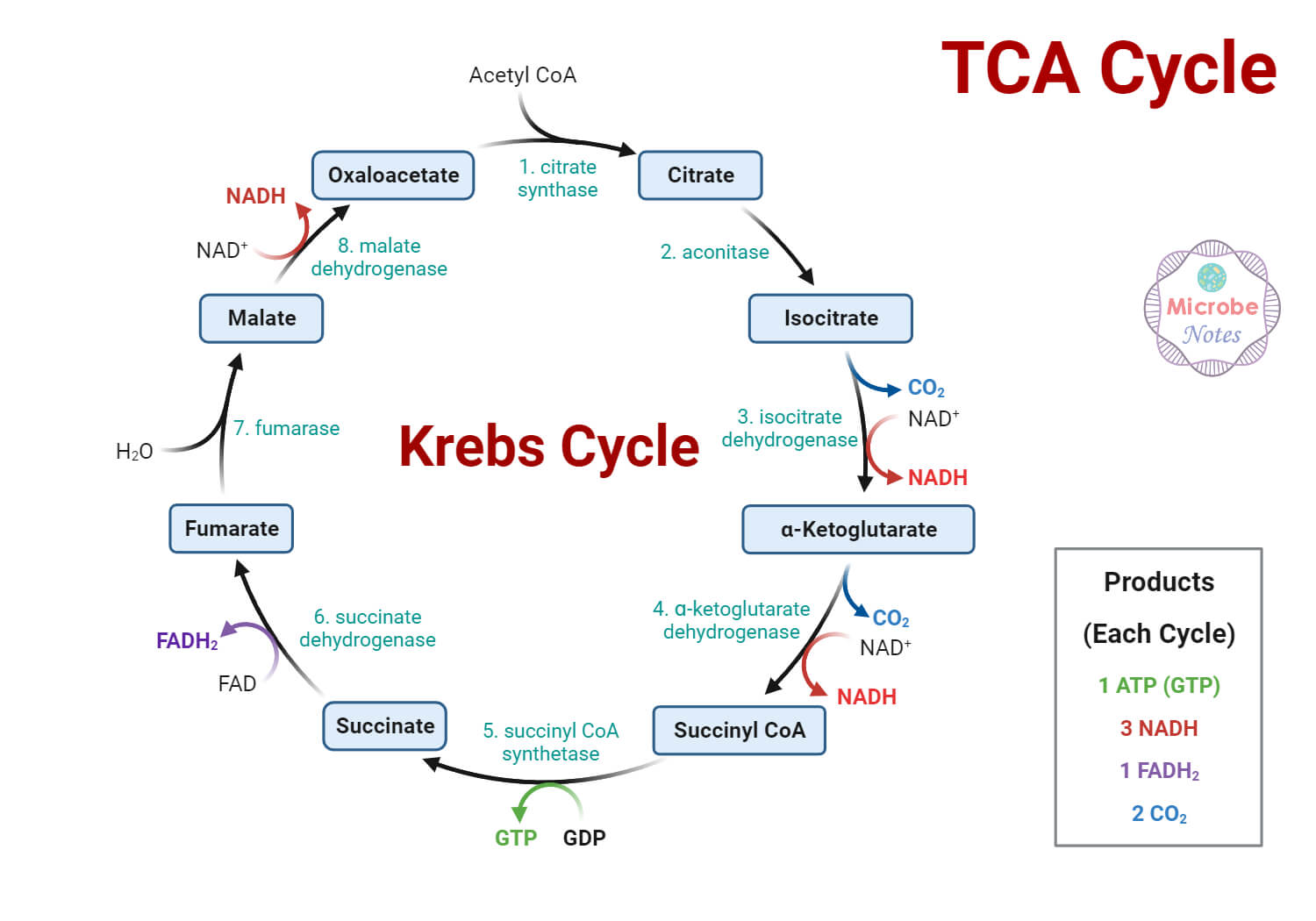
Steps of Citric Acid Cycle :
I. Formation of Citrate :
- Acetyl-CoA combines with Oxaloacetate to form Citrate.
- Enzyme : Citrate Synthase.
Reaction :
Acetyl-CoA + Oxaloacetate + H₂O → Citrate + CoA-SH
II. Formation of Isocitrate :
- Citrate is converted into Isocitrate through Cis-aconitate.
- Enzyme : Aconitase.
III. Formation of α-Ketoglutarate :
- Isocitrate undergoes oxidative decarboxylation.
- One molecule of CO₂ is released.
- One molecule of NADH is produced.
- Enzyme : Isocitrate Dehydrogenase.
IV. Formation of Succinyl-CoA :
- α-Ketoglutarate undergoes oxidative decarboxylation.
- One molecule of CO₂ is released.
- One molecule of NADH is produced.
- Enzyme : α-Ketoglutarate Dehydrogenase Complex.
V. Formation of Succinate :
- Succinyl-CoA is converted into Succinate.
- One molecule of GTP (equivalent to ATP) is produced.
- Enzyme : Succinyl-CoA Synthetase.
VI. Formation of Fumarate :
- Succinate is oxidized to Fumarate.
- One molecule of FADH₂ is produced.
- Enzyme : Succinate Dehydrogenase.
VII. Formation of Malate :
- Fumarate is converted into Malate by addition of water.
- Enzyme : Fumarase.
VIII. Regeneration of Oxaloacetate :
- Malate is oxidized to Oxaloacetate.
- One molecule of NADH is produced.
- Enzyme : Malate Dehydrogenase.
- The regenerated Oxaloacetate combines again with Acetyl-CoA to continue the cycle.
Energetics of Citric Acid Cycle :
I. Energy Produced from One Acetyl-CoA :
| Product | Number Produced | ATP Equivalent |
|---|---|---|
| NADH | 3 | 9 ATP |
| FADH₂ | 1 | 2 ATP |
| GTP | 1 | 1 ATP |
| Total | - | 12 ATP |
Significance of Citric Acid Cycle :
I. Energy Production :
- It is the final common pathway for oxidation of carbohydrates, fats and proteins.
- It produces ATP required for various cellular activities.
II. Production of Reducing Equivalents :
- It generates NADH and FADH₂.
- These molecules enter the Electron Transport Chain for ATP production.
III. Complete Oxidation of Acetyl-CoA :
- Acetyl-CoA is completely oxidized into carbon dioxide and water.
IV. Biosynthetic Role :
- Provides intermediates for amino acid synthesis.
- Provides intermediates for heme synthesis.
- Provides intermediates for gluconeogenesis.
- Provides intermediates for fatty acid synthesis.
V. Amphibolic Nature :
- The Citric Acid Cycle participates in both catabolic and anabolic pathways.
- Hence, it is called an amphibolic pathway.
Q.13 Explain the steps involved in β-Oxidation of Fatty Acid with Energetics.
Definition :
β-Oxidation is the major metabolic pathway of fatty acid degradation in which fatty acids are oxidized in the mitochondria to produce Acetyl-CoA, NADH and FADH2. The process is called β-oxidation because oxidation occurs at the β-carbon atom of the fatty acid.
Site of β-Oxidation :
- β-Oxidation takes place mainly in the mitochondrial matrix.
- Very long-chain fatty acids are initially oxidized in peroxisomes.
- Liver, heart and skeletal muscles are the major tissues where β-oxidation occurs.
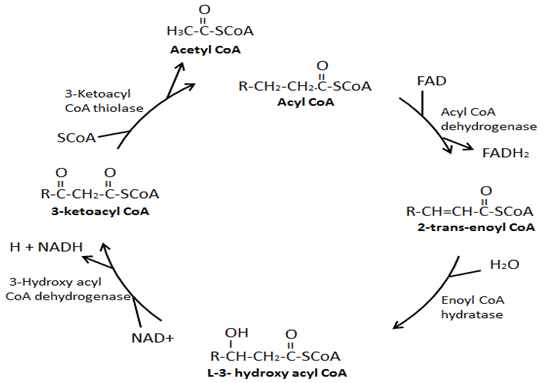
Steps of β-Oxidation :
Each cycle of β-oxidation consists of four successive reactions.
I. First Oxidation :
- Fatty Acyl-CoA is oxidized by Acyl-CoA Dehydrogenase.
- A double bond is formed between α and β carbon atoms.
- FAD is reduced to FADH2.
II. Hydration :
- Water is added across the double bond.
- The reaction is catalyzed by Enoyl-CoA Hydratase.
- β-Hydroxy Acyl-CoA is formed.
III. Second Oxidation :
- β-Hydroxy Acyl-CoA is oxidized by β-Hydroxy Acyl-CoA Dehydrogenase.
- NAD+ is reduced to NADH + H+.
- β-Keto Acyl-CoA is formed.
IV. Thiolysis :
- β-Keto Acyl-CoA reacts with another molecule of Coenzyme A.
- The reaction is catalyzed by Thiolase.
- One molecule of Acetyl-CoA is released.
- The remaining fatty acyl chain becomes shorter by two carbon atoms.
- The shortened fatty acyl-CoA again undergoes β-oxidation until the entire fatty acid is converted into Acetyl-CoA.
Energetics of β-Oxidation of Palmitic Acid (C16) :
- Palmitic acid contains 16 carbon atoms.
- It undergoes 7 cycles of β-oxidation.
- It produces 8 molecules of Acetyl-CoA.
- It produces 7 molecules of NADH.
- It produces 7 molecules of FADH2.
ATP Calculation :
| Product | Quantity | ATP Produced |
|---|---|---|
| FADH2 | 7 | 14 ATP |
| NADH | 7 | 21 ATP |
| Acetyl-CoA entering TCA Cycle | 8 | 96 ATP |
| Total ATP Produced | - | 131 ATP |
| ATP used for activation | - | -2 ATP |
| Net ATP Yield | - | 129 ATP |
Significance of β-Oxidation :
- It is the major pathway for fatty acid degradation.
- It provides a large amount of ATP for cellular activities.
- It produces Acetyl-CoA for the Citric Acid Cycle.
- It supplies energy during fasting and starvation.
- It plays an important role in liver, heart and skeletal muscles.
- It helps maintain the body's energy requirements when glucose availability is low.
Q.14 What do you mean by Urea Cycle? Explain the steps involved in the synthesis of Urea.
Definition :
The urea cycle (Ornithine Cycle or Krebs-Henseleit Cycle) is a metabolic pathway by which toxic ammonia produced during amino acid metabolism is converted into non-toxic urea in the liver. Urea is then excreted through the kidneys in urine.
Introduction :
- The urea cycle was discovered by Hans Krebs and Kurt Henseleit in 1932.
- It mainly occurs in the liver.
- Some reactions occur in the mitochondria and the remaining reactions occur in the cytoplasm.
- The main function of the urea cycle is to detoxify ammonia and maintain nitrogen balance in the body.
Site of Urea Cycle :
- The urea cycle takes place mainly in the liver.
- The first two reactions occur in the mitochondria.
- The remaining three reactions occur in the cytoplasm.

Steps Involved in Urea Synthesis :
I. Formation of Carbamoyl Phosphate :
- Ammonia combines with carbon dioxide in the presence of ATP.
- The reaction is catalyzed by the enzyme Carbamoyl Phosphate Synthetase-I (CPS-I).
- Two molecules of ATP are utilized.
- Carbamoyl phosphate is formed.
Reaction :
Ammonia + CO2 + 2 ATP → Carbamoyl Phosphate
II. Formation of Citrulline :
- Carbamoyl phosphate combines with ornithine.
- The reaction is catalyzed by Ornithine Transcarbamylase (OTC).
- Citrulline is formed.
- Citrulline is transported from mitochondria to cytoplasm.
Reaction :
Carbamoyl Phosphate + Ornithine → Citrulline
III. Formation of Argininosuccinate :
- Citrulline combines with aspartate.
- The reaction is catalyzed by Argininosuccinate Synthetase.
- One molecule of ATP is utilized.
- Argininosuccinate is formed.
Reaction :
Citrulline + Aspartate + ATP → Argininosuccinate
IV. Formation of Arginine :
- Argininosuccinate is cleaved by the enzyme Argininosuccinate Lyase.
- Arginine and fumarate are formed.
- Fumarate enters the Citric Acid Cycle.
Reaction :
Argininosuccinate → Arginine + Fumarate
V. Formation of Urea :
- Arginine is hydrolysed by the enzyme Arginase.
- Urea and ornithine are produced.
- Ornithine re-enters the mitochondria and the cycle repeats.
Reaction :
Arginine + H2O → Urea + Ornithine
Functions of Urea Cycle :
- Converts toxic ammonia into non-toxic urea.
- Maintains nitrogen balance in the body.
- Prevents accumulation of ammonia in blood.
- Helps in safe excretion of excess nitrogen through urine.
- Protects the brain from ammonia toxicity.
Q.15 What are the diseases related to abnormal metabolism of carbohydrates?
Definition :
Disorders of carbohydrate metabolism are diseases that occur due to defects in the digestion, absorption, utilization or metabolism of carbohydrates. These disorders may result from enzyme deficiency, hormonal imbalance or genetic abnormalities.
Diseases Related to Abnormal Metabolism of Carbohydrates :
I. Diabetes Mellitus :
Definition :
Diabetes mellitus is a metabolic disorder characterized by persistent hyperglycemia due to deficiency of insulin secretion, impaired insulin action or both.
Causes :
- Insulin deficiency.
- Insulin resistance.
- Genetic factors.
- Obesity.
- Sedentary lifestyle.
Clinical Features :
- Polyuria.
- Polydipsia.
- Polyphagia.
- Weight loss.
- Fatigue.
- Blurred vision.
- Delayed wound healing.
Complications :
- Diabetic ketoacidosis.
- Neuropathy.
- Nephropathy.
- Retinopathy.
- Cardiovascular diseases.
II. Hypoglycemia :
Definition :
Hypoglycemia is a condition in which blood glucose level falls below the normal range.
Causes :
- Excess insulin administration.
- Prolonged fasting.
- Excessive physical exercise.
- Liver diseases.
- Alcohol consumption.
Clinical Features :
- Sweating.
- Tremors.
- Hunger.
- Dizziness.
- Confusion.
- Loss of consciousness in severe cases.
III. Galactosemia :
Definition :
Galactosemia is an inherited disorder caused by deficiency of the enzyme galactose-1-phosphate uridyl transferase, resulting in defective metabolism of galactose.
Causes :
- Genetic enzyme deficiency.
Clinical Features :
- Vomiting.
- Jaundice.
- Hepatomegaly.
- Cataract.
- Mental retardation if untreated.
Treatment :
- Galactose-free diet.
- Avoidance of milk and milk products.
IV. Hereditary Fructose Intolerance :
Definition :
Hereditary fructose intolerance is an inherited metabolic disorder caused by deficiency of the enzyme Aldolase-B.
Causes :
- Inherited deficiency of Aldolase-B enzyme.
Clinical Features :
- Vomiting.
- Hypoglycemia.
- Abdominal pain.
- Jaundice.
- Liver dysfunction.
Treatment :
- Avoid fructose and sucrose containing foods.
V. Glycogen Storage Diseases (GSD) :
Definition :
Glycogen storage diseases are inherited disorders caused by deficiency of enzymes involved in glycogen metabolism.
Common Types :
- Von Gierke Disease (Type I).
- Pompe Disease (Type II).
- Cori Disease (Type III).
- McArdle Disease (Type V).
Clinical Features :
- Hepatomegaly.
- Hypoglycemia.
- Muscle weakness.
- Growth retardation.
- Exercise intolerance.
VI. Lactose Intolerance :
Definition :
Lactose intolerance is a disorder caused by deficiency of the enzyme lactase, resulting in inability to digest lactose present in milk.
Causes :
- Lactase enzyme deficiency.
- Congenital or acquired intestinal disorders.
Clinical Features :
- Abdominal pain.
- Bloating.
- Flatulence.
- Diarrhoea.
- Nausea.
Treatment :
- Avoid milk and dairy products.
- Use lactose-free milk.
- Lactase enzyme supplements may be administered.
Q.16 Describe different Kidney Function Tests performed routinely and their clinical significance.
Definition :
Kidney Function Tests (KFTs) are a group of laboratory investigations performed to assess the functional status of the kidneys. These tests help in evaluating glomerular filtration, tubular function and the excretory capacity of the kidneys. They are useful in the diagnosis, monitoring and prognosis of renal diseases.
Routine Kidney Function Tests :
I. Blood Urea Test :
Definition :
Blood urea is the amount of urea present in the blood. Urea is the major end product of protein metabolism and is excreted by the kidneys.
Normal Value :
- Blood Urea : 15–40 mg/dL
Clinical Significance :
- Increased blood urea indicates renal failure.
- Increased level is seen in dehydration.
- Increased level occurs in urinary tract obstruction.
- Increased level may occur after gastrointestinal bleeding.
- Decreased level may occur in severe liver disease and malnutrition.
II. Serum Creatinine :
Definition :
Creatinine is the end product of creatine metabolism in muscles. It is filtered by the kidneys and is considered one of the best indicators of kidney function.
Normal Value :
- 0.6–1.2 mg/dL
Clinical Significance :
- Increased serum creatinine indicates impaired kidney function.
- Persistent elevation suggests chronic kidney disease.
- Used to calculate Glomerular Filtration Rate (GFR).
III. Blood Urea Nitrogen (BUN) :
Definition :
Blood Urea Nitrogen measures the nitrogen present in blood in the form of urea.
Normal Value :
- 8–20 mg/dL
Clinical Significance :
- Raised BUN indicates renal impairment.
- Raised level is observed in dehydration and shock.
- Decreased level may occur in severe liver disease.
IV. Glomerular Filtration Rate (GFR) :
Definition :
GFR is the volume of filtrate formed by both kidneys per minute. It is the best overall indicator of kidney function.
Normal Value :
- 90–120 mL/min/1.73 m²
Clinical Significance :
- Reduced GFR indicates impaired renal function.
- Used for staging chronic kidney disease.
- Helps in monitoring disease progression.
V. Creatinine Clearance Test :
Definition :
Creatinine clearance measures the rate at which creatinine is removed from blood by the kidneys.
Normal Value :
- 90–140 mL/min
Clinical Significance :
- Reduced value indicates decreased glomerular filtration.
- Useful in early detection of renal impairment.
VI. Serum Uric Acid :
Definition :
Uric acid is the end product of purine metabolism and is excreted mainly by the kidneys.
Normal Value :
- Male : 3.5–7.2 mg/dL
- Female : 2.6–6.0 mg/dL
Clinical Significance :
- Raised level occurs in gout.
- Raised level may indicate renal dysfunction.
- Raised level may occur in leukemia and high cell turnover states.
VII. Urine Examination :
In urine examination these parameters are evaluated:
- Volume.
- Colour.
- Specific gravity.
- pH.
- Protein.
- Glucose.
- Ketone bodies.
- Blood cells.
- Casts.
- Crystals.
Clinical Significance :
- Proteinuria indicates glomerular damage.
- Hematuria suggests kidney stones or infection.
- Glucosuria indicates diabetes mellitus.
- Presence of casts indicates renal disease.
- Pyuria indicates urinary tract infection.
VIII. Serum Electrolytes :
Parameters :
- Sodium (Na+).
- Potassium (K+).
- Chloride (Cl-).
- Bicarbonate (HCO3-).
Clinical Significance :
- Electrolyte imbalance occurs in renal diseases.
- Hyperkalemia is common in renal failure.
- Helps assess acid-base balance.
Q.17 Describe different Liver Function Tests (LFTs) performed routinely and their clinical significance.
Definition :
Liver Function Tests (LFTs) are a group of biochemical tests used to assess the functional status of the liver, detect liver diseases, evaluate the severity of liver damage and monitor the response to treatment.
Routine Liver Function Tests :
I. Serum Bilirubin Test :
Definition :
Bilirubin is the yellow pigment formed during the breakdown of hemoglobin. It is metabolized by the liver and excreted through bile.
Types :
- Total Bilirubin.
- Direct (Conjugated) Bilirubin.
- Indirect (Unconjugated) Bilirubin.
Normal Values :
- Total Bilirubin : 0.2–1.2 mg/dL.
- Direct Bilirubin : 0–0.3 mg/dL.
- Indirect Bilirubin : 0.2–0.8 mg/dL.
Clinical Significance :
- Increased bilirubin causes jaundice.
- Raised indirect bilirubin is seen in hemolytic jaundice.
- Raised direct bilirubin is seen in obstructive jaundice.
- Both direct and indirect bilirubin increase in hepatocellular jaundice.
II. Serum Aminotransferases (AST and ALT) :
Definition :
AST (Aspartate Aminotransferase) and ALT (Alanine Aminotransferase) are intracellular enzymes released into blood following liver cell injury.
Normal Values :
- AST : 5–40 IU/L.
- ALT : 5–45 IU/L.
Clinical Significance :
- Markedly increased in acute viral hepatitis.
- Raised in liver cirrhosis.
- Raised in fatty liver disease.
- ALT is more specific for liver damage than AST.
III. Alkaline Phosphatase (ALP) :
Definition :
Alkaline phosphatase is an enzyme mainly present in liver, bone and placenta.
Normal Value :
- 40–125 IU/L.
Clinical Significance :
- Markedly increased in obstructive jaundice.
- Raised in bile duct obstruction.
- Raised in bone disorders such as rickets and Paget's disease.
IV. Gamma-Glutamyl Transferase (GGT) :
Definition :
Gamma-Glutamyl Transferase is an enzyme present mainly in liver and biliary tract.
Clinical Significance :
- Increased in alcoholic liver disease.
- Raised in biliary obstruction.
- Helps confirm that elevated ALP is of hepatic origin.
V. Serum Total Protein :
Definition :
Serum proteins mainly consist of albumin and globulins synthesized by the liver.
Normal Value :
- 6.0–8.0 g/dL.
Clinical Significance :
- Decreased in chronic liver disease.
- Decreased in severe malnutrition.
- Reduced protein synthesis indicates impaired liver function.
VI. Serum Albumin :
Definition :
Albumin is the major plasma protein synthesized by the liver.
Normal Value :
- 3.5–5.0 g/dL.
Clinical Significance :
- Decreased in liver cirrhosis.
- Decreased in chronic liver failure.
- Low albumin may result in edema and ascites.
VII. Prothrombin Time (PT) :
Definition :
Prothrombin Time measures the blood clotting ability and reflects the liver's capacity to synthesize clotting factors.
Normal Value :
- 11–15 seconds.
Clinical Significance :
- Prolonged PT indicates severe liver disease.
- Used to assess liver synthetic function.
- Helps evaluate prognosis in liver failure.
VIII. Serum Lactate Dehydrogenase (LDH) :
Definition :
LDH is an intracellular enzyme released during tissue damage including liver injury.
Clinical Significance :
- Raised in acute hepatitis.
- Raised in liver necrosis.
- Not specific for liver diseases.
Q.18 Describe different Lipid Profile Tests performed routinely and their clinical significance.
Definition :
Lipid profile is a group of blood tests performed to evaluate lipid metabolism and assess the risk of cardiovascular diseases. It measures different types of lipids and lipoproteins present in blood.
Routine Lipid Profile Tests :
I. Total Cholesterol (TC) :
Definition :
Total cholesterol is the total amount of cholesterol present in blood, including cholesterol carried by all lipoproteins.
Normal Value :
- Desirable : Less than 200 mg/dL.
Clinical Significance :
- Increased levels indicate hypercholesterolemia.
- High levels increase the risk of coronary artery disease and stroke.
- Low levels may be seen in malnutrition, liver disease and hyperthyroidism.
II. Triglycerides (TG) :
Definition :
Triglycerides are the major storage form of fat in the body and serve as an important source of energy.
Normal Value :
- Normal : Less than 150 mg/dL.
Clinical Significance :
- Increased levels are seen in obesity, diabetes mellitus and alcoholism.
- Very high levels increase the risk of acute pancreatitis.
- Raised triglycerides are associated with cardiovascular diseases.
III. High-Density Lipoprotein (HDL) Cholesterol :
Definition :
HDL is known as "Good Cholesterol" because it removes excess cholesterol from peripheral tissues and transports it to the liver for excretion.
Normal Value :
- Men : More than 40 mg/dL.
- Women : More than 50 mg/dL.
Clinical Significance :
- High HDL level reduces the risk of cardiovascular diseases.
- Low HDL level increases the risk of atherosclerosis and coronary artery disease.
IV. Low-Density Lipoprotein (LDL) Cholesterol :
Definition :
LDL is known as "Bad Cholesterol" because it transports cholesterol from the liver to peripheral tissues and promotes plaque formation in arteries.
Normal Value :
- Optimal : Less than 100 mg/dL.
Clinical Significance :
- High LDL level is the major risk factor for atherosclerosis.
- Increased LDL increases the risk of myocardial infarction and stroke.
- Reduction of LDL is an important goal in the treatment of dyslipidemia.
V. Very Low-Density Lipoprotein (VLDL) :
Definition :
VLDL is synthesized in the liver and mainly transports endogenous triglycerides to peripheral tissues.
Normal Value :
- Normal : 5–40 mg/dL.
Clinical Significance :
- Increased VLDL is associated with hypertriglyceridemia.
- High VLDL contributes to the development of atherosclerosis.
Q.19 Describe the Abnormal Constituents of Urine and their Clinical Significance.
Introduction :
Normally, urine contains water, urea, uric acid, creatinine and small amounts of inorganic salts. It does not contain glucose, proteins, ketone bodies, bile pigments or blood. The presence of these substances in urine is known as abnormal constituents of urine and usually indicates a disease or pathological condition.
Abnormal Constituents of Urine :
I. Glucose (Glycosuria) :
Definition :
Glycosuria is the presence of glucose in urine due to increased blood glucose level or defective renal tubular reabsorption.
Causes :
- Diabetes mellitus.
- Renal glycosuria.
- Pregnancy.
- Endocrine disorders such as hyperthyroidism.
Clinical Significance :
- It is an important indicator of diabetes mellitus.
- It suggests poor control of blood glucose.
- Persistent glycosuria requires further investigation.
Test Used :
- Benedict's Test.
- Glucose Oxidase Strip Test.
II. Protein (Proteinuria) :
Definition :
Proteinuria is the presence of excessive proteins, mainly albumin, in urine.
Causes :
- Glomerulonephritis.
- Nephrotic syndrome.
- Kidney infection.
- Hypertension.
- Diabetes mellitus.
Clinical Significance :
- Indicates kidney damage.
- Suggests glomerular disease.
- Helps in diagnosis of renal disorders.
Test Used :
- Heat and Acetic Acid Test.
- Sulfosalicylic Acid Test.
- Urine Dipstick Test.
III. Ketone Bodies (Ketonuria) :
Definition :
Ketonuria is the presence of ketone bodies such as acetone, acetoacetic acid and β-hydroxybutyric acid in urine.
Causes :
- Uncontrolled diabetes mellitus.
- Starvation.
- Prolonged fasting.
- Vomiting.
- Low-carbohydrate diet.
Clinical Significance :
- Indicates increased fat metabolism.
- Suggests diabetic ketoacidosis.
- May occur during starvation.
Test Used :
- Rothera's Test.
- Ketone Strip Test.
IV. Bile Pigments (Bilirubinuria) :
Definition :
Bilirubinuria is the presence of bile pigments in urine.
Causes :
- Hepatitis.
- Obstructive jaundice.
- Liver diseases.
Clinical Significance :
- Indicates hepatobiliary disorders.
- Helps in diagnosis of jaundice.
- Suggests liver dysfunction.
Test Used :
- Fouchet's Test.
- Gmelin's Test.
V. Bile Salts :
Definition :
Bile salts are normally absent in urine. Their presence indicates obstruction of bile flow.
Causes :
- Obstructive jaundice.
- Severe liver disease.
Clinical Significance :
- Indicates biliary obstruction.
- Helps in diagnosis of obstructive jaundice.
Test Used :
- Hay's Sulphur Test.
VI. Blood (Hematuria) :
Definition :
Hematuria is the presence of red blood cells in urine.
Causes :
- Urinary tract infection.
- Kidney stones.
- Glomerulonephritis.
- Tumours of urinary tract.
- Trauma.
Clinical Significance :
- Indicates diseases of kidney or urinary tract.
- Requires immediate medical evaluation.
Test Used :
- Microscopic Examination.
- Benzidine Test.
- Urine Dipstick Test.
VII. Hemoglobin (Hemoglobinuria) :
Definition :
Hemoglobinuria is the presence of free hemoglobin in urine due to excessive destruction of red blood cells.
Causes :
- Hemolytic anemia.
- Blood transfusion reaction.
- Severe burns.
- Malaria.
Clinical Significance :
- Indicates intravascular hemolysis.
- Helps in diagnosis of hemolytic disorders.
VIII. Pus Cells (Pyuria) :
Definition :
Pyuria is the presence of pus cells (white blood cells) in urine.
Causes :
- Urinary tract infection.
- Cystitis.
- Pyelonephritis.
- Renal tuberculosis.
Clinical Significance :
- Indicates bacterial infection of urinary tract.
- Suggests inflammation of urinary system.
IX. Casts :
Definition :
Casts are cylindrical structures formed in the renal tubules due to precipitation of proteins.
Types :
- Hyaline casts.
- Granular casts.
- Red blood cell casts.
- White blood cell casts.
- Waxy casts.
Clinical Significance :
- Indicate kidney diseases.
- Help in diagnosis of nephritis and renal failure.
X. Crystals :
Definition :
Crystals are formed due to precipitation of salts in urine.
Examples :
- Calcium oxalate crystals.
- Uric acid crystals.
- Triple phosphate crystals.
- Cystine crystals.
Clinical Significance :
- May indicate kidney stone formation.
- May suggest metabolic disorders.
- Useful in diagnosis of urinary tract diseases.
Q.20 Write a note on :
Kwashiorkor and Marasmus
Introduction :
Kwashiorkor and Marasmus are severe forms of Protein-Energy Malnutrition (PEM). These conditions commonly occur in infants and young children due to inadequate intake of proteins, calories or both. They are associated with impaired growth, weakened immunity and increased susceptibility to infections.
I. Kwashiorkor :
Definition :
Kwashiorkor is a severe form of Protein-Energy Malnutrition caused mainly by deficiency of dietary protein while calorie intake may be relatively adequate.
Causes :
- Deficiency of dietary proteins.
- Early weaning of infants.
- Frequent infections.
- Poverty and malnutrition.
- Lack of balanced diet.
Clinical Features :
- Generalized oedema.
- Moon face.
- Distended abdomen.
- Muscle wasting.
- Stunted growth.
- Loss of appetite.
- Sparse, dry and discoloured hair.
- Dermatitis with flaky paint appearance.
- Anaemia.
- Fatty liver.
- Diarrhoea.
- Frequent infections.
- Mental apathy and irritability.
Biochemical Changes :
- Marked decrease in serum albumin.
- Negative nitrogen balance.
- Hypoproteinemia.
- Fat accumulation in liver.
Treatment :
- Gradual nutritional rehabilitation.
- High-protein and high-calorie diet.
- Vitamin and mineral supplementation.
- Treatment of dehydration and infections.
- Maintenance of electrolyte balance.
- Regular monitoring of body weight.
II. Marasmus :
Definition :
Marasmus is a severe form of Protein-Energy Malnutrition caused by deficiency of both calories and proteins. It is characterized by severe wasting of muscles and loss of subcutaneous fat.
Causes :
- Deficiency of both proteins and calories.
- Starvation.
- Improper breastfeeding.
- Repeated diarrhoea.
- Chronic infections.
- Poverty and poor nutritional status.
Clinical Features :
- Severe wasting of muscles.
- Marked loss of body weight.
- Loss of subcutaneous fat.
- Thin limbs.
- Old man appearance.
- Sunken eyes.
- Dry and wrinkled skin.
- Growth retardation.
- Weakness and lethargy.
- No oedema.
- Frequent infections.
Biochemical Changes :
- Marked depletion of body fat.
- Reduced muscle protein.
- Negative nitrogen balance.
- Serum albumin is usually near normal or only slightly reduced.
Treatment :
- High-calorie and high-protein diet.
- Oral Rehydration Solution (ORS) if dehydration is present.
- Vitamin and mineral supplementation.
- Treatment of infections.
- Gradual nutritional rehabilitation.
- Regular follow-up and growth monitoring.
Oral Rehydration Solution (ORS)
Definition :
Oral Rehydration Solution (ORS) is a balanced solution containing glucose and electrolytes used for the prevention and treatment of dehydration caused by diarrhoea, vomiting and other conditions associated with excessive loss of body fluids.
Introduction :
- ORS is one of the most effective and economical methods for treating dehydration.
- It replaces water and essential electrolytes lost from the body.
- The World Health Organization (WHO) recommends ORS as the first-line treatment for mild and moderate dehydration.
- ORS reduces mortality due to diarrhoeal diseases, especially in infants and children.
Electrolyte Composition :
| Electrolyte | Concentration (mmol/L) |
|---|---|
| Sodium | 75 |
| Potassium | 20 |
| Chloride | 65 |
| Citrate | 10 |
| Glucose | 75 |
| Total Osmolarity | 245 mOsm/L |
Mechanism of Action :
- Glucose facilitates the absorption of sodium from the intestine through the sodium-glucose co-transport mechanism.
- Water follows sodium by osmosis.
- This promotes rapid rehydration and correction of electrolyte imbalance.
- Potassium replaces intracellular potassium lost during diarrhoea.
- Citrate helps in correcting metabolic acidosis.
Indications :
- Acute diarrhoea.
- Cholera.
- Vomiting with dehydration.
- Heat exhaustion.
- Mild to moderate dehydration.
- Gastroenteritis.
Advantages :
- Simple and easy to administer.
- Economical and easily available.
- Can be administered at home.
- Reduces the need for intravenous fluids.
- Prevents severe dehydration.
- Reduces mortality in children.
Method of Preparation :
- Dissolve the entire contents of one ORS sachet in one litre of clean drinking water.
- Mix thoroughly until completely dissolved.
- Do not boil the prepared solution.
- Do not add sugar, milk or any other substance.
Administration :
- Administer small frequent sips.
- Continue feeding during diarrhoea.
- Continue breastfeeding in infants.
- Discard any unused solution after 24 hours.
Precautions :
- Prepare ORS exactly according to the recommended instructions.
- Use clean and safe drinking water.
- Do not use expired ORS packets.
- Seek medical attention in cases of severe dehydration or persistent vomiting.
Essential Fatty Acids
Definition :
Essential fatty acids (EFAs) are polyunsaturated fatty acids that cannot be synthesized by the human body in sufficient quantities and therefore must be obtained through the diet.
Examples of Essential Fatty Acids :
- Linoleic Acid (Omega-6).
- Alpha-Linolenic Acid (Omega-3).
- Arachidonic Acid (Essential only during infancy or when Linoleic acid is deficient).
Dietary Sources :
- Sunflower oil.
- Soybean oil.
- Groundnut oil.
- Mustard oil.
- Flaxseed oil.
- Walnuts.
- Fish oil.
- Green leafy vegetables.
Functions :
- Essential for normal growth and development.
- Maintain the structure and function of cell membranes.
- Required for normal brain development.
- Maintain healthy skin and hair.
- Act as precursors of prostaglandins, thromboxanes and leukotrienes.
- Help in regulation of inflammatory responses.
- Promote normal reproductive function.
- Reduce the risk of cardiovascular diseases.
Deficiency Symptoms :
- Dry and scaly skin.
- Hair loss.
- Poor wound healing.
- Growth retardation.
- Increased susceptibility to infections.
- Impaired reproductive function.
- Poor vision in severe deficiency.
Clinical Importance :
- Omega-3 fatty acids reduce serum triglyceride levels.
- Essential fatty acids help maintain cardiovascular health.
- Adequate intake supports normal brain and retinal development.
- They are beneficial in inflammatory disorders.
Electron Transport Chain (ETC)
Definition :
Electron Transport Chain (ETC) is the final stage of aerobic respiration in which electrons released from NADH and FADH2 are transferred through a series of electron carriers present in the inner mitochondrial membrane, resulting in the formation of ATP and water.
Site of Electron Transport Chain :
- The Electron Transport Chain is located in the inner mitochondrial membrane.
- It is present in the cristae of mitochondria.
- It is absent in mature red blood cells because they do not contain mitochondria.
Components of Electron Transport Chain :
I. Complex I :
- NADH Dehydrogenase.
- Receives electrons from NADH.
- Transfers electrons to Coenzyme Q.
II. Complex II :
- Succinate Dehydrogenase.
- Receives electrons from FADH2.
- Transfers electrons to Coenzyme Q.
III. Coenzyme Q (Ubiquinone) :
- Mobile electron carrier.
- Transfers electrons from Complex I and II to Complex III.
IV. Complex III :
- Cytochrome bc1 Complex.
- Transfers electrons to Cytochrome C.
V. Cytochrome C :
- Small mobile protein.
- Transfers electrons from Complex III to Complex IV.
VI. Complex IV :
- Cytochrome Oxidase.
- Transfers electrons to molecular oxygen.
- Oxygen combines with hydrogen ions to form water.
Oxidative Phosphorylation :
- Electron transfer releases energy.
- This energy pumps hydrogen ions across the inner mitochondrial membrane.
- A proton gradient is produced.
- ATP Synthase utilizes this proton gradient to synthesize ATP from ADP and inorganic phosphate.
Energetics :
| Electron Donor | ATP Produced |
|---|---|
| NADH | Approximately 2.5 ATP |
| FADH2 | Approximately 1.5 ATP |
Functions :
- Produces the majority of ATP required by the body.
- Regenerates NAD+ and FAD for metabolic pathways.
- Maintains aerobic respiration.
- Forms water as the final product.
Fatty Liver and Hypercholesterolemia
I. Fatty Liver :
Definition :
Fatty liver is a condition characterized by excessive accumulation of triglycerides within liver cells (hepatocytes). It is also known as Hepatic Steatosis.
Causes :
- Chronic alcohol consumption.
- Obesity.
- Diabetes mellitus.
- Protein deficiency.
- Starvation.
- High-fat diet.
- Certain drugs.
Clinical Features :
- Hepatomegaly.
- Fatigue.
- Right upper abdominal discomfort.
- Loss of appetite.
- Nausea.
Complications :
- Steatohepatitis.
- Liver fibrosis.
- Cirrhosis.
- Liver failure.
Prevention :
- Balanced diet.
- Regular exercise.
- Avoid alcohol consumption.
- Maintain healthy body weight.
- Control diabetes and obesity.
II. Hypercholesterolemia :
Definition :
Hypercholesterolemia is a condition characterized by an abnormally high level of cholesterol in the blood, particularly low-density lipoprotein (LDL) cholesterol.
Causes :
- High intake of saturated fats.
- Obesity.
- Lack of physical activity.
- Genetic disorders.
- Diabetes mellitus.
- Hypothyroidism.
Clinical Features :
- Usually asymptomatic in early stages.
- Xanthomas.
- Xanthelasma.
- Premature cardiovascular disease.
Complications :
- Atherosclerosis.
- Coronary artery disease.
- Stroke.
- Peripheral vascular disease.
Prevention and Management :
- Low-fat and low-cholesterol diet.
- Regular physical exercise.
- Weight reduction.
- Smoking cessation.
- Control of diabetes and hypertension.
- Administration of lipid-lowering drugs such as statins when prescribed.
Types of Lipoproteins
Definition :
Lipoproteins are complexes of lipids and proteins that transport lipids such as cholesterol and triglycerides through the blood because lipids are insoluble in water.
Classification of Lipoproteins :
I. Chylomicrons :
- Largest lipoproteins.
- Rich in triglycerides.
- Transport dietary triglycerides from intestine to tissues.
II. Very Low-Density Lipoproteins (VLDL) :
- Synthesized in the liver.
- Transport endogenous triglycerides to peripheral tissues.
III. Intermediate-Density Lipoproteins (IDL) :
- Formed during the conversion of VLDL into LDL.
- Transport cholesterol and triglycerides.
IV. Low-Density Lipoproteins (LDL) :
- Rich in cholesterol.
- Transport cholesterol from liver to peripheral tissues.
- Known as "Bad Cholesterol".
- High LDL level increases the risk of atherosclerosis and coronary artery disease.
V. High-Density Lipoproteins (HDL) :
- Rich in proteins.
- Collect excess cholesterol from tissues.
- Transport cholesterol back to the liver.
- Known as "Good Cholesterol".
- High HDL level protects against cardiovascular diseases.
Functions of Lipoproteins :
- Transport triglycerides and cholesterol in blood.
- Maintain lipid homeostasis.
- Supply lipids to various tissues.
- Remove excess cholesterol from peripheral tissues.
- Reduce or increase cardiovascular risk depending on the lipoprotein type.
Pharmacotherapeutics
Detailed AnswersQ.1 Define Pharmacotherapeutics and write the Scope and Objectives of Pharmacotherapeutics.
Definition :
Pharmacotherapeutics is the branch of pharmacy and medicine that deals with the selection and rational use of drugs for the prevention, diagnosis, treatment and management of diseases. It focuses on providing safe, effective, economical and evidence-based drug therapy to achieve the best therapeutic outcome for the patient.
Scope of Pharmacotherapeutics :
I. Selection of Appropriate Drug Therapy :
- Selects the most appropriate drug based on the patient's disease condition.
- Considers the patient's age, body weight, gender, pregnancy status and associated diseases before selecting a medicine.
- Promotes rational prescribing and minimizes irrational drug use.
II. Individualization of Therapy :
- Drug therapy is individualized according to the patient's clinical condition.
- Dose, dosage form and route of administration are adjusted according to patient requirements.
- Special consideration is given to paediatric, geriatric, pregnant and renal or hepatic impaired patients.
III. Disease Prevention and Health Promotion :
- Includes preventive measures such as vaccination and chemoprophylaxis.
- Helps reduce the occurrence of communicable and non-communicable diseases.
- Promotes healthy lifestyle modifications.
IV. Management of Acute and Chronic Diseases :
- Provides appropriate treatment for acute diseases such as infections and poisoning.
- Ensures long-term management of chronic diseases like diabetes, hypertension, asthma and epilepsy.
- Improves patient compliance through continuous monitoring.
V. Monitoring Drug Therapy :
- Evaluates therapeutic response after administration of medicines.
- Identifies adverse drug reactions, drug interactions and treatment failure.
- Modifies therapy whenever necessary to achieve optimum therapeutic outcomes.
VI. Patient Counselling :
- Educates patients regarding proper use of medicines.
- Provides information about dosage schedule, storage conditions and precautions.
- Improves medication adherence and treatment success.
VII. Evidence-Based Practice :
- Uses current scientific evidence for selecting appropriate drug therapy.
- Follows Standard Treatment Guidelines (STGs) and Essential Medicines List (EML).
- Promotes safe, effective and economical use of medicines.
VIII. Clinical Pharmacy Services :
- Supports physicians in selecting appropriate medications.
- Participates in medication review and therapeutic drug monitoring.
- Helps prevent medication errors and improves patient safety.
Objectives of Pharmacotherapeutics :
- To provide safe, effective and rational drug therapy.
- To achieve maximum therapeutic benefit with minimum adverse effects.
- To cure diseases whenever possible.
- To relieve symptoms and improve the quality of life of patients.
- To prevent disease progression and complications.
- To reduce morbidity and mortality associated with diseases.
- To ensure proper selection of drug, dose, dosage form and duration of therapy.
- To minimize adverse drug reactions and drug interactions.
- To encourage rational prescribing and rational use of medicines.
- To improve patient compliance through counselling and education.
- To promote the use of Essential Medicines and Standard Treatment Guidelines.
- To provide cost-effective treatment without compromising therapeutic efficacy.
- To monitor therapeutic response and modify treatment when required.
- To improve overall patient care and clinical outcomes.
Importance of Pharmacotherapeutics :
- Ensures rational and evidence-based use of medicines.
- Improves therapeutic outcomes in patients.
- Reduces medication errors and adverse drug reactions.
- Promotes patient safety and quality healthcare.
- Enhances communication among healthcare professionals and patients.
- Supports effective management of both acute and chronic diseases.
Q.2 What do you understand by the term Standard Treatment Guidelines (STGs)? Elaborate the Key Features of STGs.
Definition :
Standard Treatment Guidelines (STGs) are systematically developed, evidence-based recommendations that assist healthcare professionals in selecting the most appropriate, safe, effective and economical treatment for specific diseases or clinical conditions. They promote rational use of medicines and ensure uniform standards of patient care.
Objectives of Standard Treatment Guidelines :
- To provide standardized and evidence-based treatment for common diseases.
- To promote rational prescribing of medicines.
- To improve the quality and safety of patient care.
- To reduce irrational use of medicines and polypharmacy.
- To minimize adverse drug reactions and medication errors.
- To encourage cost-effective treatment.
- To reduce antimicrobial resistance through appropriate antibiotic use.
- To ensure uniformity in treatment among healthcare professionals.
Key Features of Standard Treatment Guidelines :
I. Evidence-Based :
- STGs are prepared using the latest scientific research and clinical evidence.
- The recommendations are regularly updated according to new medical evidence.
II. Disease-Specific :
- Each guideline is prepared for a particular disease or medical condition.
- It includes recommendations for diagnosis, treatment and follow-up.
III. Patient-Centered :
- Patient age, gender, pregnancy, co-morbidities and disease severity are considered while recommending treatment.
- The treatment plan is designed to provide maximum therapeutic benefit with minimum risk.
IV. Rational Drug Therapy :
- Promotes the use of the right medicine for the right patient at the right dose, through the right route and for the right duration.
- Discourages irrational prescribing and unnecessary medications.
V. Cost-Effective :
- Preference is given to affordable and effective medicines.
- Generic medicines and essential medicines are recommended whenever appropriate.
VI. Uniformity in Treatment :
- Ensures that patients receive similar standards of treatment irrespective of the healthcare facility.
- Reduces unnecessary variations in clinical practice.
VII. Promotes Patient Safety :
- Provides guidance on contraindications, precautions and adverse drug reactions.
- Helps in preventing medication errors and complications.
VIII. Easy to Use :
- STGs are written in a simple and systematic manner.
- They can be easily followed by doctors, pharmacists, nurses and other healthcare professionals.
IX. Regularly Updated :
- Guidelines are revised periodically based on new clinical evidence and updated recommendations.
- This ensures that patients receive the most effective and safest therapy.
X. Supports Antimicrobial Stewardship :
- Encourages appropriate use of antibiotics.
- Helps reduce the development of antimicrobial resistance.
Q.3 What is Evidence-Based Medicine (EBM)? Briefly explain the concept of Essential Medicines.
Evidence-Based Medicine (EBM) :
Definition :
Evidence-Based Medicine (EBM) is the conscientious, explicit and judicious use of the current best scientific evidence in making decisions about the care and treatment of individual patients. It integrates the best available research evidence, clinical expertise and patient preferences to provide optimal healthcare.
Advantages of Evidence-Based Medicine :
- Improves the quality of patient care.
- Promotes rational use of medicines.
- Reduces unnecessary investigations and treatments.
- Improves patient safety.
- Supports clinical decision-making.
- Provides cost-effective healthcare.
- Enhances treatment outcomes.
Limitations of Evidence-Based Medicine :
- Access to updated scientific literature may be limited.
- High-quality evidence may not be available for every disease.
- Requires time and adequate training to interpret research evidence.
- Individual patient conditions may differ from research studies.
Essential Medicines :
Definition :
Essential Medicines are those medicines that satisfy the priority healthcare needs of the majority of the population. They are selected based on disease prevalence, evidence of safety and efficacy, quality and cost-effectiveness. The concept of Essential Medicines was introduced by the World Health Organization (WHO).
Objectives of Essential Medicines :
- Ensure availability of essential medicines to all people.
- Promote rational use of medicines.
- Provide safe, effective and quality medicines.
- Reduce healthcare expenditure.
- Improve public health services.
Criteria for Selection of Essential Medicines :
- Disease prevalence in the community.
- Proven efficacy and safety.
- Good quality of medicines.
- Cost-effectiveness.
- Availability of suitable dosage forms.
- Storage stability.
Characteristics of Essential Medicines :
- Meet the priority healthcare needs of the population.
- Available at all times in adequate quantities.
- Available in appropriate dosage forms and strengths.
- Affordable to individuals and the community.
- Maintain assured quality, safety and efficacy.
Advantages of Essential Medicines :
- Improves access to quality healthcare.
- Ensures continuous availability of important medicines.
- Promotes rational prescribing practices.
- Reduces unnecessary healthcare costs.
- Improves patient compliance and treatment outcomes.
- Supports national healthcare programmes.
Examples of Essential Medicines :
- Paracetamol.
- Amoxicillin.
- Metformin.
- Insulin.
- Oral Rehydration Salts (ORS).
- Iron and Folic Acid Tablets.
- Salbutamol Inhaler.
- Artemisinin-based Combination Therapy (ACT).
Q.4 What is Antimicrobial Resistance (AMR)? Explain in Detail.
Definition :
Antimicrobial Resistance (AMR) is the ability of microorganisms such as bacteria, viruses, fungi and parasites to resist the action of antimicrobial drugs that were previously effective against them. As a result, infections become difficult to treat, leading to prolonged illness, increased healthcare costs and higher mortality.
Types of Antimicrobial Resistance :
I. Natural (Intrinsic) Resistance :
- Resistance that is naturally present in certain microorganisms.
- It is an inherent characteristic of the organism.
- Example: Mycoplasma species are naturally resistant to penicillin because they lack a cell wall.
II. Acquired Resistance :
- Resistance developed by previously susceptible microorganisms.
- Occurs due to genetic mutation or acquisition of resistance genes from other microorganisms.
- It is the most common type of antimicrobial resistance encountered in clinical practice.
Causes of Antimicrobial Resistance :
- Overuse and misuse of antibiotics.
- Self-medication without medical advice.
- Incomplete course of antimicrobial therapy.
- Use of antibiotics for viral infections such as common cold and influenza.
- Inappropriate dose or duration of treatment.
- Extensive use of antibiotics in livestock and poultry farming.
- Poor infection prevention and control practices.
- Lack of antimicrobial stewardship.
- Poor sanitation and hygiene.
Mechanisms of Antimicrobial Resistance :
I. Enzymatic Drug Inactivation :
- Microorganisms produce enzymes that destroy or inactivate antimicrobial drugs.
- Example: β-lactamase enzyme hydrolyses penicillins and cephalosporins.
II. Alteration of Drug Target :
- Microorganisms modify the target site of the antimicrobial drug.
- The drug can no longer bind effectively.
- Example: Methicillin-resistant Staphylococcus aureus (MRSA).
III. Decreased Drug Permeability :
- The microorganism decreases the entry of antimicrobial drugs into the cell.
- This reduces intracellular drug concentration.
IV. Efflux Pump Mechanism :
- Microorganisms actively pump antimicrobial drugs out of the cell.
- This prevents the drug from reaching therapeutic intracellular levels.
V. Bypass of Metabolic Pathway :
- Microorganisms develop alternative metabolic pathways that are not affected by the antimicrobial drug.
Consequences of Antimicrobial Resistance :
- Treatment failure.
- Prolonged duration of illness.
- Increased hospitalization.
- Higher treatment cost.
- Increased morbidity and mortality.
- Spread of resistant microorganisms.
- Limited availability of effective antimicrobial agents.
Prevention and Control of AMR :
- Use antibiotics only when prescribed by a qualified healthcare professional.
- Complete the full course of antimicrobial therapy.
- Avoid self-medication.
- Do not use antibiotics for viral infections.
- Follow Standard Treatment Guidelines (STGs).
- Promote Antimicrobial Stewardship Programs (ASP).
- Maintain proper hand hygiene and infection control measures.
- Promote vaccination to reduce infectious diseases.
- Limit unnecessary use of antibiotics in animals.
- Increase public awareness regarding rational use of antimicrobials.
Common Drug-Resistant Microorganisms :
| Microorganism | Drug Resistance |
|---|---|
| MRSA | Resistant to Methicillin |
| VRE | Resistant to Vancomycin |
| MDR-TB | Resistant to Isoniazid and Rifampicin |
| XDR-TB | Resistant to First-line and several Second-line Anti-TB drugs |
| ESBL-producing Escherichia coli | Resistant to many β-lactam antibiotics |
Q.5 Write a Note on Definition, Etiopathogenesis, Clinical Manifestation and Pharmacological Management of Hypertension.
Hypertension
Definition :
Hypertension is a chronic cardiovascular disorder characterized by a persistent elevation of arterial blood pressure above the normal range. According to standard guidelines, hypertension is generally diagnosed when systolic blood pressure is ≥140 mmHg and/or diastolic blood pressure is ≥90 mmHg on repeated measurements.
Etiopathogenesis :
I. Primary (Essential) Hypertension :
Primary hypertension develops without any identifiable cause and accounts for approximately 90–95% of all cases.
- Genetic predisposition.
- Increasing age.
- Obesity.
- High dietary sodium intake.
- Sedentary lifestyle.
- Smoking.
- Alcohol consumption.
- Mental stress.
- Diabetes mellitus.
- Dyslipidaemia.
II. Secondary Hypertension :
Secondary hypertension occurs due to an identifiable underlying disease or condition.
- Chronic kidney disease.
- Renal artery stenosis.
- Cushing's syndrome.
- Primary hyperaldosteronism.
- Pheochromocytoma.
- Hyperthyroidism and hypothyroidism.
- Pregnancy-induced hypertension.
- Obstructive sleep apnoea.
- Oral contraceptives.
- Corticosteroids and NSAIDs.
III. Pathogenesis :
- Increased peripheral vascular resistance is the primary mechanism responsible for sustained hypertension.
- Overactivation of the sympathetic nervous system increases heart rate and cardiac output.
- Activation of the Renin-Angiotensin-Aldosterone System (RAAS) causes vasoconstriction and sodium retention.
- Excess secretion of aldosterone results in increased sodium and water reabsorption, leading to an increase in blood volume.
- Endothelial dysfunction decreases nitric oxide production and increases vascular resistance.
- Obesity and insulin resistance further contribute to persistent elevation of blood pressure.
Clinical Manifestations :
Hypertension is commonly known as a "Silent Killer" because many patients remain asymptomatic for several years.
- Persistent headache, especially in the morning.
- Dizziness.
- Blurred vision.
- Palpitations.
- Fatigue.
- Shortness of breath.
- Nose bleeding (Epistaxis).
- Chest pain in severe cases.
- Tinnitus (ringing in the ears).
- Severe hypertension may lead to stroke, myocardial infarction, heart failure and renal failure.
Pharmacological Management :
I. Diuretics :
Examples : Hydrochlorothiazide, Chlorthalidone, Furosemide.
- Increase sodium and water excretion.
- Reduce blood volume and cardiac output.
- Commonly used as first-line drugs in uncomplicated hypertension.
II. Angiotensin-Converting Enzyme (ACE) Inhibitors :
Examples : Enalapril, Ramipril, Lisinopril.
- Inhibit the formation of angiotensin II.
- Produce vasodilation.
- Reduce aldosterone secretion.
- Preferred in patients with diabetes mellitus and chronic kidney disease.
III. Angiotensin Receptor Blockers (ARBs) :
Examples : Losartan, Telmisartan, Valsartan.
- Block angiotensin II receptors.
- Produce vasodilation.
- Used in patients who cannot tolerate ACE inhibitors.
IV. Calcium Channel Blockers (CCBs) :
Examples : Amlodipine, Nifedipine, Diltiazem.
- Relax vascular smooth muscles.
- Reduce peripheral vascular resistance.
- Effective in elderly patients and isolated systolic hypertension.
V. Beta-Adrenergic Blockers :
Examples : Atenolol, Metoprolol, Propranolol.
- Reduce heart rate and cardiac output.
- Decrease renin release from the kidneys.
- Useful in patients with angina or previous myocardial infarction.
VI. Alpha-Adrenergic Blockers :
Examples : Prazosin, Doxazosin.
- Produce peripheral vasodilation.
- Reduce systemic vascular resistance.
VII. Direct Vasodilators :
Examples : Hydralazine, Minoxidil.
- Directly relax vascular smooth muscles.
- Mainly used in resistant hypertension.
Non-Pharmacological Management :
- Reduce dietary salt intake.
- Maintain ideal body weight.
- Perform regular physical exercise.
- Stop smoking.
- Avoid excessive alcohol consumption.
- Consume a balanced diet rich in fruits and vegetables.
- Manage stress through relaxation techniques.
- Monitor blood pressure regularly.
ASTHMA
Definition :
Asthma is a chronic inflammatory disease of the airways characterized by variable and reversible airway obstruction, bronchial hyperresponsiveness and recurrent episodes of wheezing, breathlessness, chest tightness and cough.
Etiopathogenesis :
I. Etiological Factors :
- Allergens such as house dust mites, pollen, animal dander and moulds can trigger asthma.
- Respiratory tract infections may precipitate asthma attacks.
- Exposure to tobacco smoke, air pollution and occupational irritants can worsen symptoms.
- Exercise and exposure to cold air may trigger bronchoconstriction.
- Certain drugs such as aspirin and other NSAIDs may precipitate asthma in susceptible individuals.
- Emotional stress can aggravate asthma symptoms.
II. Pathogenesis :
- Exposure to a trigger causes inflammation of the bronchial airways.
- Inflammatory cells release mediators that produce bronchial smooth-muscle contraction.
- Bronchial mucosa becomes swollen due to inflammation and oedema.
- Excess mucus secretion may obstruct the airways.
- These changes produce reversible narrowing of the airways and increased airway resistance.
- Repeated inflammation may cause airway remodeling in chronic asthma.
Clinical Manifestations :
- Recurrent episodes of wheezing.
- Shortness of breath.
- Chest tightness.
- Persistent or recurrent cough, particularly at night or early morning.
- Difficulty in breathing.
- Symptoms may worsen after exercise or exposure to allergens.
- Severe attacks may cause marked respiratory distress and difficulty in speaking.
Pharmacological Management :
I. Bronchodilators :
- Short-acting β2-agonists: Salbutamol and Terbutaline are used for rapid relief of bronchospasm.
- Long-acting β2-agonists: Salmeterol and Formoterol provide prolonged bronchodilation and are generally used with inhaled corticosteroids for maintenance treatment.
- Anticholinergics: Ipratropium bromide and Tiotropium produce bronchodilation by blocking muscarinic receptors in the airways.
- Methylxanthines: Theophylline produces bronchodilation but is used less frequently because of its narrow therapeutic index.
II. Corticosteroids :
- Inhaled corticosteroids such as Budesonide, Beclometasone and Fluticasone reduce airway inflammation.
- Systemic corticosteroids such as Prednisolone may be used for severe exacerbations.
III. Leukotriene Modifiers :
- Montelukast reduces leukotriene-mediated bronchoconstriction and inflammation.
- Zafirlukast is another leukotriene receptor antagonist.
IV. Other Drugs :
- Cromoglycate may be used as a preventive anti-inflammatory drug in selected patients.
- Biological agents such as Omalizumab and other monoclonal antibodies may be used in selected patients with severe asthma.
V. General Measures :
- Patients should identify and avoid known asthma triggers.
- Inhaler technique should be demonstrated and checked regularly.
- Smoking and exposure to tobacco smoke should be avoided.
- Patients should follow an individualized asthma action plan.
MYOCARDIAL INFARCTION
Definition :
Myocardial infarction (MI) is a condition in which prolonged interruption of blood supply to a portion of the cardiac muscle causes myocardial injury and necrosis.
Etiopathogenesis :
I. Major Cause :
- The most common cause is rupture or erosion of an atherosclerotic plaque in a coronary artery.
- Plaque disruption promotes platelet adhesion, activation and aggregation.
- Thrombus formation may partially or completely obstruct the coronary artery.
- Reduced coronary blood flow causes myocardial ischaemia.
- Prolonged severe ischaemia results in irreversible myocardial cell injury and necrosis.
II. Risk Factors :
- Hypertension.
- Diabetes mellitus.
- Smoking.
- Hypercholesterolaemia.
- Obesity.
- Physical inactivity.
- Increasing age.
- Family history of coronary artery disease.
Clinical Manifestations :
- Severe or persistent chest pain or pressure.
- Pain may radiate to the left arm, shoulder, neck, jaw or back.
- Shortness of breath.
- Sweating.
- Nausea and vomiting.
- Dizziness or weakness.
- Palpitations.
- Anxiety or feeling of impending death.
- Some patients, particularly those with diabetes, may have atypical or minimal symptoms.
Pharmacological Management :
I. Antiplatelet Drugs :
- Aspirin inhibits platelet aggregation and is a fundamental drug in acute MI unless contraindicated.
- Clopidogrel, Prasugrel or Ticagrelor may be used as an additional antiplatelet agent depending on the clinical situation.
II. Anticoagulants :
- Heparin or other appropriate anticoagulants may be used to reduce thrombus propagation in selected patients.
III. Nitrates :
- Nitroglycerin produces vasodilation and may relieve ischaemic chest pain.
- Nitrates should be avoided in patients with certain contraindications such as recent use of phosphodiesterase-5 inhibitors or significant hypotension.
IV. Beta-Adrenergic Blockers :
- Metoprolol and other appropriate beta-blockers reduce heart rate and myocardial oxygen demand.
- They may reduce the risk of recurrent myocardial ischaemia in suitable patients.
V. Statins :
- High-intensity statins such as Atorvastatin and Rosuvastatin are used to reduce LDL cholesterol and prevent recurrent cardiovascular events.
VI. ACE Inhibitors :
- Enalapril, Ramipril and other ACE inhibitors reduce adverse ventricular remodeling and are particularly useful in patients with left ventricular dysfunction, hypertension or diabetes.
VII. Fibrinolytic Therapy :
- Fibrinolytic drugs such as Streptokinase or Tenecteplase may be used in selected patients with ST-elevation myocardial infarction when timely primary PCI is not available.
VIII. Reperfusion Therapy :
- Primary Percutaneous Coronary Intervention (PCI) is the preferred reperfusion strategy when it can be performed promptly in appropriate patients with STEMI.
DIABETES MELLITUS
Definition :
Diabetes mellitus is a group of metabolic disorders characterized by persistent hyperglycaemia resulting from defects in insulin secretion, insulin action, or both.
Etiopathogenesis :
I. Type 1 Diabetes Mellitus :
- Type 1 diabetes mellitus results from autoimmune destruction of pancreatic β-cells.
- This causes severe or complete deficiency of insulin secretion.
- It commonly develops during childhood or adolescence, although it can occur at any age.
II. Type 2 Diabetes Mellitus :
- Type 2 diabetes mellitus is mainly associated with insulin resistance and progressive impairment of β-cell insulin secretion.
- Obesity and physical inactivity are important risk factors.
- Genetic predisposition also contributes to the development of the disease.
III. Other Causes :
- Gestational diabetes mellitus.
- Diseases affecting the pancreas.
- Endocrine disorders.
- Certain drugs may cause secondary diabetes.
Clinical Manifestations :
- Polyuria or increased frequency of urination.
- Polydipsia or excessive thirst.
- Polyphagia or increased hunger.
- Unexplained weight loss, particularly in uncontrolled type 1 diabetes.
- Fatigue and weakness.
- Blurred vision.
- Delayed wound healing.
- Recurrent infections.
- Dry or itchy skin.
- Some patients with type 2 diabetes may remain asymptomatic for a long period.
Pharmacological Management :
I. Insulin :
- Insulin is essential for the treatment of type 1 diabetes mellitus.
- It is also used in type 2 diabetes when adequate glycaemic control cannot be achieved with other measures or when clinically indicated.
- Types include rapid-acting, short-acting, intermediate-acting and long-acting insulin preparations.
II. Biguanides :
- Metformin is commonly used as an initial pharmacological treatment for type 2 diabetes when appropriate.
- It primarily reduces hepatic glucose production and improves insulin sensitivity.
III. Sulfonylureas :
- Glimepiride and Glipizide stimulate pancreatic β-cells to release insulin.
- They can cause hypoglycaemia and weight gain.
IV. DPP-4 Inhibitors :
- Sitagliptin and Linagliptin increase incretin activity and enhance glucose-dependent insulin secretion.
V. SGLT2 Inhibitors :
- Dapagliflozin and Empagliflozin reduce renal glucose reabsorption and increase urinary glucose excretion.
- Some drugs in this class also provide cardiovascular and renal benefits in appropriately selected patients.
VI. GLP-1 Receptor Agonists :
- Liraglutide, Semaglutide and other agents in this class increase glucose-dependent insulin secretion and reduce glucagon secretion.
- They may also reduce appetite and body weight.
VII. Thiazolidinediones :
- Pioglitazone improves insulin sensitivity in peripheral tissues.
VIII. Other Antidiabetic Drugs :
- Alpha-glucosidase inhibitors such as Acarbose delay intestinal carbohydrate absorption.
- Other agents may be selected according to the patient's glycaemic status, cardiovascular risk, kidney function, body weight and other clinical factors.
IX. Monitoring :
- Blood glucose levels should be monitored regularly.
- HbA1c should be assessed periodically to evaluate long-term glycaemic control.
- Patients receiving insulin or drugs capable of causing hypoglycaemia should be educated about recognition and management of hypoglycaemia.
CONGESTIVE HEART FAILURE (CHF)
Definition :
Congestive Heart Failure (CHF) is a clinical syndrome in which the heart is unable to pump sufficient blood to meet the metabolic requirements of the body, resulting in inadequate tissue perfusion and, in many patients, congestion of the lungs or peripheral tissues.
Etiopathogenesis :
I. Causes :
- Coronary artery disease and previous myocardial infarction are major causes of heart failure.
- Long-standing hypertension increases the workload of the heart and may lead to ventricular dysfunction.
- Cardiomyopathy can impair the contractile function of the myocardium.
- Valvular heart diseases may produce pressure or volume overload.
- Congenital heart diseases may lead to heart failure.
- Arrhythmias may impair effective cardiac output.
II. Pathogenesis :
- Damage or dysfunction of the myocardium reduces the pumping capacity of the heart.
- Reduced cardiac output activates the sympathetic nervous system.
- Activation of the Renin-Angiotensin-Aldosterone System (RAAS) causes vasoconstriction and retention of sodium and water.
- Increased fluid retention raises blood volume and contributes to pulmonary and peripheral congestion.
- Persistent neurohormonal activation increases cardiac workload and promotes ventricular remodeling.
- Progressive ventricular dysfunction further reduces cardiac output and aggravates the condition.
Clinical Manifestations :
- Breathlessness, especially during exertion.
- Orthopnoea, which is difficulty in breathing while lying flat.
- Paroxysmal nocturnal dyspnoea.
- Fatigue and weakness.
- Reduced exercise tolerance.
- Peripheral oedema, especially of the ankles and legs.
- Rapid weight gain due to fluid retention.
- Persistent cough or pulmonary congestion.
- Tachycardia.
- Raised jugular venous pressure may occur.
Pharmacological Management :
I. ACE Inhibitors :
- Enalapril, Ramipril and Lisinopril inhibit the formation of angiotensin II.
- They reduce vasoconstriction and aldosterone-mediated sodium and water retention.
- They reduce cardiac workload and adverse ventricular remodeling.
II. Angiotensin II Receptor Blockers (ARBs) :
- Losartan, Valsartan and similar drugs block the action of angiotensin II at AT1 receptors.
- They produce vasodilation and reduce the effects of excessive RAAS activation.
III. Beta-Adrenergic Blockers :
- Carvedilol, Metoprolol and Bisoprolol reduce sympathetic stimulation of the heart.
- They decrease heart rate and myocardial oxygen demand.
- In appropriate patients with chronic heart failure, they improve ventricular function and clinical outcomes.
IV. Diuretics :
- Furosemide and other loop diuretics increase sodium and water excretion.
- They reduce pulmonary and peripheral congestion and provide symptomatic relief.
V. Mineralocorticoid Receptor Antagonists :
- Spironolactone and Eplerenone block the effects of aldosterone.
- They reduce sodium and water retention and may reduce adverse cardiac remodeling.
VI. Angiotensin Receptor-Neprilysin Inhibitor (ARNI) :
- Sacubitril/Valsartan combines neprilysin inhibition with AT1 receptor blockade.
- It enhances beneficial natriuretic peptide activity while reducing the effects of angiotensin II.
VII. SGLT2 Inhibitors :
- Dapagliflozin and Empagliflozin are useful in appropriate patients with heart failure, including many patients without diabetes.
- They reduce the risk of hospitalization for heart failure and cardiovascular events in appropriate patient groups.
THYROID DISORDER
Definition :
Thyroid disorders are diseases resulting from abnormal production or action of thyroid hormones. The major functional disorders are hypothyroidism, in which thyroid hormone production is insufficient, and hyperthyroidism, in which thyroid hormone production or activity is excessive.
Etiopathogenesis :
I. Hypothyroidism :
- Hashimoto's thyroiditis is a common autoimmune cause of hypothyroidism.
- Iodine deficiency can impair thyroid hormone synthesis.
- Thyroid surgery or radioactive iodine treatment may reduce thyroid function.
- Certain drugs may interfere with thyroid hormone synthesis or action.
- Pituitary or hypothalamic disorders may cause secondary or tertiary hypothyroidism.
II. Hyperthyroidism :
- Graves' disease is a common autoimmune cause of hyperthyroidism.
- Toxic multinodular goitre may result in excessive thyroid hormone production.
- Toxic adenoma can autonomously produce thyroid hormones.
- Excessive intake of thyroid hormone can produce thyrotoxicosis.
Clinical Manifestations :
I. Hypothyroidism :
- Fatigue and weakness.
- Weight gain.
- Cold intolerance.
- Dry skin.
- Constipation.
- Bradycardia.
- Slow mental activity.
- Depression.
- Hair loss.
- Menstrual disturbances may occur.
II. Hyperthyroidism :
- Weight loss despite increased appetite.
- Heat intolerance.
- Excessive sweating.
- Tachycardia and palpitations.
- Nervousness and anxiety.
- Tremor.
- Increased bowel movements.
- Insomnia.
- Muscle weakness.
- Goitre may be present.
- Eye manifestations such as exophthalmos may occur in Graves' disease.
Pharmacological Management :
I. Management of Hypothyroidism :
- Levothyroxine is the standard replacement therapy for hypothyroidism.
- It is a synthetic form of thyroxine (T4).
- The dose is individualized according to age, clinical condition and thyroid function tests.
II. Management of Hyperthyroidism :
- Methimazole and Carbimazole inhibit thyroid hormone synthesis and are commonly used as antithyroid drugs.
- Propylthiouracil (PTU) inhibits thyroid hormone synthesis and also reduces peripheral conversion of T4 to T3.
- Propranolol may be used to control symptoms such as tachycardia, tremor and anxiety.
- Radioactive iodine may be used as a definitive treatment in selected patients.
EPILEPSY
Definition :
Epilepsy is a chronic neurological disorder characterized by a predisposition to recurrent unprovoked epileptic seizures resulting from abnormal, excessive and synchronous electrical activity of neurons in the brain.
Etiopathogenesis :
I. Causes :
- Genetic factors may predispose an individual to epilepsy.
- Structural brain abnormalities may produce recurrent seizures.
- Head injury can damage brain tissue and increase the risk of epilepsy.
- Stroke and brain tumours may act as underlying causes.
- Central nervous system infections may produce seizures.
- Perinatal brain injury may lead to epilepsy.
- In some patients, no specific cause can be identified.
II. Pathogenesis :
- Epileptic seizures result from abnormal and excessive neuronal activity in the brain.
- Increased excitatory neurotransmission, particularly involving glutamate, can promote seizure activity.
- Reduced inhibitory neurotransmission mediated by GABA can also increase neuronal excitability.
- Abnormal synchronization and propagation of neuronal discharges produce clinical seizures.
- The clinical manifestations depend on the brain region involved and the extent of seizure spread.
Clinical Manifestations :
- Recurrent seizures are the characteristic manifestation.
- Loss of consciousness may occur in generalized seizures.
- Sudden jerking of muscles may occur.
- Tonic stiffening followed by rhythmic clonic movements may occur in generalized tonic-clonic seizures.
- Absence seizures may present as brief episodes of impaired awareness.
- Focal seizures may produce abnormal sensations, movements or altered awareness.
- Confusion and drowsiness may occur after a seizure.
- Some patients may experience an aura before a seizure.
Pharmacological Management :
I. Sodium Channel Blocking Drugs :
- Phenytoin stabilizes neuronal membranes by prolonging the inactive state of voltage-gated sodium channels.
- Carbamazepine is commonly used in focal seizures.
- Lamotrigine also reduces repetitive neuronal firing by blocking voltage-gated sodium channels.
II. GABA-Enhancing Drugs :
- Diazepam and Lorazepam enhance GABA-mediated inhibitory neurotransmission and are important in the emergency treatment of prolonged seizures.
- Phenobarbital enhances GABA-mediated inhibition and has anticonvulsant activity.
III. Broad-Spectrum Antiepileptic Drugs :
- Valproate is effective against several seizure types.
- Levetiracetam is widely used in the treatment of focal and generalized seizures.
- Topiramate may be used in several types of epilepsy.
IV. Other Antiepileptic Drugs :
- Ethosuximide is particularly effective for absence seizures.
- Gabapentin may be used as an adjunctive treatment, particularly for focal seizures.
V. General Principles of Pharmacological Management :
- The choice of antiepileptic drug depends on seizure type, age, comorbidities and patient-specific factors.
- Treatment is usually started with an appropriate single drug at a suitable dose.
- Drug adherence is essential for preventing breakthrough seizures.
- Antiepileptic drugs should not be stopped abruptly without medical advice.
PARKINSON'S DISEASE
Definition :
Parkinson's disease is a chronic and progressive neurodegenerative disorder characterized mainly by tremor, rigidity, bradykinesia and postural instability due to degeneration of dopaminergic neurons in the substantia nigra of the brain.
Etiopathogenesis :
I. Etiological Factors :
- Increasing age is an important risk factor for Parkinson's disease.
- Genetic factors may contribute to the development of the disease in some patients.
- Exposure to certain environmental toxins and pesticides may increase the risk.
- Oxidative stress and mitochondrial dysfunction may contribute to neuronal damage.
- In many patients, the exact cause remains unknown.
II. Pathogenesis :
- There is progressive degeneration of dopamine-producing neurons in the substantia nigra pars compacta.
- This degeneration reduces dopamine concentration in the striatum.
- Loss of dopamine produces an imbalance between dopaminergic and cholinergic activity in the basal ganglia.
- This neurotransmitter imbalance results in impaired control of voluntary movements.
- Lewy bodies containing abnormal alpha-synuclein protein are commonly found in affected neurons.
Clinical Manifestations :
- Bradykinesia or slowness of voluntary movements.
- Resting tremor, commonly described as a pill-rolling tremor.
- Muscular rigidity.
- Postural instability and impaired balance.
- Shuffling gait with short steps.
- Stooped posture.
- Reduced facial expression or mask-like face.
- Soft and monotonous speech.
- Difficulty in initiating movements.
- Small handwriting or micrographia may occur.
- Depression, sleep disturbances and cognitive impairment may occur in some patients.
Pharmacological Management :
I. Levodopa with Carbidopa :
- Levodopa is converted into dopamine in the brain and improves motor symptoms.
- Carbidopa inhibits the peripheral conversion of Levodopa into dopamine.
- The combination increases the amount of Levodopa reaching the brain and reduces peripheral adverse effects.
- It is highly effective for controlling bradykinesia and rigidity.
II. Dopamine Agonists :
- Pramipexole and Ropinirole directly stimulate dopamine receptors.
- They may be used alone in early disease or with Levodopa in advanced disease.
III. MAO-B Inhibitors :
- Selegiline and Rasagiline inhibit monoamine oxidase-B.
- They reduce the breakdown of dopamine in the brain and prolong its action.
IV. COMT Inhibitors :
- Entacapone inhibits catechol-O-methyltransferase and prolongs the action of Levodopa.
- It is generally used along with Levodopa-Carbidopa in patients experiencing wearing-off symptoms.
V. Anticholinergic Drugs :
- Trihexyphenidyl and Benztropine reduce excessive cholinergic activity in the basal ganglia.
- They are mainly useful for controlling tremor in selected patients.
VI. Amantadine :
- Amantadine has dopaminergic and NMDA receptor antagonist actions.
- It may improve motor symptoms and can be useful for Levodopa-induced dyskinesia.
ALZHEIMER'S DISEASE
Definition :
Alzheimer's disease is a progressive neurodegenerative disorder characterized by gradual deterioration of memory, thinking, behaviour and other cognitive functions, ultimately interfering with normal daily activities.
Etiopathogenesis :
I. Etiological Factors :
- Advanced age is the most important risk factor.
- Genetic factors and family history may increase the risk.
- Cardiovascular risk factors may contribute to cognitive decline.
- Previous traumatic brain injury may increase the risk in some individuals.
- The exact cause is multifactorial and is not completely understood.
II. Pathogenesis :
- Abnormal accumulation of beta-amyloid protein forms extracellular amyloid plaques in the brain.
- Abnormal tau protein forms intracellular neurofibrillary tangles.
- These pathological changes interfere with neuronal function and communication.
- Progressive neuronal degeneration and synaptic loss occur, particularly in brain regions involved in memory and cognition.
- There is a reduction in cholinergic neurotransmission due to loss of cholinergic neurons.
- Progressive cerebral atrophy develops as the disease advances.
Clinical Manifestations :
- Progressive loss of recent memory.
- Difficulty in learning and retaining new information.
- Disorientation regarding time and place.
- Difficulty in finding appropriate words.
- Impaired judgement and decision-making.
- Difficulty in performing familiar daily activities.
- Changes in mood, behaviour and personality.
- Confusion and agitation may occur.
- Loss of recognition of familiar persons may occur in advanced stages.
- Severe patients may become completely dependent on caregivers.
Pharmacological Management :
I. Acetylcholinesterase Inhibitors :
- Donepezil inhibits acetylcholinesterase and increases acetylcholine concentration in the brain.
- Rivastigmine inhibits cholinesterase activity and improves cholinergic neurotransmission.
- Galantamine increases cholinergic activity by inhibiting acetylcholinesterase.
- These drugs may provide symptomatic improvement in cognition and daily functioning in suitable patients.
II. NMDA Receptor Antagonist :
- Memantine blocks excessive stimulation of NMDA-type glutamate receptors.
- It is generally used in moderate to severe Alzheimer's disease.
- It may be used alone or in combination with an acetylcholinesterase inhibitor.
III. Management of Associated Symptoms :
- Antidepressants may be used when clinically significant depression is present.
- Behavioural and psychological symptoms should be managed according to their severity and underlying cause.
- Drug treatment for behavioural symptoms should be individualized because some medicines may produce serious adverse effects in elderly patients.
STROKE
Definition :
Stroke is an acute neurological condition caused by interruption of cerebral blood flow due to blockage or rupture of a blood vessel, resulting in sudden neurological deficits and injury to brain tissue.
Etiopathogenesis :
I. Ischaemic Stroke :
- Ischaemic stroke occurs due to obstruction of a cerebral blood vessel.
- Atherosclerosis may produce local thrombus formation.
- An embolus originating from the heart or another blood vessel may obstruct a cerebral artery.
- Reduced blood flow causes cerebral ischaemia and oxygen deprivation.
- Prolonged ischaemia causes irreversible neuronal injury and cerebral infarction.
II. Haemorrhagic Stroke :
- Haemorrhagic stroke occurs due to rupture of a cerebral blood vessel.
- Chronic hypertension is an important risk factor.
- Rupture of an intracranial aneurysm may cause subarachnoid haemorrhage.
- Accumulated blood produces direct tissue injury and may increase intracranial pressure.
III. Risk Factors :
- Hypertension.
- Diabetes mellitus.
- Smoking.
- Dyslipidaemia.
- Atrial fibrillation.
- Obesity.
- Previous transient ischaemic attack or stroke.
Clinical Manifestations :
- Sudden weakness or numbness of the face, arm or leg, especially on one side of the body.
- Facial drooping.
- Sudden difficulty in speaking or understanding speech.
- Sudden loss or disturbance of vision.
- Loss of balance or coordination.
- Dizziness and difficulty in walking.
- Sudden severe headache may occur, particularly in haemorrhagic stroke.
- Difficulty in swallowing may occur.
- Altered consciousness may occur in severe stroke.
Pharmacological Management :
I. Management of Acute Ischaemic Stroke :
- Eligible patients presenting within the appropriate time window may receive intravenous thrombolytic therapy with Alteplase or Tenecteplase after exclusion of intracranial haemorrhage and other contraindications.
- Mechanical thrombectomy may be performed in selected patients with large-vessel occlusion.
- Aspirin is used as antiplatelet therapy in appropriate patients after haemorrhage has been excluded.
- Short-term dual antiplatelet therapy with Aspirin and Clopidogrel may be used in selected patients with minor ischaemic stroke or high-risk transient ischaemic attack.
II. Management of Haemorrhagic Stroke :
- Thrombolytic and antiplatelet therapy are not used for treating the acute intracranial bleeding itself.
- Blood pressure is carefully controlled with appropriate antihypertensive drugs when indicated.
- Anticoagulant effects should be reversed when anticoagulant-associated intracranial haemorrhage is present and an appropriate reversal agent is available.
- Management of increased intracranial pressure may be required in selected patients.
III. Secondary Prevention :
- Antiplatelet drugs such as Aspirin or Clopidogrel are used for secondary prevention after non-cardioembolic ischaemic stroke when appropriate.
- Oral anticoagulants may be used for prevention of recurrent cardioembolic stroke in suitable patients with atrial fibrillation.
- Statins such as Atorvastatin may be used for lipid management and secondary prevention in appropriate patients.
- Antihypertensive therapy is used for long-term blood pressure control.
- Diabetes and other cardiovascular risk factors should be appropriately controlled.
INFLAMMATORY BOWEL DISEASE (IBD)
Definition :
Inflammatory Bowel Disease (IBD) is a group of chronic inflammatory disorders affecting the gastrointestinal tract. The two major forms are Crohn's disease and Ulcerative Colitis.
Etiopathogenesis :
I. Genetic Factors :
- Genetic susceptibility plays an important role in the development of IBD.
- Family history of IBD increases the risk of developing the disease.
II. Immune Factors :
- Abnormal activation of the intestinal immune system contributes to persistent inflammation.
- Excessive production of inflammatory mediators causes damage to the intestinal mucosa.
III. Environmental Factors :
- Alterations in intestinal microbiota may contribute to abnormal immune responses.
- Diet, smoking and other environmental factors may influence disease development and severity.
IV. Pathological Changes :
- Ulcerative Colitis primarily affects the colonic mucosa and usually begins in the rectum.
- Crohn's disease can affect any part of the gastrointestinal tract and commonly involves the terminal ileum.
- Persistent inflammation produces ulceration, oedema and impairment of normal intestinal function.
Clinical Manifestations :
- Abdominal pain and cramps.
- Persistent diarrhoea.
- Blood or mucus in stool, particularly in Ulcerative Colitis.
- Urgency to defecate.
- Weight loss.
- Loss of appetite.
- Fatigue and weakness.
- Fever may occur during active disease.
- Anaemia may develop due to chronic blood loss or nutritional deficiency.
- Extraintestinal manifestations such as arthritis, skin lesions and eye inflammation may occur.
Pharmacological Management :
I. Aminosalicylates :
- Mesalamine and Sulfasalazine are commonly used, particularly for mild to moderate Ulcerative Colitis.
- They reduce inflammation within the intestinal mucosa.
II. Corticosteroids :
- Prednisolone and Budesonide may be used to induce remission during moderate to severe inflammatory activity.
- Long-term corticosteroid use should generally be avoided because of significant adverse effects.
III. Immunomodulators :
- Azathioprine and 6-Mercaptopurine suppress excessive immune activity.
- They may be used for maintenance therapy in selected patients.
IV. Biological Agents :
- Infliximab and Adalimumab are anti-TNF-α agents used in moderate to severe IBD.
- Vedolizumab and Ustekinumab may also be used in selected patients.
V. Other Drugs :
- Antidiarrhoeal drugs may provide symptomatic relief in selected patients.
- Antibiotics may be used in specific situations, particularly certain complications of Crohn's disease.
IRON DEFICIENCY ANEMIA
Definition :
Iron deficiency anemia is a type of anemia caused by insufficient iron availability for haemoglobin synthesis, resulting in reduced haemoglobin concentration and production of small, pale red blood cells.
Etiopathogenesis :
I. Causes :
- Chronic blood loss is an important cause of iron deficiency anemia.
- Heavy menstrual bleeding can cause significant iron loss in women.
- Gastrointestinal bleeding may occur due to peptic ulcer, gastrointestinal lesions or other disorders.
- Inadequate dietary iron intake may produce iron deficiency.
- Increased iron requirements during pregnancy and periods of rapid growth may cause deficiency if dietary intake is inadequate.
- Malabsorption of iron can occur in certain gastrointestinal disorders.
II. Pathogenesis :
- Reduced body iron stores decrease the availability of iron for haemoglobin synthesis.
- Haemoglobin production becomes impaired.
- Red blood cells become smaller and contain less haemoglobin.
- Progressive reduction in haemoglobin causes decreased oxygen-carrying capacity of blood.
- Tissue hypoxia produces the clinical manifestations of anemia.
Clinical Manifestations :
- Fatigue and weakness.
- Pallor of skin and mucous membranes.
- Shortness of breath, particularly on exertion.
- Dizziness and headache.
- Palpitations.
- Reduced concentration and poor work capacity.
- Brittle nails.
- Koilonychia or spoon-shaped nails may occur in severe deficiency.
- Glossitis and angular cheilitis may occur.
- Pica may occur, particularly in children and pregnant women.
Pharmacological Management :
I. Oral Iron Preparations :
- Ferrous Sulfate is commonly used for oral iron replacement.
- Ferrous Fumarate and Ferrous Gluconate are alternative oral preparations.
- Oral iron is generally preferred when the patient can tolerate and absorb it adequately.
II. Intravenous Iron Preparations :
- Iron Sucrose may be administered intravenously when oral iron is not tolerated or is inadequate.
- Ferric Carboxymaltose is another intravenous iron preparation used in appropriate patients.
- Intravenous iron may be useful when rapid replacement is required or significant malabsorption is present.
III. General Principles of Treatment :
- The underlying cause of iron deficiency should be identified and treated.
- Iron therapy should be continued for an appropriate period after haemoglobin normalization to replenish body iron stores.
- Haemoglobin and iron status should be monitored during treatment.
IV. Adverse Effects of Oral Iron :
- Nausea and vomiting may occur.
- Abdominal discomfort may occur.
- Constipation or diarrhoea may occur.
- Darkening of stools is common during oral iron therapy.
PEPTIC ULCER
Definition :
Peptic ulcer is a localized break in the mucosa of the stomach or duodenum that occurs when the damaging effects of gastric acid and pepsin exceed the protective mechanisms of the gastrointestinal mucosa.
Etiopathogenesis :
I. Helicobacter pylori Infection :
- Helicobacter pylori infection is an important cause of peptic ulcer disease.
- The organism colonizes the gastric mucosa and produces chronic inflammation.
- It can impair mucosal defense and promote ulcer formation.
II. NSAID Use :
- Non-steroidal anti-inflammatory drugs such as Aspirin, Ibuprofen and Diclofenac can increase the risk of peptic ulcers.
- NSAIDs inhibit cyclooxygenase enzymes and reduce prostaglandin synthesis.
- Reduced prostaglandins decrease mucus and bicarbonate secretion and impair mucosal protection.
III. Other Factors :
- Excessive gastric acid secretion may contribute to ulcer formation.
- Smoking increases the risk of ulcer development and delays healing.
- Severe physiological stress may contribute to stress-related mucosal injury.
- Rarely, excessive gastrin secretion may cause recurrent peptic ulcers.
Clinical Manifestations :
- Burning or gnawing upper abdominal pain.
- Epigastric discomfort.
- Bloating and belching.
- Nausea and vomiting.
- Loss of appetite.
- Weight loss may occur.
- Gastrointestinal bleeding may produce haematemesis or black, tarry stools.
- Perforation may cause sudden severe abdominal pain and is a medical emergency.
Pharmacological Management :
I. Proton Pump Inhibitors (PPIs) :
- Omeprazole, Pantoprazole, Esomeprazole and Rabeprazole inhibit the gastric H+/K+-ATPase.
- They strongly suppress gastric acid secretion and promote ulcer healing.
II. H2-Receptor Antagonists :
- Famotidine reduces gastric acid secretion by blocking histamine H2 receptors on gastric parietal cells.
- These drugs may be used in selected acid-related disorders.
III. Antacids :
- Aluminium hydroxide and Magnesium hydroxide neutralize gastric acid.
- They provide rapid symptomatic relief but are generally less effective for ulcer healing than PPIs.
IV. Mucosal Protective Drugs :
- Sucralfate forms a protective barrier over the ulcer surface.
- Bismuth compounds provide mucosal protection and also have activity against Helicobacter pylori.
V. Treatment of Helicobacter pylori Infection :
- H. pylori-positive peptic ulcer disease requires eradication therapy.
- Appropriate regimens combine a proton pump inhibitor with antibiotics and, when indicated, bismuth.
- Common antibiotics used in eradication regimens include Amoxicillin, Clarithromycin, Metronidazole or Tetracycline depending on the selected regimen and local resistance patterns.
VI. Management of NSAID-Associated Ulcer :
- The offending NSAID should be discontinued whenever clinically possible.
- A proton pump inhibitor may be prescribed to promote ulcer healing.
- If continued NSAID therapy is essential, appropriate gastroprotective therapy should be considered.
MALARIA
Definition :
Malaria is an infectious disease caused by protozoan parasites of the genus Plasmodium and transmitted to humans mainly through the bite of an infected female Anopheles mosquito.
Etiopathogenesis :
I. Causative Organisms :
- Plasmodium falciparum is an important cause of severe malaria.
- Plasmodium vivax commonly causes malaria with recurrent episodes due to dormant liver stages.
- Plasmodium malariae may cause chronic infection.
- Plasmodium ovale may also produce relapsing malaria.
II. Mode of Transmission :
- The infection is transmitted mainly through the bite of an infected female Anopheles mosquito.
- The mosquito injects infective sporozoites into the bloodstream.
- The parasites initially multiply in liver cells and subsequently infect red blood cells.
III. Pathogenesis :
- After entering the liver, the parasites undergo multiplication inside hepatocytes.
- Merozoites are released into the bloodstream and invade red blood cells.
- Repeated rupture of infected red blood cells releases parasite products and produces fever and other symptoms.
- Destruction of red blood cells contributes to anaemia.
- P. falciparum may cause sequestration of infected erythrocytes in small blood vessels and can produce severe complications.
Clinical Manifestations :
- Fever with chills and rigors.
- Sweating following the febrile episode.
- Headache.
- Body ache and weakness.
- Nausea and vomiting.
- Abdominal discomfort may occur.
- Anaemia may develop.
- Splenomegaly may occur.
- Severe malaria may cause cerebral malaria, severe anaemia, hypoglycaemia, renal impairment or respiratory distress.
Pharmacological Management :
I. Artemisinin-Based Combination Therapy (ACT) :
- Artemisinin-based combination therapies are important treatments for uncomplicated P. falciparum malaria.
- Artemether-Lumefantrine is a commonly used ACT.
- Dihydroartemisinin-Piperaquine is another ACT used in appropriate settings.
II. Chloroquine :
- Chloroquine is effective against chloroquine-sensitive malaria.
- Its use depends on the species of Plasmodium and the local pattern of drug resistance.
III. Primaquine :
- Primaquine is used for radical cure of P. vivax and P. ovale by eliminating dormant liver-stage parasites.
- G6PD deficiency should be assessed before primaquine therapy because it can cause haemolysis in susceptible individuals.
IV. Severe Malaria :
- Intravenous Artesunate is recommended for severe malaria.
- After clinical improvement, treatment is completed with an appropriate oral antimalarial regimen.
- Supportive management is required for complications such as severe anaemia, hypoglycaemia, renal impairment and seizures.
URINARY TRACT INFECTION (UTI)
Definition :
Urinary Tract Infection (UTI) is an infection caused by pathogenic microorganisms affecting any part of the urinary tract, including the urethra, bladder, ureters or kidneys.
Etiopathogenesis :
I. Causative Organisms :
- Escherichia coli is the most common causative organism of uncomplicated UTI.
- Other organisms include Klebsiella, Proteus and Staphylococcus saprophyticus.
II. Predisposing Factors :
- Female sex and shorter urethral length increase the risk of UTI.
- Pregnancy may increase susceptibility to urinary infection.
- Urinary catheterization increases the risk of infection.
- Urinary tract obstruction and urinary stones may predispose to infection.
- Diabetes mellitus increases the risk of UTI.
- Incomplete emptying of the urinary bladder may promote bacterial growth.
III. Pathogenesis :
- Most UTIs occur through ascending migration of microorganisms from the urethra into the urinary tract.
- Bacteria colonize the urinary tract and attach to the uroepithelium.
- Multiplication of microorganisms produces local inflammation and tissue irritation.
- Infection may remain in the bladder or ascend to the kidneys and cause pyelonephritis.
Clinical Manifestations :
- Burning or pain during urination.
- Increased frequency of urination.
- Urgency to urinate.
- Lower abdominal or suprapubic discomfort.
- Cloudy or foul-smelling urine.
- Blood may be present in urine.
- Fever and chills may occur in upper urinary tract infection.
- Flank or loin pain may occur in pyelonephritis.
- Nausea and vomiting may occur in severe upper urinary tract infection.
Pharmacological Management :
I. Antibiotics for Uncomplicated UTI :
- Nitrofurantoin is commonly used for uncomplicated lower UTI when appropriate.
- Trimethoprim-Sulfamethoxazole may be used when the organism is susceptible and there are no contraindications.
- Fosfomycin is another option for uncomplicated cystitis.
II. Other Antibiotics :
- Amoxicillin-Clavulanate or selected cephalosporins may be used in appropriate clinical situations.
- Fluoroquinolones may be used for selected complicated infections or pyelonephritis when appropriate, but their use should be guided by local resistance patterns and safety considerations.
III. General Management :
- Adequate fluid intake should be maintained unless fluid restriction is medically indicated.
- Urine culture and antimicrobial susceptibility testing should be performed in complicated, recurrent or upper urinary tract infections when clinically indicated.
- The complete prescribed antibiotic course should be taken as directed.
- Underlying conditions such as urinary obstruction, stones or diabetes should be appropriately managed.
RHEUMATOID ARTHRITIS
Definition :
Rheumatoid arthritis is a chronic systemic autoimmune inflammatory disorder that primarily affects the synovial joints and causes persistent inflammation, pain, swelling and progressive joint destruction.
Etiopathogenesis :
I. Genetic and Environmental Factors :
- Genetic susceptibility contributes to the development of rheumatoid arthritis.
- Environmental factors such as smoking may increase the risk.
- Hormonal and other immune-related factors may also contribute to disease development.
II. Autoimmune Mechanism :
- The immune system becomes abnormally activated against components of the synovial tissue.
- Autoantibodies such as rheumatoid factor and anti-citrullinated protein antibodies may be present.
- Activated immune cells release inflammatory cytokines such as Tumour Necrosis Factor-alpha (TNF-α), Interleukin-1 and Interleukin-6.
- Persistent inflammation causes synovial proliferation and formation of pannus tissue.
- The pannus progressively damages cartilage and bone, producing joint deformity and loss of function.
Clinical Manifestations :
- Pain and swelling of affected joints.
- Morning stiffness lasting for a prolonged period.
- Symmetrical involvement of small joints of the hands and feet is common.
- Reduced range of joint movement.
- Joint tenderness.
- Progressive joint deformity may occur.
- Fatigue and weakness.
- Low-grade fever may occur.
- Rheumatoid nodules may develop in some patients.
- Extra-articular manifestations may involve the eyes, lungs, heart and blood vessels.
Pharmacological Management :
I. Non-Steroidal Anti-Inflammatory Drugs (NSAIDs) :
- Ibuprofen, Naproxen and Diclofenac reduce pain and inflammation.
- NSAIDs provide symptomatic relief but do not prevent progressive joint destruction.
II. Corticosteroids :
- Prednisolone may be used for short-term control of significant inflammatory symptoms.
- Intra-articular corticosteroids may be administered into selected inflamed joints.
- Long-term systemic corticosteroid therapy should be minimized because of its adverse effects.
III. Disease-Modifying Antirheumatic Drugs (DMARDs) :
- Methotrexate is commonly used as the first-line conventional DMARD in many patients.
- Hydroxychloroquine and Sulfasalazine may be used in selected patients.
- Leflunomide is another conventional DMARD that inhibits pyrimidine synthesis and reduces lymphocyte proliferation.
IV. Biological DMARDs :
- Infliximab and Adalimumab inhibit TNF-α.
- Etanercept is another TNF inhibitor.
- Tocilizumab blocks the Interleukin-6 receptor.
- Rituximab targets CD20-positive B lymphocytes and is used in selected patients.
V. Targeted Synthetic DMARDs :
- Tofacitinib and Baricitinib inhibit Janus kinase (JAK) signalling.
- These drugs may be used in patients with inadequate response or intolerance to conventional treatment, according to clinical guidelines.
SCABIES
Definition :
Scabies is a contagious parasitic skin infestation caused by the mite Sarcoptes scabiei var. hominis. It is characterized by intense itching and a typical skin rash caused by infestation of the superficial layers of the skin.
Etiopathogenesis :
I. Causative Organism :
- Scabies is caused by the human itch mite Sarcoptes scabiei var. hominis.
- The female mite burrows into the superficial layer of the skin and lays eggs.
- The mites, eggs and their products trigger a hypersensitivity reaction in the host.
II. Mode of Transmission :
- Transmission commonly occurs through prolonged and close skin-to-skin contact with an infected person.
- Sexual contact can also facilitate transmission in adults.
- Transmission through clothing, bedding and towels can occur, particularly in heavily infested cases.
III. Pathogenesis :
- After transmission, the fertilized female mite penetrates the superficial skin and forms burrows.
- The mite lays eggs within the burrow.
- The developing mites and their products stimulate an inflammatory and hypersensitivity response.
- This produces intense itching and characteristic skin lesions.
Clinical Manifestations :
- Severe itching, which is often worse at night.
- Small erythematous papules and vesicles.
- Thin burrows may be visible in the skin.
- Common sites include finger webs, wrists, elbows, waist, axillae, genital region and buttocks.
- In infants and young children, the scalp, face, palms and soles may also be involved.
- Secondary bacterial infection may develop due to scratching.
- Crusted scabies may occur in immunocompromised individuals and may involve extensive crusting and very large numbers of mites.
Pharmacological Management :
I. Permethrin :
- Permethrin 5% cream is a commonly used first-line treatment for scabies.
- It is applied to the entire body according to age-appropriate instructions and is usually washed off after the recommended contact period.
- A second application is commonly recommended after about one week.
II. Ivermectin :
- Oral Ivermectin is an effective treatment for scabies in appropriate patients.
- It is particularly useful when topical treatment is impractical, in outbreaks or in crusted scabies as part of combination therapy.
- Its use should follow appropriate age, weight and clinical recommendations.
III. Other Topical Agents :
- Benzyl benzoate may be used as an alternative topical scabicide.
- Sulfur preparations may be used in selected patients, including certain situations where other treatments are unsuitable.
IV. General Measures :
- Close household and sexual contacts should be evaluated and treated when indicated.
- Clothing, towels and bedding used by the affected person should be appropriately washed and dried.
- Itching may persist for several weeks after successful treatment because of the continuing hypersensitivity reaction.
TUBERCULOSIS
Definition :
Tuberculosis (TB) is a communicable infectious disease caused mainly by Mycobacterium tuberculosis. It most commonly affects the lungs but can involve other organs and is therefore classified as pulmonary or extrapulmonary tuberculosis.
Etiopathogenesis :
I. Causative Organism :
- The principal causative organism is Mycobacterium tuberculosis.
- It is an acid-fast bacillus with a lipid-rich cell wall.
II. Mode of Transmission :
- Pulmonary tuberculosis is mainly transmitted through airborne droplet nuclei released by an infectious person during coughing, sneezing, speaking or singing.
- Inhaled bacilli can reach the alveoli of a susceptible individual.
III. Pathogenesis :
- Inhaled bacilli are taken up by alveolar macrophages.
- The organisms can survive and multiply within macrophages.
- Cell-mediated immunity develops and activates macrophages.
- Granulomas or tubercles form around the infected area.
- The infection may remain latent or progress to active disease.
- Reactivation can occur when immune control is weakened.
Clinical Manifestations :
- Persistent cough, commonly lasting for several weeks.
- Fever.
- Night sweats.
- Weight loss.
- Loss of appetite.
- Fatigue and weakness.
- Chest pain.
- Haemoptysis may occur in pulmonary TB.
- Extrapulmonary TB produces manifestations according to the organ involved.
Pharmacological Management :
I. First-Line Antitubercular Drugs :
- Isoniazid (INH): Inhibits synthesis of mycolic acids required for the mycobacterial cell wall.
- Rifampicin: Inhibits bacterial DNA-dependent RNA polymerase.
- Pyrazinamide: Has important activity against susceptible organisms in acidic environments and helps shorten treatment.
- Ethambutol: Inhibits arabinosyl transferases involved in mycobacterial cell-wall synthesis.
II. Drug-Sensitive Pulmonary Tuberculosis :
- Standard treatment uses a combination of multiple effective antitubercular drugs rather than a single drug.
- A commonly used regimen consists of an intensive phase with Isoniazid, Rifampicin, Pyrazinamide and Ethambutol, followed by a continuation phase with Isoniazid and Rifampicin, according to applicable national guidelines.
- Combination therapy reduces the development of drug resistance.
III. Adverse Effects :
- Isoniazid: Hepatotoxicity and peripheral neuropathy may occur.
- Rifampicin: Hepatotoxicity and orange-red discoloration of body fluids may occur.
- Pyrazinamide: Hepatotoxicity and hyperuricaemia may occur.
- Ethambutol: Optic neuritis with visual disturbance may occur.
IV. General Principles :
- Antitubercular treatment should be taken regularly and for the complete prescribed duration.
- Drug susceptibility testing is important when drug resistance is suspected.
- Patients should be monitored for treatment response and important drug-related adverse effects.
GLAUCOMA
Definition :
Glaucoma is a group of progressive optic neuropathies characterized by damage to the optic nerve and corresponding visual field loss. Increased intraocular pressure is an important risk factor, although glaucoma can occur even when intraocular pressure is within the statistically normal range.
Etiopathogenesis :
I. Open-Angle Glaucoma :
- The anterior chamber angle remains open.
- Resistance to aqueous humour drainage through the trabecular meshwork increases.
- Reduced aqueous humour outflow may increase intraocular pressure.
- Progressive optic nerve damage and visual field loss can occur.
II. Angle-Closure Glaucoma :
- The drainage angle becomes narrowed or closed.
- Aqueous humour outflow is suddenly or progressively obstructed.
- Intraocular pressure can rise rapidly.
- Acute angle-closure glaucoma is an ophthalmic emergency.
Clinical Manifestations :
I. Open-Angle Glaucoma :
- It is usually asymptomatic during the early stages.
- Gradual loss of peripheral vision may occur.
- Progressive visual field loss may eventually affect central vision.
II. Acute Angle-Closure Glaucoma :
- Severe eye pain.
- Redness of the eye.
- Blurred vision.
- Halos around lights.
- Headache.
- Nausea and vomiting.
- A fixed or poorly reactive pupil may occur.
Pharmacological Management :
I. Prostaglandin Analogues :
- Latanoprost, Travoprost and Bimatoprost increase uveoscleral outflow of aqueous humour.
- They are commonly used as first-line therapy for many patients with open-angle glaucoma.
II. Beta-Adrenergic Blockers :
- Timolol reduces aqueous humour production by the ciliary body.
- It lowers intraocular pressure.
III. Carbonic Anhydrase Inhibitors :
- Dorzolamide and Brinzolamide reduce aqueous humour production when administered topically.
- Acetazolamide is an oral or systemic carbonic anhydrase inhibitor used in selected situations, including acute pressure elevation.
IV. Alpha2-Adrenergic Agonists :
- Brimonidine reduces aqueous humour production and increases uveoscleral outflow.
V. Miotics :
- Pilocarpine causes contraction of the ciliary muscle and facilitates trabecular outflow of aqueous humour.
- It may be used in selected cases, particularly certain forms of angle-closure glaucoma after initial pressure reduction.
VI. Hyperosmotic Agents :
- Mannitol may be administered intravenously in severe acute elevation of intraocular pressure when rapid reduction is required.
VII. Surgical Management :
- Laser trabeculoplasty may be used in selected open-angle glaucoma.
- Laser peripheral iridotomy is an important treatment for angle-closure mechanisms.
- Surgery may be required when adequate intraocular pressure control cannot be achieved with medicines and laser procedures.
ECZEMA
Definition :
Eczema is a group of inflammatory skin disorders characterized by dry, itchy, inflamed and sometimes scaly or blistering skin. Atopic dermatitis is the most common form of eczema.
Etiopathogenesis :
I. Genetic Factors :
- Genetic abnormalities affecting the skin barrier can increase susceptibility to eczema.
- Deficiency or dysfunction of skin barrier proteins can increase water loss and penetration of irritants and allergens.
II. Immune Factors :
- Abnormal activation of the immune system contributes to chronic skin inflammation.
- Type 2 immune responses are particularly important in atopic dermatitis.
III. Environmental Factors :
- Soaps, detergents and other irritants may aggravate eczema.
- Dust, pollen and other allergens may trigger symptoms in susceptible individuals.
- Dry weather and excessive bathing may worsen skin dryness.
- Stress, sweating and infections may aggravate the condition.
IV. Pathogenesis :
- Defective skin-barrier function increases penetration of irritants and allergens.
- Immune activation produces inflammation of the skin.
- Inflammatory mediators cause redness, itching and swelling.
- Repeated scratching damages the skin further and may produce lichenification.
Clinical Manifestations :
- Intense itching is a characteristic symptom.
- Dry and scaly skin.
- Redness and inflammation.
- Small papules or vesicles may occur during acute inflammation.
- Oozing and crusting may occur in acute eczema.
- Chronic scratching may produce thickened skin and lichenification.
- Skin cracks and excoriations may develop.
- Secondary bacterial infection may occur.
Pharmacological Management :
I. Topical Corticosteroids :
- Hydrocortisone and other topical corticosteroids reduce skin inflammation and itching.
- The potency and duration of treatment are selected according to the severity and location of the eczema.
II. Topical Calcineurin Inhibitors :
- Tacrolimus and Pimecrolimus suppress local T-cell-mediated inflammation.
- They are useful in selected patients, particularly for sensitive areas such as the face.
III. Emollients and Moisturizers :
- Emollients help restore the skin barrier and reduce dryness.
- Regular application helps reduce itching and frequency of flare-ups.
IV. Antihistamines :
- Antihistamines may be used in selected patients when itching is associated with allergic symptoms.
- Sedating antihistamines may sometimes be used at night when severe itching interferes with sleep.
V. Systemic Therapy :
- Systemic corticosteroids may occasionally be used for severe acute exacerbations but are generally avoided for routine long-term management.
- Severe refractory eczema may require systemic immunomodulatory or biologic therapy under specialist supervision.
POLYCYSTIC OVARY SYNDROME (PCOS)
Definition :
Polycystic Ovary Syndrome (PCOS) is a common endocrine and metabolic disorder characterized by varying combinations of ovulatory dysfunction, clinical or biochemical hyperandrogenism and polycystic ovarian morphology.
Etiopathogenesis :
I. Genetic Factors :
- Genetic predisposition contributes to the development of PCOS.
- Family history of PCOS may increase the risk.
II. Insulin Resistance :
- Insulin resistance is common in PCOS and may occur independently of obesity.
- Compensatory hyperinsulinaemia can stimulate ovarian androgen production.
- Insulin may also reduce hepatic production of sex hormone-binding globulin, increasing circulating free androgens.
III. Hyperandrogenism :
- Increased androgen production contributes to acne, hirsutism and other clinical manifestations.
- Excess androgen may interfere with normal follicular development and ovulation.
IV. Ovulatory Dysfunction :
- Abnormal follicular development may result in irregular or absent ovulation.
- Chronic anovulation can lead to irregular menstrual cycles and increased risk of endometrial hyperplasia.
Clinical Manifestations :
- Irregular menstrual cycles.
- Oligomenorrhoea or amenorrhoea.
- Difficulty in becoming pregnant due to ovulatory dysfunction.
- Hirsutism or excessive facial and body hair.
- Acne and oily skin.
- Androgenic hair loss may occur.
- Weight gain or obesity may be present.
- Insulin resistance and impaired glucose tolerance may occur.
- Acanthosis nigricans may be present in patients with insulin resistance.
Pharmacological Management :
I. Combined Oral Contraceptives :
- Combined oral contraceptives containing estrogen and progestin are commonly used for menstrual cycle regulation in patients who do not desire pregnancy.
- They reduce ovarian androgen production and increase sex hormone-binding globulin.
- They can improve hirsutism and acne over time.
II. Metformin :
- Metformin improves insulin sensitivity and reduces hepatic glucose production.
- It may be particularly useful in patients with metabolic abnormalities or impaired glucose tolerance.
- It may improve menstrual regularity in some patients.
III. Antiandrogens :
- Spironolactone may be used for the treatment of hirsutism when appropriate.
- Effective contraception is required when antiandrogenic drugs with potential fetal risk are used in women who could become pregnant.
IV. Ovulation Induction :
- Letrozole is generally preferred for ovulation induction in women with PCOS who are seeking pregnancy.
- Clomiphene citrate may be used in selected patients when appropriate.
V. Management of Associated Metabolic Abnormalities :
- Diabetes, dyslipidaemia and other metabolic abnormalities should be appropriately treated.
- Weight management and regular physical activity are important components of overall PCOS management.
DYSMENORRHEA
Definition :
Dysmenorrhea is painful menstruation characterized by cramping pain in the lower abdomen occurring shortly before or during menstruation. It may be classified as primary or secondary dysmenorrhea.
Etiopathogenesis :
I. Primary Dysmenorrhea :
- Primary dysmenorrhea occurs in the absence of an identifiable pelvic disease.
- Increased production of prostaglandins by the endometrium plays a major role.
- Prostaglandins increase uterine contractions and reduce uterine blood flow.
- Increased uterine contractions and transient tissue ischaemia produce menstrual pain.
II. Secondary Dysmenorrhea :
- Secondary dysmenorrhea occurs due to an underlying pelvic disorder.
- Endometriosis is an important cause.
- Uterine fibroids may produce painful menstruation.
- Adenomyosis and pelvic inflammatory disease may also cause dysmenorrhea.
- Intrauterine devices may contribute to menstrual pain in some individuals.
Clinical Manifestations :
- Cramping lower abdominal pain occurring shortly before or during menstruation.
- Pain may radiate to the lower back or thighs.
- Nausea and vomiting may occur.
- Headache may occur.
- Dizziness and fatigue may occur.
- Diarrhoea may occur.
- Sweating may accompany severe pain.
- The symptoms may interfere with daily activities, education or work.
Pharmacological Management :
I. Non-Steroidal Anti-Inflammatory Drugs (NSAIDs) :
- Ibuprofen, Naproxen and Mefenamic Acid are commonly used for primary dysmenorrhea.
- NSAIDs inhibit cyclooxygenase enzymes and reduce prostaglandin synthesis.
- They reduce uterine contractions and provide effective pain relief.
- Treatment is most effective when started at the onset of symptoms or shortly before the expected menstrual period.
II. Hormonal Contraceptives :
- Combined oral contraceptives can reduce menstrual pain by suppressing ovulation and reducing endometrial proliferation.
- Progestin-only contraceptive methods may also reduce dysmenorrhea in appropriate patients.
III. Other Analgesics :
- Paracetamol may be used for pain relief when NSAIDs are unsuitable or contraindicated.
IV. Management of Secondary Dysmenorrhea :
- Treatment should be directed toward the underlying cause.
- Endometriosis may require hormonal therapy and, in selected cases, surgical treatment.
- Uterine fibroids and other structural disorders should be managed according to the underlying condition.
V. General Measures :
- Application of local heat to the lower abdomen may provide symptomatic relief.
- Regular physical activity may help reduce menstrual pain in some patients.
- Adequate sleep and stress management may support overall symptom control.
Hospital & Clinical Pharmacy
Detailed AnswersQ.1 Define Hospital Pharmacy and Write Its Scope.
Definition :
Hospital pharmacy is the branch of pharmacy that deals with the procurement, storage, preparation, dispensing, distribution and proper use of medicines and pharmaceutical services within a hospital. It provides pharmaceutical care to hospitalized patients and supports healthcare professionals in achieving safe, effective and rational drug therapy.
Objectives of Hospital Pharmacy :
- To ensure the availability of safe, effective and quality medicines in the hospital.
- To provide medicines to patients at the appropriate dose, dosage form and time.
- To promote rational and economical use of medicines.
- To minimize medication errors and adverse drug events.
- To provide drug information to doctors, nurses and other healthcare professionals.
- To participate in patient care and improve therapeutic outcomes.
- To maintain proper records of medicines and pharmaceutical activities.
Scope of Hospital Pharmacy :
I. Procurement of Medicines :
- The hospital pharmacist helps in estimating the requirement of medicines and pharmaceutical products.
- Medicines are procured from approved and reliable suppliers according to hospital requirements.
- Quality, quantity, cost and storage requirements are considered during procurement.
II. Storage of Medicines :
- Medicines are stored under appropriate temperature, humidity and light conditions.
- Special storage arrangements are maintained for vaccines, narcotic drugs, psychotropic drugs and other temperature-sensitive products.
- FIFO and FEFO principles are followed to reduce wastage due to expiry.
III. Dispensing of Medicines :
- The pharmacist dispenses medicines according to valid prescriptions or authorized medication orders.
- The correct medicine, strength, dosage form, quantity and directions are verified before dispensing.
- Proper labelling is performed to ensure safe administration.
IV. Drug Distribution :
- The pharmacy supplies medicines to different wards, departments and emergency units.
- Special distribution systems such as Unit Dose Drug Distribution System may be used.
- Emergency medicines are maintained for immediate patient care.
V. Manufacturing and Compounding :
- Hospital pharmacies may prepare pharmaceutical products that are not readily available commercially.
- Compounding may include suitable formulations for individual patient requirements.
- Proper quality control and documentation are maintained during preparation.
VI. Clinical Pharmacy Services :
- The pharmacist participates in multidisciplinary healthcare teams.
- The pharmacist reviews medication therapy and identifies potential drug-related problems.
- Patient counselling and medication-related education are provided when required.
VII. Drug Information Services :
- The pharmacist provides reliable information regarding drug dosage, administration, adverse effects, contraindications and interactions.
- Drug information can be provided to doctors, nurses, patients and other healthcare professionals.
VIII. Inventory Management :
- The pharmacist maintains adequate stock of essential medicines.
- Stock levels, expiry dates, purchases and consumption are monitored.
- Inventory control helps prevent both overstocking and shortage of medicines.
IX. Pharmacovigilance :
- The hospital pharmacist can participate in identification and reporting of suspected adverse drug reactions.
- Adverse drug reaction monitoring contributes to safer medicine use.
X. Medication Safety :
- The pharmacist helps identify and prevent medication errors.
- Look-Alike Sound-Alike medicines and high-alert medicines require particular attention.
- Proper documentation and checking procedures are used to improve medication safety.
Q.2 Discuss in Detail the Roles, Responsibilities and Essential Qualities of a Hospital Pharmacist.
Introduction :
A hospital pharmacist is a qualified pharmacy professional who is responsible for ensuring the safe, effective, rational and economical use of medicines in a hospital. The pharmacist works with doctors, nurses and other healthcare professionals as a member of the healthcare team.
Roles of a Hospital Pharmacist :
I. Procurement and Supply of Medicines :
- The pharmacist participates in the selection and procurement of medicines required by the hospital.
- The pharmacist ensures that appropriate medicines are available when required.
- The pharmacist helps maintain a continuous supply of essential medicines.
II. Storage and Inventory Management :
- The pharmacist ensures proper storage of medicines according to their individual storage requirements.
- Stock levels, expiry dates and storage conditions are regularly monitored.
- FIFO and FEFO principles are applied wherever appropriate.
III. Dispensing of Medicines :
- The pharmacist checks prescriptions and medication orders before dispensing.
- The correct drug, strength, dosage form, quantity and instructions are verified.
- Medicines are properly labelled before supply.
IV. Clinical Role :
- The pharmacist participates in patient-centred pharmaceutical care.
- The pharmacist identifies actual or potential drug-related problems.
- The pharmacist contributes to the selection and optimization of drug therapy.
- The pharmacist may monitor therapeutic response and medicine-related problems.
V. Patient Counselling :
- The pharmacist explains the proper use of medicines to patients.
- Information regarding dose, route, frequency and duration of therapy is provided.
- Patients are informed about important adverse effects and precautions when appropriate.
VI. Drug Information Services :
- The pharmacist provides accurate and unbiased information about medicines.
- Information may include indications, contraindications, adverse effects, interactions and dosage.
- The pharmacist assists healthcare professionals in resolving medicine-related queries.
VII. Adverse Drug Reaction Monitoring :
- The pharmacist participates in the identification and documentation of suspected adverse drug reactions.
- Relevant adverse drug reactions are reported through the appropriate institutional or pharmacovigilance system.
VIII. Medication Safety :
- The pharmacist helps identify prescribing, dispensing and administration errors.
- The pharmacist promotes safe systems for handling high-alert and Look-Alike Sound-Alike medicines.
- The pharmacist supports measures designed to reduce preventable medication-related harm.
Responsibilities of a Hospital Pharmacist :
- To maintain the quality and proper storage of medicines.
- To dispense medicines accurately according to authorized prescriptions.
- To maintain appropriate records of medicines and pharmacy transactions.
- To ensure proper handling of narcotic and controlled medicines according to applicable requirements.
- To monitor medicine stock and prevent unnecessary shortages or expiry.
- To provide appropriate drug information to healthcare professionals and patients.
- To maintain confidentiality of patient and medication-related information.
- To participate in medication safety, pharmacovigilance and quality-improvement activities.
- To cooperate with doctors, nurses and other healthcare professionals in patient care.
Essential Qualities of a Hospital Pharmacist :
I. Professional Knowledge :
- The pharmacist should have sound knowledge of pharmacology, pharmaceutics, pharmacotherapy and clinical pharmacy.
II. Accuracy :
- The pharmacist should be highly accurate while interpreting prescriptions, calculating doses and dispensing medicines.
III. Communication Skills :
- The pharmacist should communicate clearly with patients, doctors, nurses and other healthcare professionals.
IV. Clinical Judgement :
- The pharmacist should be able to recognize potential drug-related problems and identify situations requiring further clinical evaluation.
V. Responsibility and Accountability :
- The pharmacist should take responsibility for professional decisions and maintain appropriate documentation.
VI. Ethical Behaviour :
- The pharmacist should follow professional ethics and place patient safety at the centre of pharmaceutical services.
VII. Teamwork :
- The pharmacist should work effectively as a member of the multidisciplinary healthcare team.
VIII. Continuous Learning :
- The pharmacist should continuously update knowledge about medicines, treatment guidelines, safety information and advances in pharmacy practice.
Q.3 Write a Note on Good Pharmacy Practices (GPPs).
Definition :
Good Pharmacy Practice (GPP) refers to the standards and practices that ensure the provision of high-quality pharmaceutical services and promote the safe, effective and rational use of medicines. GPP places the patient's needs and safety at the centre of pharmacy practice.
Objectives of Good Pharmacy Practices :
- To ensure safe and effective use of medicines.
- To promote rational use of medicines.
- To provide high-quality pharmaceutical services.
- To protect patients from medication-related problems.
- To provide appropriate information and counselling to patients.
- To maintain professional standards and accountability.
Principles of Good Pharmacy Practices :
I. Patient-Centred Care :
- The pharmacist should consider the individual needs and safety of the patient while providing pharmaceutical services.
- Pharmacy services should contribute to improving therapeutic outcomes and quality of life.
II. Appropriate Procurement and Storage :
- Medicines should be obtained from reliable and authorized sources.
- Medicines should be stored under appropriate environmental conditions.
- Expired, damaged or unsuitable medicines should not be supplied to patients.
III. Proper Dispensing :
- Prescriptions should be carefully evaluated before dispensing.
- The correct medicine, strength, dosage form, quantity and directions should be verified.
- Medicines should be appropriately labelled.
IV. Patient Counselling :
- Patients should receive appropriate information about their medicines.
- The pharmacist should explain how and when medicines should be taken.
- Important precautions and possible adverse effects should be explained when necessary.
V. Drug Information :
- The pharmacist should provide accurate, objective and up-to-date information about medicines.
- Reliable reference sources should be used when answering drug-related questions.
VI. Documentation and Record Keeping :
- Appropriate records of prescriptions, dispensing, inventory and other professional activities should be maintained.
- Records should be accurate, accessible when required and maintained confidentially.
VII. Medication Safety :
- Procedures should be established to minimize medication errors.
- High-alert medicines and Look-Alike Sound-Alike medicines should receive appropriate safety precautions.
- Adverse drug reactions and medication incidents should be documented and reported through appropriate systems.
VIII. Professional Competence :
- Pharmacists should maintain and update their professional knowledge and skills.
- Continuing professional development should be encouraged to maintain competent pharmacy practice.
IX. Confidentiality :
- Patient information should be kept confidential.
- Patient-specific information should only be disclosed to authorized persons or where legally required.
X. Collaboration with Healthcare Professionals :
- The pharmacist should maintain effective communication with doctors, nurses and other healthcare professionals.
- Collaboration helps promote rational medicine use and improve patient care.
Importance of Good Pharmacy Practices :
- GPP improves the quality of pharmaceutical services.
- GPP promotes rational and safe use of medicines.
- GPP helps reduce medication errors and preventable drug-related problems.
- GPP improves patient counselling and adherence to therapy.
- GPP promotes professional accountability and ethical pharmacy practice.
- GPP contributes to better patient outcomes and improved quality of healthcare.
Q.4 Explain in Brief the Functions, Objectives and Composition of Pharmacy Therapeutics Committee (PTC).
Definition :
Pharmacy Therapeutics Committee (PTC), also commonly known as the Pharmacy and Therapeutics Committee, is a multidisciplinary committee in a hospital that develops and maintains policies related to the safe, effective and rational use of medicines in the institution.
Objectives of PTC :
- To promote the safe, effective and rational use of medicines in the hospital.
- To develop and maintain the hospital formulary.
- To evaluate medicines for inclusion or removal from the hospital formulary.
- To establish policies and procedures related to medicine use.
- To promote economical use of medicines without compromising patient care.
- To monitor medication-related problems and improve medication safety.
- To encourage appropriate use of antibiotics and other high-risk medicines.
Composition of PTC :
The exact composition may vary according to the size and requirements of the hospital. It generally consists of representatives from different healthcare disciplines.
I. Chairperson :
- A senior medical practitioner or other appropriately designated healthcare professional generally serves as the chairperson.
- The chairperson coordinates the activities and meetings of the committee.
II. Secretary :
- A hospital pharmacist or another designated professional may act as the secretary.
- The secretary maintains records, prepares the agenda and documents the decisions of the committee.
III. Medical Representatives :
- Physicians from different clinical specialties may participate in the committee.
- They provide clinical information regarding therapeutic requirements and medicine selection.
IV. Hospital Pharmacist :
- The pharmacist provides information regarding drug properties, dosage, interactions, adverse effects and availability.
- The pharmacist contributes to formulary management and medication-use evaluation.
V. Nursing Representative :
- A nursing representative provides information regarding medicine administration and practical issues related to medication use.
VI. Other Healthcare Professionals :
- Representatives such as microbiologists, infection-control professionals and hospital administrators may participate when required.
Functions of PTC :
I. Formulary Management :
- The committee develops, reviews and updates the hospital formulary.
- Medicines are selected based on efficacy, safety, quality, therapeutic need and economic considerations.
II. Evaluation of Medicines :
- The committee evaluates new medicines before their routine use in the hospital.
- Existing medicines may also be reviewed for continued inclusion in the formulary.
III. Development of Drug Policies :
- The committee develops policies for prescribing, dispensing, administration and monitoring of medicines.
- Policies may also address restricted medicines and high-alert medicines.
IV. Medication Safety :
- The committee reviews medication errors and other medicine-related incidents.
- Measures are recommended to prevent recurrence of medication-related problems.
V. Antibiotic Use :
- The committee supports appropriate and rational use of antimicrobial medicines.
- It may work with infection-control teams to promote antimicrobial stewardship.
VI. Adverse Drug Reaction Monitoring :
- The committee may review significant adverse drug reactions occurring within the hospital.
- Appropriate corrective and preventive measures may be recommended.
VII. Medication-Use Evaluation :
- The committee may conduct medication-use evaluations to determine whether medicines are being used appropriately.
- The findings can be used to improve prescribing and medicine-use practices.
VIII. Drug Information :
- The committee provides or supports access to reliable drug information for healthcare professionals.
- Evidence-based information is considered during therapeutic decisions and policy development.
Q.5 Write a Note on Infection Control Committee.
Definition :
An Infection Control Committee is a multidisciplinary hospital committee responsible for planning, implementing, monitoring and improving measures designed to prevent and control healthcare-associated infections.
Objectives of Infection Control Committee :
- To prevent and control healthcare-associated infections.
- To reduce the transmission of infectious organisms within the hospital.
- To establish and monitor infection-prevention policies and procedures.
- To promote appropriate hand hygiene and aseptic practices.
- To monitor infection rates and identify outbreaks.
- To promote rational antimicrobial use and help control antimicrobial resistance.
- To provide education and training regarding infection prevention.
Composition of Infection Control Committee :
I. Chairperson :
- A senior physician or designated hospital authority generally serves as the chairperson.
II. Infection Control Officer :
- The infection control officer coordinates infection-prevention activities and assists in investigation of healthcare-associated infections.
III. Infection Control Nurse :
- The infection control nurse participates in surveillance, education, infection investigation and implementation of preventive measures.
IV. Microbiologist :
- The microbiologist provides information regarding microorganisms, antimicrobial susceptibility and laboratory surveillance.
V. Hospital Pharmacist :
- The pharmacist contributes to antimicrobial-use monitoring, medicine-related infection-control activities and antimicrobial stewardship.
VI. Nursing Representative :
- The nursing representative assists in implementing infection-control practices in patient-care areas.
VII. Hospital Administration :
- An administrative representative helps provide resources and support for implementation of infection-control programmes.
Functions of Infection Control Committee :
I. Infection Surveillance :
- The committee monitors healthcare-associated infections within the hospital.
- Infection trends are evaluated to identify areas requiring intervention.
II. Development of Infection-Control Policies :
- The committee develops and periodically reviews infection-prevention policies.
- Policies may cover hand hygiene, isolation precautions, sterilization, disinfection and safe handling of infectious materials.
III. Investigation of Outbreaks :
- The committee participates in investigating suspected outbreaks of infection.
- Possible sources and routes of transmission are identified and appropriate control measures are implemented.
IV. Hand Hygiene :
- The committee promotes proper hand hygiene among healthcare workers.
- Compliance with hand-hygiene practices may be monitored.
V. Antimicrobial Stewardship :
- The committee promotes appropriate selection, dose, route and duration of antimicrobial therapy.
- It works to reduce unnecessary antimicrobial exposure and the development of antimicrobial resistance.
VI. Sterilization and Disinfection :
- The committee monitors appropriate sterilization and disinfection practices.
- Proper procedures are recommended for medical equipment and patient-care areas.
VII. Education and Training :
- Healthcare workers are educated regarding standard precautions and infection-prevention practices.
- Training programmes are conducted when required.
VIII. Waste Management :
- The committee promotes appropriate segregation and disposal of biomedical waste according to applicable procedures.
- Safe handling of sharps and contaminated materials is emphasized.
Q.6 Write a Note on Disposal of Narcotic Drugs.
Introduction :
Narcotic drugs require strict control because of their potential for dependence, misuse and diversion. Disposal of expired, damaged, contaminated or otherwise unusable narcotic drugs must therefore be carried out through an authorized and properly documented procedure.
Reasons for Disposal :
- Narcotic drugs may require disposal after expiry.
- Damaged or contaminated narcotic preparations may become unsuitable for use.
- Recalled products may require removal from stock.
- Unused or partially used preparations may require disposal according to institutional procedures and applicable law.
Procedure for Disposal of Narcotic Drugs :
I. Identification and Segregation :
- Expired, damaged or otherwise unusable narcotic drugs should be identified during regular stock verification.
- Such medicines should be separated from usable stock and clearly marked to prevent accidental dispensing.
II. Verification and Documentation :
- The name, strength, dosage form, quantity, batch number and expiry date should be recorded.
- The relevant stock and controlled-drug records should be updated according to institutional requirements.
- The quantity proposed for disposal should be verified by the responsible authorized personnel.
III. Authorization :
- Disposal should be performed only through the authorized procedure applicable to the hospital and the relevant regulatory requirements.
- Appropriate authorization should be obtained before destruction.
IV. Witnessed Destruction :
- Destruction of controlled narcotic medicines should be carried out by authorized personnel in accordance with applicable requirements.
- Where required, destruction should be witnessed and documented by the designated persons.
V. Appropriate Destruction Method :
- The method of destruction should be consistent with applicable drug-control, pharmaceutical-waste and environmental requirements.
- Medicines should not be discarded into ordinary waste or wastewater unless the applicable disposal procedure specifically permits it.
- Where an authorized pharmaceutical-waste disposal service is used, the narcotic medicines should be transferred according to the required controlled-drug procedure.
VI. Final Record :
- A record of the quantity destroyed, date of destruction, method used and persons involved should be maintained.
- The documentation should provide an auditable trail from the original stock record to final disposal.
Precautions During Disposal :
- Narcotic drugs should remain secured until the disposal process is completed.
- Unauthorized persons should not have access to medicines awaiting destruction.
- The quantity being destroyed should be carefully verified.
- Disposal should never be performed secretly or without proper documentation.
- Hospital policies and applicable legal and regulatory requirements should always be followed.
Importance of Proper Disposal :
- Proper disposal prevents diversion and misuse of narcotic medicines.
- It reduces the risk of accidental exposure to patients, staff and the public.
- It prevents expired medicines from being accidentally supplied.
- It provides accountability for controlled medicines.
- It supports compliance with applicable legal and institutional requirements.
Q.7 Define Inventory Management in Detail. Discuss the Ideal Storage Conditions of Medicines.
Definition :
Inventory management is the systematic process of planning, purchasing, receiving, storing, issuing and controlling medicines and pharmaceutical products so that the required items are available in the required quantity, at the right time and with minimum wastage and cost.
Objectives of Inventory Management :
- To maintain an adequate supply of medicines in the hospital.
- To prevent shortage of essential medicines.
- To avoid excessive accumulation of stock.
- To minimize loss due to expiry, deterioration, damage and pilferage.
- To maintain proper records of medicines received, stored and issued.
- To ensure economical utilization of hospital funds.
- To maintain medicines in suitable storage conditions until their use.
Functions of Inventory Management :
I. Selection of Medicines :
- Medicines are selected according to the therapeutic requirements of the hospital.
- The hospital formulary and prescribing requirements are considered during selection.
II. Estimation of Requirements :
- The quantity of medicines required is estimated using previous consumption, morbidity patterns, seasonal requirements and available stock.
- Appropriate stock levels are maintained to avoid shortages and overstocking.
III. Purchasing :
- Medicines are purchased from reliable and authorized suppliers.
- Quality, price, quantity, delivery time and storage requirements are considered during purchasing.
IV. Receiving :
- Received medicines are checked against the purchase order and delivery documents.
- The name, strength, dosage form, quantity, batch number, expiry date and physical condition are verified.
V. Storage :
- Medicines are stored according to their temperature, humidity, light and security requirements.
- Special storage arrangements are provided for refrigerated, controlled and hazardous medicines.
VI. Stock Control :
- Stock levels are regularly monitored.
- Minimum, maximum and reorder levels may be established.
- Regular physical stock verification is performed.
VII. Issuing and Distribution :
- Medicines are issued to wards and departments according to authorized requisitions or established distribution procedures.
- Appropriate records are maintained for medicines issued.
VIII. Expiry Control :
- Expiry dates are regularly monitored.
- FEFO principles are followed to minimize expiry-related losses.
- Expired medicines are segregated from usable stock and disposed of through the appropriate procedure.
Ideal Storage Conditions of Medicines :
I. Temperature :
- Medicines should be stored according to the temperature specified by the manufacturer.
- Products requiring refrigeration should generally be maintained at 2°C to 8°C unless the product information specifies otherwise.
- Medicines should be protected from excessive heat.
- Temperature-sensitive products should be stored in appropriate temperature-controlled equipment.
II. Humidity :
- Medicines should be protected from excessive moisture.
- High humidity can cause deterioration, microbial growth, tablet softening and changes in physical properties.
- Moisture-sensitive medicines should be stored in tightly closed containers where appropriate.
III. Protection from Light :
- Light-sensitive medicines should be protected from direct sunlight and excessive artificial light.
- Amber-coloured containers or other suitable protective packaging may be used when required.
IV. Cleanliness :
- The pharmacy and storage areas should be clean, dry and well maintained.
- Regular cleaning should be performed to prevent accumulation of dust and contamination.
V. Ventilation :
- Storage areas should have adequate ventilation.
- Proper ventilation helps maintain suitable environmental conditions and prevents excessive heat and moisture accumulation.
VI. Protection from Pests :
- Storage areas should be protected against insects, rodents and other pests.
- Appropriate pest-control measures should be implemented without contaminating medicines.
VII. Security :
- Medicines should be stored in a secure area with access restricted to authorized personnel.
- Narcotic, psychotropic and other controlled medicines require additional security measures.
VIII. Arrangement of Medicines :
- Medicines should be arranged systematically to facilitate easy identification and retrieval.
- Look-Alike Sound-Alike medicines should be stored and labelled carefully to reduce medication errors.
- Expired and damaged medicines should be separated from usable stock.
Q.8 Explain the Disposal Methods of Expiry Drugs.
Definition :
Expired drugs are pharmaceutical products that have passed their specified expiry date and should not be dispensed for patient use. Expired medicines must be segregated, documented and disposed of through appropriate pharmaceutical-waste disposal procedures.
Objectives of Disposal of Expired Drugs :
- To prevent accidental dispensing or administration of expired medicines.
- To prevent misuse and diversion of medicines.
- To protect patients, healthcare workers and the environment.
- To prevent contamination of soil and water.
- To maintain proper inventory and regulatory records.
Procedure for Disposal of Expired Drugs :
I. Identification :
- Expiry dates should be checked regularly during stock verification.
- Expired medicines should be identified and recorded.
II. Segregation :
- Expired medicines should immediately be separated from usable stock.
- They should be clearly labelled as "Expired" or "Not for Use".
- Expired medicines should be stored in a designated secure area until disposal.
III. Documentation :
- The name, strength, dosage form, batch number, quantity and expiry date should be documented.
- Appropriate stock records should be updated.
IV. Authorization :
- Disposal should be carried out according to the hospital's approved procedure and applicable legal and environmental requirements.
- Special categories such as narcotic drugs, cytotoxic medicines and other controlled or hazardous products require their specific disposal procedures.
Methods of Disposal :
I. Return to Manufacturer or Supplier :
- Expired or recalled medicines may be returned to the manufacturer or supplier when a suitable return arrangement exists.
- The return should be properly documented.
II. High-Temperature Incineration :
- Suitable pharmaceutical waste may be destroyed by controlled high-temperature incineration through an authorized facility.
- This method is particularly useful for pharmaceutical waste that requires controlled destruction.
III. Encapsulation :
- Medicines may be immobilized by placing them in a suitable container and surrounding them with an appropriate binding material.
- After solidification, the material can be disposed of according to approved waste-management procedures.
IV. Inertization :
- Inertization involves removing medicines from their packaging, mixing them with suitable materials such as cement or other inert substances and producing a stable mass.
- The resulting material is disposed of according to approved procedures.
V. Disposal Through Authorized Pharmaceutical-Waste Facility :
- Expired medicines may be handed over to an authorized biomedical or pharmaceutical-waste disposal facility.
- The facility carries out treatment and final disposal according to applicable requirements.
VI. Disposal of Liquid Preparations :
- Liquid pharmaceutical waste should be handled according to its composition and applicable waste-disposal requirements.
- It should not be indiscriminately poured into drains or water bodies.
VII. Disposal of Cytotoxic and Hazardous Drugs :
- Cytotoxic and hazardous medicines require specialized handling and disposal procedures.
- They should be segregated from ordinary pharmaceutical waste.
- Appropriate personal protective equipment and authorized waste-disposal systems should be used.
Q.9 Discuss FIFO and FEFO Methods.
Introduction :
FIFO and FEFO are inventory-control methods used in hospital pharmacies to ensure proper movement of medicines and to reduce losses due to expiry and deterioration.
I. FIFO Method :
Definition :
FIFO stands for First In, First Out. Under this method, the medicines received first are issued first, provided that they remain suitable for use.
Principle of FIFO :
- The earliest received stock is placed in a position where it can be issued first.
- Newly received stock is placed behind or after the older stock.
- This method helps prevent old stock from remaining unused for a prolonged period.
Advantages of FIFO :
- It helps maintain proper stock rotation.
- It reduces the possibility of old stock remaining unused.
- It is simple and easy to implement.
- It helps reduce wastage caused by prolonged storage.
Limitations of FIFO :
- The earliest received product may not always have the earliest expiry date.
- Therefore, FIFO alone may not be sufficient for effective expiry control.
II. FEFO Method :
Definition :
FEFO stands for First Expiry, First Out. Under this method, the medicine having the earliest expiry date is issued first, irrespective of when it was received.
Principle of FEFO :
- Medicines are arranged according to their expiry dates.
- The product with the earliest expiry date is placed in a position for first issue.
- Products with later expiry dates are issued after the earlier-expiring stock.
Advantages of FEFO :
- It directly helps minimize expiry of medicines.
- It reduces financial losses caused by expired stock.
- It improves inventory control in hospital pharmacies.
- It is particularly useful when different batches of the same medicine have different expiry dates.
- It promotes safe utilization of pharmaceutical products.
Application in Hospital Pharmacy :
- Both FIFO and FEFO can be used as part of an effective inventory-management system.
- FEFO should be given particular importance for medicines because expiry dates directly affect their suitability for patient use.
- Regular checking of batch numbers and expiry dates should be performed.
- Near-expiry medicines should be identified early and managed according to hospital policy.
Q.10 Write a Note on Distribution of Drugs to ICCU, ICU, NICU and Emergency Wards.
Introduction :
Drug distribution in a hospital is the systematic process of supplying medicines from the hospital pharmacy to different patient-care areas. ICCU, ICU, NICU and Emergency departments require a reliable and rapid supply of medicines because patients in these areas often require immediate and critical treatment.
I. Distribution of Drugs to ICCU :
ICCU stands for Intensive Coronary Care Unit. It provides specialized care to patients with serious cardiac conditions.
Important Medicines :
- Emergency cardiovascular medicines such as adrenaline, amiodarone and other drugs required according to hospital protocols should be readily available.
- Antiplatelet and anticoagulant medicines may be supplied according to authorized prescriptions and treatment protocols.
- Medicines for management of hypertension, arrhythmias and acute cardiac conditions may be required.
- Intravenous fluids and other supportive pharmaceutical products should be available according to patient requirements.
Distribution Procedure :
- Medicines are supplied against authorized requisitions or medication orders.
- Emergency medicines should be readily accessible within the ICCU.
- Stock levels should be regularly checked by authorized personnel.
- Expiry dates and storage conditions should be monitored regularly.
- Medicines used from emergency stock should be replenished promptly.
II. Distribution of Drugs to ICU :
ICU stands for Intensive Care Unit. It provides care to critically ill patients requiring continuous monitoring and specialized treatment.
Important Medicines :
- Antibiotics and other anti-infective medicines may be required according to the patient's condition and prescription.
- Analgesics and sedative medicines may be required for appropriate patient management.
- Vasoactive medicines may be required for patients with circulatory instability.
- Anticonvulsants, anticoagulants, gastrointestinal medicines and other supportive medicines may be required depending on the patient's condition.
- Intravenous fluids and injectable preparations are commonly required in critical care.
Distribution Procedure :
- The pharmacy supplies medicines according to authorized medication orders.
- Medicines should be supplied in appropriate dosage forms and quantities.
- High-alert medicines should receive additional checking and storage precautions.
- Emergency and frequently required medicines should be maintained at appropriate stock levels.
- Unused, discontinued and expired medicines should be identified and removed according to hospital procedures.
III. Distribution of Drugs to NICU :
NICU stands for Neonatal Intensive Care Unit. It provides specialized care to newborn infants, including premature and critically ill neonates.
Special Requirements :
- Neonatal medicines often require very small and accurately calculated doses.
- Suitable dosage forms and concentrations should be selected according to the prescribed dose.
- Extemporaneous preparation or dilution may be required under appropriate pharmacy and hospital procedures.
- Storage conditions of temperature-sensitive products should be strictly maintained.
Distribution Procedure :
- Medicines should be supplied against clearly authorized medication orders.
- Drug strength, concentration, dose and volume should be carefully verified before supply.
- Paediatric and neonatal formulations should be clearly identified to prevent dosing errors.
- Medicines should be appropriately labelled with necessary patient and administration information.
- Stock and expiry dates should be regularly monitored.
IV. Distribution of Drugs to Emergency Ward :
The Emergency Department provides immediate treatment to patients with acute illness, injury and life-threatening conditions. Therefore, essential emergency medicines must be available without unnecessary delay.
Important Medicines :
- Emergency medicines such as adrenaline, atropine and other resuscitation medicines should be readily accessible according to the hospital emergency formulary.
- Analgesics, antiemetics, anticonvulsants and other medicines may be required according to the patient's condition.
- Intravenous fluids and commonly required injectable medicines should be maintained.
Distribution Procedure :
- Emergency medicines should be supplied through a rapid and reliable distribution system.
- Emergency trays, crash carts or emergency medicine cupboards should be checked regularly.
- Used emergency medicines should be replenished promptly.
- Expired or damaged medicines should be removed immediately.
- Controlled medicines should be handled according to applicable legal and institutional requirements.
General Principles of Drug Distribution to Critical Care Areas :
- Medicines should be supplied only against authorized medication orders or approved requisitions.
- Correct drug, strength, dosage form and quantity should be verified before supply.
- Emergency medicines should remain readily accessible to authorized healthcare personnel.
- Storage temperature and other special storage conditions should be maintained.
- Expiry dates should be checked regularly.
- High-alert and Look-Alike Sound-Alike medicines should receive appropriate safety precautions.
- Records of medicines supplied and returned should be maintained.
- Regular stock reconciliation should be performed.
Q.11 What is UDDS and Explain Its Two Methods.
Definition :
UDDS stands for Unit Dose Drug Distribution System. It is a hospital drug-distribution system in which medicines are prepared and supplied in individual doses for administration to a particular patient at a specified time.
Objectives of UDDS :
- To provide the right medicine to the right patient at the right dose and appropriate time.
- To reduce medication errors.
- To improve control over the distribution and use of medicines.
- To reduce medicine wastage.
- To improve the utilization of pharmacist services.
- To provide better documentation of medicine administration.
- To improve patient safety.
Methods of UDDS :
I. Centralized Unit Dose Drug Distribution System :
In a centralized UDDS, preparation and distribution of unit doses are carried out from a central hospital pharmacy.
- The physician's medication order is received by the pharmacy.
- The pharmacist reviews the medication order.
- Required medicines are selected and prepared as individual doses.
- Each dose is appropriately labelled for the patient.
- The prepared doses are placed in a patient-specific medication container or delivery system.
- The doses are transported from the central pharmacy to the appropriate patient-care area.
- Nursing staff administer the medicines according to the authorized medication order.
- Unused or discontinued doses are returned according to hospital policy.
Advantages of Centralized UDDS :
- It provides greater centralized pharmacist control over medication distribution.
- It facilitates standardized checking and documentation.
- It may reduce duplication of pharmacy facilities and equipment.
- It allows centralized inventory management.
II. Decentralized Unit Dose Drug Distribution System :
In a decentralized UDDS, unit-dose preparation and distribution services are provided from pharmacy facilities located close to or within individual patient-care areas.
- The medication order is reviewed by the pharmacist serving the patient-care area.
- Individual doses are prepared or supplied from the decentralized pharmacy unit.
- Medicines are labelled and arranged for individual patients.
- The doses are made available close to the patient-care area.
- The pharmacist can communicate more directly with doctors and nurses working in the clinical area.
- Unused or discontinued medicines are managed according to institutional procedures.
Advantages of Decentralized UDDS :
- Medicines are available closer to the patient-care area.
- It can facilitate rapid communication between pharmacists and healthcare professionals.
- It supports greater pharmacist involvement in clinical activities within the patient-care unit.
- It may improve the response time for medication-related requirements.
Q.12 Write a Brief Account of Storage of Narcotic and Psychotropic Drugs.
Introduction :
Narcotic and psychotropic medicines require special storage because of their potential for misuse, dependence, diversion and unauthorized access. Hospitals must maintain secure storage, restricted access and proper documentation according to applicable laws, regulations and institutional procedures.
Storage of Narcotic Drugs :
I. Secure Storage :
- Narcotic drugs should be stored in a secure, locked facility designed to prevent unauthorized access.
- The storage arrangement should comply with applicable controlled-drug requirements.
II. Restricted Access :
- Access should be limited to authorized and responsible personnel.
- Keys, access codes or other security mechanisms should be controlled appropriately.
III. Separate Identification :
- Narcotic medicines should be clearly identified and stored in an organized manner.
- They should be separated from ordinary medicines where required by hospital policy or applicable regulations.
IV. Record Keeping :
- Receipts, issues, balances and other required transactions should be recorded accurately.
- Stock should be periodically reconciled with the documented balance.
V. Stock Verification :
- Regular physical verification should be performed.
- Any discrepancy should be investigated and reported through the appropriate institutional procedure.
VI. Expiry and Disposal :
- Expired or damaged narcotic medicines should be segregated from usable stock.
- Disposal should be performed through the authorized procedure and properly documented.
Storage of Psychotropic Drugs :
I. Secure Storage :
- Psychotropic medicines should be stored securely to prevent unauthorized access and diversion.
- Storage arrangements should follow applicable legal and institutional requirements.
II. Controlled Access :
- Only authorized personnel should have access to the storage area.
- Access should be controlled according to hospital policy.
III. Proper Labelling and Arrangement :
- Psychotropic medicines should be clearly labelled and systematically arranged.
- Look-Alike Sound-Alike medicines should be appropriately identified to reduce dispensing errors.
IV. Record Maintenance :
- Appropriate records of receipt, issue, balance and disposal should be maintained where required.
- Records should be available for inspection and audit according to applicable requirements.
V. Expiry Monitoring :
- Expiry dates should be checked regularly.
- Expired medicines should be segregated and disposed of through the approved procedure.
Q.13 What are Radiopharmaceuticals? Write a Note on Them.
Definition :
Radiopharmaceuticals are medicinal preparations containing a radioactive isotope or radionuclide that are used for diagnosis, treatment or monitoring of diseases. They are administered to patients in carefully controlled amounts and are mainly used in nuclear medicine.
Components of Radiopharmaceuticals :
- A radiopharmaceutical generally consists of a radioactive component and, where required, a pharmaceutical carrier or targeting molecule.
- The radionuclide provides the radioactive signal or therapeutic radiation.
- The pharmaceutical component helps deliver the radionuclide to a particular organ, tissue or biological process.
Classification of Radiopharmaceuticals :
I. Diagnostic Radiopharmaceuticals :
- These are used to obtain images or information about the structure and function of organs.
- Technetium-99m is one of the most widely used radionuclides for diagnostic nuclear medicine.
- Other radionuclides used for diagnostic purposes include fluorine-18, iodine-123 and gallium-67.
II. Therapeutic Radiopharmaceuticals :
- These are used to deliver therapeutic radiation to diseased tissues.
- Iodine-131 is used in the treatment of certain thyroid disorders.
- Lutetium-177 and other therapeutic radionuclides may be used for selected targeted radionuclide therapies.
Examples :
| Radiopharmaceutical / Radionuclide | Major Use |
|---|---|
| Technetium-99m | Diagnostic imaging of various organs |
| Fluorine-18 FDG | PET imaging, particularly assessment of glucose metabolism |
| Iodine-123 | Thyroid imaging |
| Iodine-131 | Diagnosis and treatment of selected thyroid disorders |
| Lutetium-177 | Selected targeted radionuclide therapies |
Applications of Radiopharmaceuticals :
I. Diagnostic Applications :
- Radiopharmaceuticals are used for imaging organs and tissues.
- They help evaluate the functional activity of organs rather than only their anatomical structure.
- They are used in procedures such as bone scans, renal scans, thyroid imaging and cardiac imaging.
- Fluorine-18 fluorodeoxyglucose is used in Positron Emission Tomography for assessment of metabolic activity.
II. Therapeutic Applications :
- Radiopharmaceuticals can deliver ionizing radiation to selected diseased tissues.
- Iodine-131 is used for selected thyroid diseases.
- Targeted radionuclide therapies may be used for selected cancers and other specific disorders.
III. Research Applications :
- Radiolabelled compounds can be used to study physiological and biochemical processes.
- They can help investigate distribution and metabolism of substances within the body.
Advantages :
- They can provide functional information about organs and tissues.
- They can help detect certain diseases at an early stage.
- They can be used for both diagnosis and treatment.
- Some radiopharmaceuticals provide targeted delivery of radiation to specific tissues.
Q.14 Write the Applications of Computers in Hospital Pharmacy Practice.
Introduction :
Computers are important tools in modern hospital pharmacy practice. They assist pharmacists in managing medicines, patient medication information, inventory, dispensing, clinical services, documentation and communication.
Applications of Computers in Hospital Pharmacy :
I. Inventory Management :
- Computer systems can maintain records of medicines received, issued and remaining in stock.
- They can help monitor minimum and maximum stock levels.
- They can assist in identifying medicines approaching their expiry dates.
- Computerized inventory systems can help reduce stock-outs and excessive inventory.
II. Procurement :
- Computer systems can assist in preparing purchase requirements and purchase orders.
- Previous consumption data can be used to support forecasting of medicine requirements.
- Supplier and purchasing records can be maintained electronically.
III. Prescription Processing :
- Computerized systems can receive and process electronic medication orders where available.
- Patient medication profiles can be maintained electronically.
- Computerized prescription processing can help reduce errors associated with illegible handwritten prescriptions.
IV. Drug Dispensing :
- Computers can assist pharmacists in processing prescriptions and preparing dispensing labels.
- Dispensing records can be stored electronically.
- Barcode systems can be used to support verification of medicines and patients where implemented.
V. Drug Interaction Checking :
- Computerized clinical systems may identify potential drug-drug interactions.
- They may also provide alerts for allergies, duplicate therapy and selected contraindications.
- Such alerts support pharmacist review and clinical decision-making.
VI. Patient Medication Records :
- Patient medication histories can be maintained electronically.
- Information regarding prescribed medicines, allergies and other relevant medication-related information can be retrieved when authorized.
VII. Drug Information :
- Computers provide access to electronic drug information resources and databases.
- Pharmacists can retrieve information regarding dosage, adverse effects, interactions, contraindications and administration.
VIII. Adverse Drug Reaction Monitoring :
- Computer systems can be used to record suspected adverse drug reactions.
- Electronic records facilitate analysis and reporting of medication-safety information.
IX. Medication Error Monitoring :
- Medication errors and medication-related incidents can be documented electronically.
- Collected data can be analyzed to identify recurring problems and support corrective measures.
X. Billing and Financial Management :
- Computer systems can assist in medicine billing and generation of invoices.
- Drug consumption and expenditure can be analyzed.
- Financial reports can be generated for pharmacy management.
XI. Communication :
- Computers facilitate communication between pharmacy, wards, laboratories and other hospital departments.
- Electronic communication can support timely transmission of medication-related information.
XII. Reporting and Documentation :
- Computerized systems can generate reports on drug consumption, stock, expiry, dispensing and other pharmacy activities.
- Electronic documentation improves accessibility and organization of pharmacy records.
Q.15 Define Clinical Pharmacy and Write Its Scope.
Definition :
Clinical pharmacy is the branch of pharmacy concerned with the science and practice of rational use of medicines, with the pharmacist providing patient-centred care to optimize medication therapy and improve therapeutic outcomes.
Objectives of Clinical Pharmacy :
- To promote safe, effective and rational use of medicines.
- To identify and resolve drug-related problems.
- To optimize individual patient medication therapy.
- To minimize adverse drug reactions and medication errors.
- To improve patient adherence and therapeutic outcomes.
- To contribute to multidisciplinary patient care.
Scope of Clinical Pharmacy :
I. Medication History :
- The clinical pharmacist obtains and reviews the patient's medication history.
- Information about prescription medicines, non-prescription medicines, supplements and previous medication use may be collected when relevant.
II. Prescription Review :
- The pharmacist reviews medication orders for appropriateness.
- Drug selection, dose, route, frequency, duration and potential contraindications are assessed.
III. Drug-Related Problem Identification :
- The pharmacist identifies problems such as inappropriate drug selection, incorrect dose, untreated indications, adverse drug reactions and drug interactions.
- Appropriate recommendations are communicated to the healthcare team.
IV. Therapeutic Drug Monitoring :
- The pharmacist may participate in monitoring medicines that require measurement of drug concentrations.
- Drug concentration results are interpreted along with clinical information to support appropriate dosing.
V. Adverse Drug Reaction Monitoring :
- The clinical pharmacist helps identify and assess suspected adverse drug reactions.
- Relevant reactions are documented and reported through appropriate systems.
VI. Drug Interaction Monitoring :
- The pharmacist identifies clinically significant drug-drug, drug-food and drug-disease interactions.
- Appropriate measures are recommended to prevent or manage clinically important interactions.
VII. Patient Counselling :
- The pharmacist provides patients with information about the proper use of medicines.
- Instructions regarding dose, administration, duration, precautions and important adverse effects are explained when appropriate.
- Patient understanding and adherence can be assessed during counselling.
VIII. Medication Reconciliation :
- The pharmacist compares the patient's medication history with current medication orders during transitions of care.
- Discrepancies are identified and communicated for correction when necessary.
IX. Drug Information Services :
- The clinical pharmacist provides evidence-based medicine information to healthcare professionals and patients.
- Information may include dosage, adverse effects, contraindications, interactions and administration.
X. Participation in Clinical Rounds :
- Clinical pharmacists may participate in ward rounds as members of the multidisciplinary healthcare team.
- They can provide medication-related recommendations during patient-care discussions.
XI. Pharmacovigilance :
- Clinical pharmacists can contribute to pharmacovigilance by identifying, documenting and reporting suspected adverse drug reactions.
XII. Medication Safety :
- Clinical pharmacists participate in activities designed to reduce medication errors and preventable medication-related harm.
- They may help develop safer prescribing, dispensing and administration procedures.
XIII. Health Education :
- Clinical pharmacists educate patients and healthcare professionals regarding appropriate medicine use.
- They may participate in health-promotion and medicine-awareness programmes.
Q.16 What are the Steps Involved in General Treatment of Poisoning?
Introduction :
Poisoning is a condition produced by exposure to a toxic substance through ingestion, inhalation, injection, skin contact or other routes. The management of poisoning requires rapid assessment, stabilization of the patient and appropriate supportive and specific treatment.
General Principles of Treatment :
I. Removal from Source :
- The patient should be removed from further exposure to the poisonous substance.
- In cases of inhalational poisoning, the patient should be moved to a safe area with adequate ventilation.
- In cases of skin or eye exposure, contaminated clothing should be removed and the affected area should be appropriately decontaminated.
II. Initial Assessment and Stabilization :
- The patient's airway, breathing and circulation should be assessed immediately.
- Airway patency should be maintained.
- Oxygen and ventilatory support should be provided when clinically required.
- Circulation, blood pressure and heart rate should be monitored and supported.
- Level of consciousness and vital signs should be assessed repeatedly.
III. Identification of Poison :
- The identity of the poison should be determined whenever possible.
- The amount, route and approximate time of exposure should be established.
- Information may be obtained from the patient, relatives, caregivers, medication containers or other available evidence.
- Clinical findings and appropriate laboratory investigations may assist in identifying the toxic substance.
IV. Gastrointestinal Decontamination :
- Gastrointestinal decontamination is considered only when clinically appropriate.
- Activated charcoal may be used for selected poisonings when administered within an appropriate time and when the substance is adsorbed by charcoal.
- Routine induction of vomiting is not recommended because it can cause aspiration and other complications.
- Gastric lavage is not routinely recommended and is reserved for selected life-threatening situations under appropriate medical supervision.
V. Treatment of Poison on Skin or Eyes :
- Contaminated clothing should be removed when appropriate.
- Exposed skin should be thoroughly washed with water and suitable cleansing procedures.
- Eyes exposed to toxic substances should be irrigated appropriately and urgently assessed when required.
VI. Administration of Specific Antidotes :
- An antidote should be administered when an appropriate antidote is available and indicated.
- Examples include naloxone for opioid toxicity and N-acetylcysteine for acetaminophen toxicity.
- Specific antidotes should be selected according to the identified or strongly suspected poison and clinical condition.
VII. Supportive and Symptomatic Treatment :
- Supportive treatment is an important part of management for most poisonings.
- Fluid and electrolyte abnormalities should be corrected.
- Hypoglycaemia should be treated appropriately.
- Seizures should be managed with appropriate anticonvulsant therapy.
- Body temperature should be monitored and abnormal temperature should be managed appropriately.
- Cardiovascular and respiratory complications should be treated promptly.
VIII. Enhancement of Poison Elimination :
- In selected poisonings, elimination of the toxic substance may be enhanced by specific methods.
- Repeated-dose activated charcoal may be considered for selected substances.
- Urinary alkalinization may be useful for selected toxic substances under appropriate medical supervision.
- Haemodialysis or other extracorporeal elimination techniques may be considered for selected severe poisonings.
IX. Monitoring :
- The patient's vital signs, neurological status and clinical condition should be monitored continuously or at appropriate intervals.
- Laboratory investigations should be performed according to the suspected poison and clinical condition.
- Cardiac monitoring may be required in patients at risk of serious cardiovascular toxicity.
X. Psychological and Psychiatric Assessment :
- Patients with suspected intentional poisoning should receive appropriate psychological or psychiatric assessment after medical stabilization.
- Measures should be taken to reduce the risk of recurrent self-harm.
Q.17 Write a Note on Drug and Poison Information Centre.
Definition :
A Drug Information Centre is a specialized service that provides accurate, unbiased and evidence-based information about medicines to healthcare professionals and patients. A Poison Information Centre provides information and clinical support regarding poisoning, toxic substances, diagnosis, management and prevention of poisoning.
Drug Information Centre :
I. Objectives :
- To provide accurate and unbiased information about medicines.
- To support healthcare professionals in making appropriate medication-related decisions.
- To promote rational and safe use of medicines.
- To provide information regarding drug dosage, adverse effects, contraindications and interactions.
- To assist in resolving medicine-related queries.
II. Sources of Drug Information :
- Primary literature such as original research articles.
- Secondary sources such as indexing and abstracting databases.
- Tertiary sources such as standard textbooks, formularies and reference databases.
- Official prescribing information and regulatory publications.
III. Services Provided :
- Information regarding drug selection and dosage.
- Information regarding adverse drug reactions.
- Information regarding drug-drug and drug-food interactions.
- Information regarding contraindications and precautions.
- Information regarding drug use during pregnancy and lactation when appropriate.
- Information regarding administration and storage of medicines.
Poison Information Centre :
I. Objectives :
- To provide information about poisonous substances and poisoning management.
- To assist healthcare professionals in the diagnosis and treatment of poisoning.
- To provide information regarding appropriate supportive treatment and antidotes.
- To assist in poison prevention and public education.
- To support surveillance and collection of information about poisoning incidents.
II. Services Provided :
- Identification of potentially toxic substances.
- Information regarding clinical manifestations of poisoning.
- Information regarding appropriate first aid and decontamination.
- Information regarding specific antidotes when available.
- Guidance regarding laboratory investigations and monitoring.
- Information regarding appropriate referral and emergency management.
Role of Pharmacist in Drug and Poison Information Services :
- The pharmacist receives and evaluates medicine-related information requests.
- The pharmacist searches reliable and appropriate information sources.
- The pharmacist provides accurate and unbiased information.
- The pharmacist assists healthcare professionals with drug-related problems.
- The pharmacist can support poison-management teams by providing information regarding medicines, toxic substances and antidotes.
- Appropriate records of information requests and responses should be maintained.
Importance :
- These centres provide rapid access to reliable medication and poisoning information.
- They support safe and rational medicine use.
- They can assist healthcare professionals in emergency poisoning situations.
- They help reduce preventable medication-related harm.
- They contribute to education, prevention and improved patient care.
Q.18 Discuss Pharmacovigilance and Its Importance. Describe the Scope of Pharmacovigilance.
Definition :
Pharmacovigilance is the science and activities concerned with the detection, assessment, understanding and prevention of adverse effects or any other medicine-related problems.
Importance of Pharmacovigilance :
I. Detection of Adverse Drug Reactions :
- Pharmacovigilance helps identify adverse drug reactions occurring during routine clinical use.
- It can identify reactions that were not detected or were insufficiently characterized during clinical trials.
II. Improvement of Patient Safety :
- Identification of medicine-related risks allows appropriate measures to reduce patient harm.
- Healthcare professionals can be informed about important safety concerns.
III. Detection of Safety Signals :
- Collected safety data can be analyzed to identify potential signals of previously unrecognized medicine-related risks.
- Signals may require further investigation and evaluation.
IV. Risk-Benefit Assessment :
- Pharmacovigilance contributes to continuous evaluation of the balance between the benefits and risks of medicines.
- New safety information may influence recommendations for medicine use.
V. Regulatory Action :
- Important safety findings can support regulatory decisions concerning warnings, precautions, restrictions or other risk-minimization measures.
Scope of Pharmacovigilance :
I. Adverse Drug Reactions :
- Monitoring of suspected adverse reactions associated with medicines.
- Assessment and reporting of clinically significant adverse reactions.
II. Medication Errors :
- Pharmacovigilance may include identification and assessment of medicine-related harm associated with medication errors.
- Information from medication errors can help develop strategies for improving medication safety.
III. Drug Interactions :
- Potentially harmful drug-drug, drug-food and drug-disease interactions may be identified and assessed.
IV. Medication Use in Special Populations :
- Medicine safety can be monitored in populations such as children, older adults and pregnant or breastfeeding patients.
- Safety information in populations inadequately represented in clinical trials may be particularly valuable.
V. Product Quality-Related Problems :
- Medicine quality defects that may affect patient safety can be identified and reported through appropriate systems.
VI. Lack of Therapeutic Efficacy :
- Unexpected or clinically important lack of therapeutic effect may be reported and evaluated when it may indicate a medicine-related safety or quality concern.
VII. Medication Abuse and Misuse :
- Pharmacovigilance activities can contribute to identifying safety problems associated with misuse, abuse and inappropriate use of medicines.
VIII. Overdose :
- Information concerning adverse outcomes associated with accidental or intentional overdose can contribute to medicine-safety assessment.
Sources of Pharmacovigilance Data :
- Spontaneous adverse drug reaction reports.
- Healthcare professionals.
- Patients and consumers.
- Clinical studies and post-marketing studies.
- Electronic health records and other healthcare databases.
- Published medical literature.
- Regulatory and pharmacovigilance databases.
Role of Pharmacist in Pharmacovigilance :
- The pharmacist can identify suspected adverse drug reactions during routine practice.
- The pharmacist can document relevant patient and medicine information.
- The pharmacist can report suspected adverse reactions through appropriate reporting systems.
- The pharmacist can educate patients and healthcare professionals about medicine safety.
- The pharmacist can contribute to medication-safety programmes and risk-minimization activities.
Q.19 Define Medication Error and Discuss the Strategies to Minimize Medication Errors. Write a Brief Note on LASA Drugs.
Definition of Medication Error :
A medication error is a preventable event that may cause or lead to inappropriate medication use or patient harm while the medicine is in the control of a healthcare professional, patient or consumer. Such errors may occur during prescribing, transcribing, dispensing, administration or monitoring of medicines.
Types of Medication Errors :
I. Prescribing Error :
- A prescribing error may occur when the wrong medicine, dose, route, frequency or duration is prescribed.
- Failure to consider contraindications, allergies or clinically significant interactions may also contribute to prescribing errors.
II. Transcription Error :
- A transcription error occurs when a medication order is incorrectly transferred from one record or system to another.
III. Dispensing Error :
- A dispensing error occurs when the pharmacy supplies an incorrect medicine, strength, dosage form or quantity.
- Incorrect labelling may also result in a dispensing error.
IV. Administration Error :
- An administration error occurs when a medicine is administered incorrectly.
- Examples include incorrect patient, dose, route or administration time.
V. Monitoring Error :
- A monitoring error may occur when an important therapeutic response, adverse effect or laboratory parameter is not appropriately monitored.
Strategies to Minimize Medication Errors :
I. Accurate Prescribing :
- Prescriptions should contain complete and unambiguous information.
- Drug name, strength, dosage form, dose, route, frequency and duration should be clearly specified.
- Appropriate patient-specific factors should be considered before prescribing.
II. Medication Reconciliation :
- A complete medication history should be obtained at appropriate transitions of care.
- Discrepancies between previous and current medication orders should be identified and resolved.
III. Pharmacist Review :
- Pharmacists should review medication orders when required before dispensing.
- Potential interactions, allergies, inappropriate doses and duplicate therapy should be identified.
IV. Standardization :
- Standardized prescribing and medication-use procedures should be developed.
- Approved protocols, order sets and standardized concentrations can reduce variation and errors.
V. Proper Labelling :
- All dispensed medicines should be appropriately labelled.
- Labels should contain essential information required for safe use.
VI. Use of Technology :
- Computerized prescribing systems can reduce errors associated with illegible handwriting.
- Barcode-assisted medication administration can help verify the patient and medicine where such systems are implemented.
- Clinical decision-support systems may provide alerts for selected interactions, allergies and dose-related problems.
VII. Staff Education :
- Healthcare professionals should receive regular education regarding medication safety.
- High-alert medicines and common sources of medication errors should receive particular attention.
VIII. Safe Storage :
- Medicines should be stored systematically to reduce selection errors.
- High-alert medicines and Look-Alike Sound-Alike medicines should receive additional safety precautions.
IX. Double Checking :
- Independent double-checking should be used for selected high-risk medicines and processes where appropriate.
- The check should involve verification of the medicine, patient, dose, route and other relevant details.
X. Reporting and Learning :
- Medication errors and near misses should be documented through appropriate reporting systems.
- Root-cause analysis can be used for significant incidents to identify system-related causes.
- Corrective and preventive measures should be implemented to reduce recurrence.
LASA Drugs :
Definition :
LASA stands for Look-Alike Sound-Alike. LASA drugs are medicines whose names, packaging, labels or physical appearance are sufficiently similar to another medicine that they may be confused with each other.
Examples of LASA Drugs :
- Hydralazine and Hydroxyzine.
- Chlorpropamide and Chlorpromazine.
- Prednisone and Prednisolone.
Risks Associated with LASA Drugs :
- Similarity in names can result in selection of the wrong medicine.
- Similar packaging or appearance can contribute to dispensing errors.
- LASA errors can occur during prescribing, dispensing and administration.
- Such errors may cause serious patient harm depending on the medicines involved.
Strategies to Prevent LASA Errors :
- LASA medicines should be identified and maintained on a hospital-specific list.
- Similar medicines should be stored separately where appropriate.
- Tall Man lettering may be used to emphasize differences between similar medicine names.
- Computerized alerts and barcode systems may be used where available.
- Healthcare professionals should be educated about commonly confused medicines.
- High-risk selections should be independently checked when appropriate.
- Unclear verbal or written medication orders should be clarified before dispensing or administration.
Q.20 Write a Note on Drug Interactions.
Definition :
A drug interaction occurs when the effect of one drug is altered by the presence of another drug, food, beverage, disease condition or other substance. The interaction may increase, decrease or otherwise modify the therapeutic or toxic effects of a medicine.
Classification of Drug Interactions :
I. Pharmaceutical Interaction :
- A pharmaceutical interaction occurs before a drug reaches the patient, commonly because of physical or chemical incompatibility.
- It may occur during preparation, mixing or administration of medicines.
- Such incompatibility may result in precipitation, colour change, degradation or loss of drug activity.
II. Pharmacokinetic Interaction :
Pharmacokinetic interactions occur when one substance alters the absorption, distribution, metabolism or excretion of another drug.
A. Absorption :
- One drug may alter the absorption of another drug from the gastrointestinal tract.
- Changes in gastric pH, gastrointestinal motility or complex formation can affect drug absorption.
- Example: Antacids can reduce the absorption of certain medicines.
B. Distribution :
- One drug may alter the distribution of another drug by affecting plasma-protein binding or tissue distribution.
- This can alter the concentration of the active drug available at its site of action.
C. Metabolism :
- Some drugs induce or inhibit drug-metabolizing enzymes.
- Enzyme inhibition may increase the plasma concentration and effects of another drug.
- Enzyme induction may increase metabolism and reduce the concentration or effect of another drug.
D. Excretion :
- One drug may alter the renal or other routes of elimination of another drug.
- Changes in renal tubular secretion, reabsorption or renal blood flow can affect drug elimination.
III. Pharmacodynamic Interaction :
Pharmacodynamic interactions occur when one drug alters the effect of another drug without necessarily changing its concentration at the site of action.
A. Additive Effect :
- Two drugs with similar effects may produce a combined effect approximately equal to the sum of their individual effects.
- Example: Two central nervous system depressants may produce increased CNS depression.
B. Synergism :
- Two drugs may produce a combined effect greater than the effect expected from either drug alone.
- Synergistic interactions may be therapeutically useful but can also increase toxicity.
C. Antagonism :
- One drug may reduce or oppose the effect of another drug.
- Antagonism may be useful therapeutically, such as when an antidote reverses the effect of a poison.
Drug-Food Interactions :
- Food can alter the absorption, metabolism or effect of certain medicines.
- Some medicines should be taken with food to improve tolerability, whereas others may require administration on an empty stomach.
- Grapefruit and grapefruit juice can affect the metabolism of certain medicines.
- Patients should follow medicine-specific administration instructions provided by healthcare professionals.
Drug-Disease Interactions :
- A disease condition may alter the effect or safety of a medicine.
- Certain medicines may worsen pre-existing diseases or require dose adjustment.
- Examples include medicines that may adversely affect patients with renal impairment, hepatic impairment, asthma or heart failure.
Factors Affecting Drug Interactions :
- Number of medicines being taken by the patient.
- Age of the patient.
- Renal and hepatic function.
- Dosage and duration of therapy.
- Genetic factors affecting drug metabolism.
- Presence of other diseases.
- Food, alcohol and other substances.
- Therapeutic index of the medicines involved.
Clinical Significance of Drug Interactions :
- Drug interactions may increase or decrease therapeutic effects.
- They may increase the risk of adverse drug reactions and toxicity.
- They may result in treatment failure when drug concentrations or effects become insufficient.
- Some interactions can be clinically beneficial and may be intentionally used in therapy.
Management and Prevention of Drug Interactions :
I. Medication History :
- A complete medication history should be obtained before starting or changing therapy.
- Prescription medicines, non-prescription medicines, supplements and relevant substances should be considered.
II. Interaction Checking :
- Potentially significant interactions should be assessed using reliable drug-information resources.
- Computerized interaction-checking systems may assist healthcare professionals.
III. Dose Adjustment :
- The dose or dosing interval may need adjustment when an interaction alters drug exposure.
- Patients with renal or hepatic impairment may require additional consideration.
IV. Monitoring :
- Patients should be monitored for therapeutic response and signs of toxicity when clinically significant interactions are possible.
- Laboratory parameters or drug concentrations may be monitored when appropriate.
V. Patient Counselling :
- Patients should be informed about important medicine-food and medicine-medicine interactions relevant to their treatment.
- Patients should be advised to inform healthcare professionals about all medicines and supplements they are using.
VI. Avoidance or Substitution :
- When an interaction is clinically significant and cannot be adequately managed, one of the interacting medicines may be discontinued or replaced with a suitable alternative under professional supervision.
Pharmacy Law & Ethics
Detailed AnswersQ.1 What are the objectives of the Pharmacy Act, 1948?
Introduction :
The Pharmacy Act, 1948 was enacted by the Government of India to regulate the profession of pharmacy. The Act ensures that only qualified and registered pharmacists are allowed to practice pharmacy, thereby protecting public health and ensuring the safe dispensing of medicines.
Objectives of the Pharmacy Act, 1948 :
I. Regulation of Pharmacy Profession :
- To regulate the profession of pharmacy throughout India.
- To maintain uniform standards in pharmacy practice.
- To prevent unqualified persons from practicing pharmacy.
II. Constitution of Pharmacy Council of India (PCI) :
- To establish the Pharmacy Council of India.
- To regulate pharmacy education at the national level.
- To prescribe minimum educational standards for pharmacists.
III. Constitution of State Pharmacy Councils (SPC) :
- To establish State Pharmacy Councils in different states.
- To supervise registration of pharmacists within the state.
- To maintain State Register of Pharmacists.
IV. Registration of Pharmacists :
- To provide legal registration of qualified pharmacists.
- To prepare and maintain the register of pharmacists.
- To renew and update pharmacist registration.
V. Regulation of Pharmacy Education :
- To prescribe minimum educational qualifications.
- To approve pharmacy institutions conducting pharmacy courses.
- To maintain uniform educational standards throughout the country.
VI. Inspection of Pharmacy Institutions :
- To inspect pharmacy colleges.
- To inspect examination authorities.
- To ensure compliance with Education Regulations.
VII. Uniform Standard of Education :
- To maintain uniform syllabus for pharmacy education.
- To improve the quality of pharmacy professionals.
- To ensure competent pharmacists are produced.
VIII. Protection of Public Health :
- To ensure safe dispensing of medicines.
- To promote rational use of drugs.
- To protect patients from medication errors caused by unqualified persons.
IX. Legal Recognition of Pharmacists :
- To provide legal status to registered pharmacists.
- To recognize pharmacy as a professional healthcare service.
Q.2 Give the constitution (composition) and functions of the Pharmacy Council of India (PCI).
Introduction :
The Pharmacy Council of India (PCI) is a statutory body constituted under Section 3 of the Pharmacy Act, 1948. It regulates pharmacy education and profession throughout India.
Constitution (Composition) of PCI :
I. Elected Members :
- Six members elected by the University Grants Commission (UGC) from among teachers of pharmacy or pharmaceutical sciences.
- One member elected by each State Pharmacy Council from among its members.
II. Nominated Members :
- Six members nominated by the Central Government possessing special knowledge or experience in pharmacy or pharmaceutical sciences.
III. Ex-Officio Members :
- Director General of Health Services (DGHS).
- Drugs Controller General of India (DCGI).
- Director of the Central Drugs Laboratory (CDL).
IV. President and Vice-President :
- The President is elected by the members of the Council.
- The Vice-President is also elected by the members of the Council.
- The term of office is generally five years.
Functions of Pharmacy Council of India :
I. Regulation of Pharmacy Education :
- To prescribe minimum educational standards.
- To frame Education Regulations.
- To ensure uniform pharmacy education throughout India.
II. Approval of Pharmacy Institutions :
- To approve pharmacy colleges.
- To approve pharmacy courses.
- To withdraw approval when standards are not maintained.
III. Inspection of Institutions :
- To appoint inspectors.
- To inspect pharmacy colleges and examination authorities.
- To verify educational standards.
IV. Recognition of Qualifications :
- To approve pharmacy qualifications granted by universities and institutions.
- To recognize foreign pharmacy qualifications whenever applicable.
V. Maintenance of Central Register :
- To maintain the Central Register of Pharmacists.
- To receive updated State Registers from State Pharmacy Councils.
VI. Professional Development :
- To promote higher standards of pharmacy profession.
- To encourage continuing pharmacy education.
- To improve pharmaceutical services.
VII. Advisory Functions :
- To advise the Central Government on pharmacy education.
- To recommend improvements in pharmacy profession.
- To coordinate with State Pharmacy Councils.
Q.3 What are the objectives of the Drugs and Cosmetics Act, 1940?
Introduction :
The Drugs and Cosmetics Act, 1940 was enacted to regulate the import, manufacture, distribution and sale of drugs and cosmetics in India. The Act aims to ensure that only safe, effective and quality medicines are made available to the public.
Objectives of the Drugs and Cosmetics Act, 1940 :
I. Regulation of Import :
- To regulate the import of drugs and cosmetics into India.
- To prohibit the import of substandard and harmful products.
II. Regulation of Manufacture :
- To regulate the manufacture of drugs and cosmetics.
- To ensure compliance with Good Manufacturing Practices (GMP).
III. Regulation of Sale and Distribution :
- To regulate the sale, stocking and distribution of drugs.
- To ensure medicines are supplied through licensed premises.
IV. Maintenance of Drug Quality :
- To ensure drugs conform to prescribed quality standards.
- To prevent the manufacture and sale of substandard medicines.
V. Prevention of Misbranding :
- To prohibit the manufacture and sale of misbranded drugs and cosmetics.
- To ensure proper labeling and packaging.
VI. Prevention of Adulterated Drugs :
- To prevent adulteration of drugs and cosmetics.
- To safeguard public health from contaminated products.
VII. Prevention of Spurious Drugs :
- To prohibit manufacture and sale of spurious drugs.
- To impose strict penalties for counterfeit medicines.
VIII. Establishment of Regulatory Authorities :
- To establish Central Drugs Laboratory (CDL).
- To establish Drug Technical Advisory Board (DTAB).
- To establish Drug Consultative Committee (DCC).
- To appoint Government Analysts and Drug Inspectors.
IX. Protection of Public Health :
- To ensure availability of safe, effective and quality medicines.
- To protect consumers from harmful drugs and cosmetics.
- To promote rational use of medicines.
X. Enforcement of Legal Provisions :
- To provide penalties for violations of the Act.
- To empower Drug Inspectors to inspect, seize and prosecute offenders.
- To ensure effective implementation of drug laws throughout India.
Q.4 Elaborate on the constitution and functions of State Pharmacy Councils and Joint State Pharmacy Councils.
Introduction :
According to the Pharmacy Act, 1948, every State Government shall constitute a State Pharmacy Council for regulating the profession of pharmacy within the state. Two or more State Governments may also establish a Joint State Pharmacy Council through mutual agreement.
I. Constitution of State Pharmacy Council :
Elected Members :
- Six members elected from among the registered pharmacists of the State.
Nominated Members :
- Five members nominated by the State Government.
- At least three nominated members should possess pharmacy qualifications.
Ex-Officio Members :
- Chief Administrative Medical Officer of the State or his nominee.
- Officer-in-Charge of the State Drugs Control Organization.
- Government Analyst under the Drugs and Cosmetics Act, 1940.
II. Functions of State Pharmacy Council :
I. Registration of Pharmacists :
- Prepare and maintain the First Register of Pharmacists.
- Register qualified pharmacists.
- Issue Registration Certificates.
- Renew registration as per prescribed rules.
II. Maintenance of Register :
- Maintain updated Register of Pharmacists.
- Add eligible pharmacists.
- Remove names of deceased or disqualified pharmacists.
- Correct errors in the register.
III. Professional Conduct :
- Ensure ethical practice of pharmacy profession.
- Take disciplinary action against professional misconduct.
- Promote professional standards.
IV. Administrative Functions :
- Conduct council meetings.
- Maintain records and accounts.
- Implement provisions of the Pharmacy Act.
V. Public Welfare :
- Protect public health by ensuring qualified pharmacy practice.
- Prevent unauthorized persons from practising pharmacy.
III. Joint State Pharmacy Council :
Introduction :
- Two or more State Governments may establish a Joint State Pharmacy Council by mutual agreement.
- The Joint Council performs all functions of a State Pharmacy Council for the participating States.
Constitution :
- Constituted by agreement between participating State Governments.
- Includes elected, nominated and ex-officio members representing each participating State.
Functions :
- Maintain Register of Pharmacists.
- Register pharmacists of participating States.
- Exercise disciplinary control.
- Perform all duties assigned under the Pharmacy Act, 1948.
Q.5 What are the prerequisite conditions required for the grant of a repacking licence?
Introduction :
A repacking licence is granted under the Drugs and Cosmetics Act, 1940 and Rules, 1945 for repacking drugs from bulk containers into smaller containers without changing their composition.
Prerequisite Conditions for Grant of Repacking Licence :
I. Application :
- The applicant shall submit the prescribed application form.
- The prescribed licence fee shall be paid.
II. Premises :
- The premises shall be clean, hygienic and suitable for repacking.
- Adequate space shall be available for storage and repacking operations.
- The premises shall prevent contamination of drugs.
III. Equipment :
- Suitable equipment shall be available for repacking.
- Proper weighing and measuring devices shall be provided.
- Proper sealing and labelling equipment shall be available.
IV. Technical Staff :
- Repacking shall be carried out under the supervision of a competent technical person.
- The technical staff shall possess prescribed qualifications and experience.
V. Storage Facilities :
- Adequate storage facilities shall be available.
- Storage conditions shall comply with prescribed requirements.
- Separate storage shall be provided for rejected drugs.
VI. Records :
- Proper records of receipt, repacking and distribution shall be maintained.
- Records shall be preserved for the prescribed period.
VII. Labelling :
- Every repacked container shall bear proper label.
- Label shall contain name of drug, batch number, manufacturing licence number, date of repacking, expiry date and other statutory particulars.
VIII. Inspection :
- The premises shall be inspected by the Licensing Authority before grant of licence.
- The licence shall be granted only after satisfactory inspection.
Q.6 Write detailed notes on Schedule H and Schedule X.
Introduction :
Schedules under the Drugs and Cosmetics Rules, 1945 prescribe legal requirements relating to manufacture, sale, storage and distribution of drugs. Schedule H and Schedule X contain provisions regarding prescription medicines and controlled drugs.
I. Schedule H :
Definition :
- Schedule H contains prescription drugs which can be sold only on the prescription of a Registered Medical Practitioner (RMP).
Important Requirements :
- Sale is permitted only on the prescription of a Registered Medical Practitioner.
- Retail sale without prescription is prohibited.
- The label shall display the symbol "Rx".
- The label shall carry the warning:
"Schedule H Drug - Warning: To be sold by retail on the prescription of a Registered Medical Practitioner only."
Examples :
- Amoxicillin.
- Ciprofloxacin.
- Metformin.
- Amlodipine.
II. Schedule X :
Definition :
- Schedule X contains certain habit-forming and narcotic drugs requiring strict control over sale and distribution.
Important Requirements :
- Sale is permitted only on the prescription of a Registered Medical Practitioner.
- Separate licence is required for sale.
- Purchase and sale records shall be maintained.
- Prescription shall be preserved for at least two years.
- Drugs shall be stored under secure conditions.
Labelling Requirements :
- The label shall bear the symbol "XRx".
- The prescribed statutory warning shall appear on the label.
Examples :
- Amphetamine.
- Methylphenidate.
- Methaqualone.
Difference Between Schedule H and Schedule X :
| Basis | Schedule H | Schedule X |
|---|---|---|
| Nature of Drugs | Prescription drugs. | Habit-forming and controlled drugs. |
| Prescription Required | Yes. | Yes. |
| Separate Licence | Not required. | Required. |
| Record Maintenance | Normal records. | Special purchase and sale records are compulsory. |
| Preservation | Not mandatory for two years. | Prescription must be preserved for at least two years. |
| Control | Moderate control. | Strict legal control. |
Q.7 Write down the offenses and penalties for manufacturing spurious drugs.
Introduction :
Manufacturing spurious drugs is a serious offence under the Drugs and Cosmetics Act, 1940. A spurious drug is one that is falsely manufactured, falsely labelled or sold under the name of another drug with an intention to deceive the public. Such drugs may be harmful and may endanger human life.
Meaning of Spurious Drug :
- A drug manufactured under the name of another drug.
- A drug that imitates or substitutes another genuine drug.
- A drug bearing the name of a fictitious manufacturer.
- A drug whose container or label is fraudulently copied.
- A drug falsely claiming to be manufactured by another manufacturer.
Offences for Manufacturing Spurious Drugs :
- Manufacturing drugs which falsely represent another genuine drug.
- Manufacturing drugs using fake labels or packaging.
- Manufacturing drugs without following prescribed standards.
Penalties for Manufacturing Spurious Drugs :
I. If Death or Grievous Hurt is Caused :
- Imprisonment of not less than 10 years, which may extend to life imprisonment.
- Fine of not less than Rs. 10 lakh or three times the value of the confiscated drugs, whichever is higher.
II. Other Cases of Manufacturing Spurious Drugs :
- Imprisonment of not less than 7 years, which may extend to life imprisonment.
- Fine of not less than Rs. 3 lakh or three times the value of the drugs confiscated, whichever is higher.
III. Repeat Offence :
- Higher punishment may be awarded by the court.
- Licence may be cancelled or suspended.
- Property and drugs may be confiscated.
Importance of Strict Penalties :
- Protects public health.
- Prevents circulation of fake medicines.
- Maintains confidence in healthcare system.
- Discourages illegal manufacturing.
Q.8 Discuss the qualifications, powers, duties and inspection procedures of a Drug Inspector.
Introduction :
Drug Inspectors are appointed under the Drugs and Cosmetics Act, 1940 to ensure that drugs and cosmetics manufactured, distributed and sold comply with the provisions of the Act and Rules.
Qualifications of Drug Inspector :
I. Educational Qualification :
- Degree in Pharmacy or Pharmaceutical Sciences.
- OR Degree in Medicine with specialization in Clinical Pharmacology or Microbiology from a recognized University.
II. Experience :
- Practical experience in manufacture or testing of drugs.
- Experience prescribed under the Drugs and Cosmetics Rules.
Powers of Drug Inspector :
I. Inspection :
- Inspect manufacturing premises.
- Inspect sales premises.
- Inspect storage facilities.
II. Sampling :
- Collect samples of drugs and cosmetics.
- Send samples to Government Analyst.
III. Search and Seizure :
- Search premises where violations are suspected.
- Seize adulterated, misbranded or spurious drugs.
- Seize relevant documents and records.
IV. Investigation :
- Investigate complaints.
- Examine registers and invoices.
- Initiate prosecution against offenders.
Duties of Drug Inspector :
I. Inspection of Licensed Premises :
- Verify licence conditions.
- Ensure compliance with legal requirements.
II. Collection of Samples :
- Collect representative samples.
- Maintain proper documentation.
III. Investigation of Complaints :
- Investigate complaints regarding drug quality.
- Take appropriate legal action.
IV. Maintenance of Records :
- Maintain inspection reports.
- Maintain seizure records.
- Maintain prosecution records.
Inspection Procedure :
I. Entry into Premises :
- Drug Inspector visits licensed premises during reasonable hours.
II. Verification of Licence :
- Licence and records are examined.
III. Inspection of Premises :
- Manufacturing area is inspected.
- Storage conditions are verified.
- Cleanliness is examined.
IV. Collection of Samples :
- Samples are collected according to legal procedure.
- Proper receipt is issued.
V. Laboratory Analysis :
- Samples are sent to Government Analyst.
VI. Action on Report :
- If violations are found, prosecution or seizure is initiated.
- Licence suspension or cancellation may be recommended.
Q.9 Define import of drugs and mention the classes of drugs and cosmetics prohibited from import.
Definition of Import :
Import means bringing any drug or cosmetic into India from a foreign country by land, sea or air in accordance with the provisions of the Drugs and Cosmetics Act, 1940.
Objectives of Import Control :
- To ensure safety of imported drugs.
- To prevent entry of harmful medicines.
- To maintain quality standards.
- To protect public health.
Classes of Drugs and Cosmetics Prohibited from Import :
I. Drugs Not of Standard Quality :
- Drugs failing to meet prescribed quality standards.
II. Misbranded Drugs :
- Drugs carrying false or misleading labels.
- Drugs with misleading claims.
III. Adulterated Drugs :
- Drugs contaminated with harmful substances.
- Drugs prepared under insanitary conditions.
IV. Spurious Drugs :
- Fake or counterfeit drugs.
- Drugs falsely claiming another manufacturer.
V. Patent or Proprietary Medicines with False Claims :
- Medicines making false therapeutic claims.
- Medicines violating legal labelling requirements.
VI. Drugs Prohibited by Central Government :
- Any drug prohibited by notification in the Official Gazette.
VII. Cosmetics Not of Standard Quality :
- Cosmetics failing prescribed quality standards.
VIII. Misbranded Cosmetics :
- Cosmetics with false labels or misleading information.
IX. Adulterated Cosmetics :
- Cosmetics containing harmful or contaminated ingredients.
X. Spurious Cosmetics :
- Counterfeit cosmetics.
- Cosmetics falsely representing another manufacturer.
Q.10 Write about the constitution and functions of the Drug Technical Advisory Board (DTAB).
Introduction :
The Drug Technical Advisory Board (DTAB) is the highest statutory technical advisory body constituted under Section 5 of the Drugs and Cosmetics Act, 1940. It advises the Central Government and State Governments on technical matters relating to drugs and cosmetics.
Constitution of DTAB :
I. Ex-Officio Members :
- Director General of Health Services (Chairman).
- Drugs Controller General of India (DCGI).
- Director, Central Drugs Laboratory.
- Director, Central Research Institute, Kasauli.
- Director, Indian Veterinary Research Institute, Izatnagar.
- President, Medical Council of India (Now National Medical Commission).
- President, Pharmacy Council of India.
- Director, Central Drug Research Institute, Lucknow.
II. Nominated Members :
- Experts in Pharmaceutical Chemistry.
- Experts in Pharmacy.
- Experts in Pharmacology.
- Experts in Pharmaceutical Industry.
III. Elected Members :
- One teacher elected by the Medical Council.
- One teacher elected by the Pharmacy Council of India.
Functions of DTAB :
I. Advisory Functions :
- Advises the Central Government on technical matters relating to drugs and cosmetics.
- Advises State Governments whenever required.
II. Regulatory Functions :
- Recommends amendments in the Drugs and Cosmetics Rules.
- Recommends inclusion or deletion of drugs in various schedules.
III. Quality Control :
- Suggests standards for drugs and cosmetics.
- Promotes quality, safety and efficacy of medicines.
IV. Technical Guidance :
- Provides technical guidance regarding manufacture, import and sale of drugs.
- Helps in solving technical problems related to pharmaceutical products.
V. Public Health :
- Recommends measures to protect public health.
- Ensures availability of safe and effective medicines.
Q.11 What are the qualifications required for the appointment of a Government Analyst? What are their duties?
Introduction :
Government Analysts are appointed under Section 20 of the Drugs and Cosmetics Act, 1940. They are responsible for testing and analyzing samples of drugs and cosmetics submitted by Drug Inspectors or licensing authorities.
Qualifications of Government Analyst :
I. Educational Qualification :
- Should possess a Degree in Medicine, Science, Pharmacy or Pharmaceutical Chemistry from a recognized University.
II. Experience :
- Should have practical experience in testing and analysis of drugs.
- Experience should be obtained in a Government Laboratory or an approved laboratory.
- Should possess adequate knowledge of analytical techniques.
III. Other Requirements :
- Should possess sound knowledge of the Drugs and Cosmetics Act and Rules.
- Should be competent to perform chemical, biological and microbiological analysis.
Duties of Government Analyst :
I. Analysis of Samples :
- Analyzes samples received from Drug Inspectors.
- Tests drugs according to prescribed standards.
II. Issue of Test Report :
- Issues signed analytical reports after completion of testing.
- Reports indicate whether the sample complies with official standards.
III. Quality Control :
- Detects substandard, adulterated and spurious drugs.
- Ensures quality of medicines available in the market.
IV. Legal Duties :
- Acts as an expert witness in courts whenever required.
- Provides scientific evidence during legal proceedings.
V. Laboratory Functions :
- Maintains laboratory records.
- Uses validated analytical methods.
- Ensures proper maintenance of laboratory equipment.
Q.12 Discuss the offences and penalties under the NDPS Act, 1985.
Introduction :
The Narcotic Drugs and Psychotropic Substances (NDPS) Act, 1985 was enacted to control and regulate narcotic drugs and psychotropic substances in India. The Act aims to prevent drug abuse and illegal trafficking while allowing their use for medical and scientific purposes.
Objectives of the NDPS Act :
- To control production of narcotic drugs.
- To regulate manufacture of narcotic drugs.
- To regulate possession and sale.
- To prevent drug abuse.
- To prevent illegal trafficking.
- To ensure availability for medical and scientific purposes.
Major Offence under NDPS Act :
I. Cultivation :
- Illegal cultivation of opium poppy.
- Illegal cultivation of cannabis plant.
- Illegal cultivation of coca plant.
II. Manufacture :
- Illegal manufacture of narcotic drugs.
- Illegal manufacture of psychotropic substances.
III. Possession :
- Possession of narcotic drugs without authorization.
- Possession beyond the permitted quantity.
IV. Sale and Distribution :
- Illegal sale of narcotic drugs.
- Illegal purchase or distribution.
- Illegal transport and storage.
V. Import and Export :
- Illegal import of narcotic drugs.
- Illegal export of psychotropic substances.
- International trafficking.
VI. Consumption :
- Consumption of prohibited narcotic drugs.
- Consumption of psychotropic substances without legal authority.
VII. Financing Illegal Traffic :
- Providing financial support for illegal drug trafficking.
- Harbouring drug offenders.
Penalties under NDPS Act :
I. Small Quantity :
- Rigorous imprisonment up to 1 year.
- Fine up to ₹10,000.
- Or both imprisonment and fine.
II. Quantity More Than Small but Less Than Commercial Quantity :
- Rigorous imprisonment up to 10 years.
- Fine up to ₹1 lakh.
- Or both imprisonment and fine.
III. Commercial Quantity :
- Rigorous imprisonment from 10 years to 20 years.
- Fine from ₹1 lakh to ₹2 lakh or more as decided by the court.
IV. Repeat Offences :
- More severe punishment is provided.
- Long-term imprisonment may be imposed.
- Higher fines may also be imposed.
Important Features of the NDPS Act :
- Provides strict control over narcotic drugs.
- Empowers authorized officers for search, seizure and arrest.
- Provides punishment according to quantity involved.
- Permits medical and scientific use under proper authorization.
- Helps in controlling drug abuse and illegal trafficking.
Q.13 Give the classes of advertisements which are prohibited under the Drugs and Magic Remedies (Objectionable Advertisements) Act, 1954.
Introduction :
The Drugs and Magic Remedies (Objectionable Advertisements) Act, 1954 was enacted to control misleading advertisements related to drugs and magic remedies. The Act protects the public from false claims and prevents self-medication by prohibiting objectionable advertisements.
Objectives of the Act :
- To prohibit misleading advertisements relating to drugs.
- To control advertisements of magic remedies.
- To protect the public from false therapeutic claims.
- To prevent self-medication.
- To regulate advertisements related to specified diseases and disorders.
Classes of Advertisements Prohibited :
I. Advertisement of Drugs for Procurement of Miscarriage :
- Advertisement relating to drugs intended to procure miscarriage is prohibited.
- Advertisement promoting abortion drugs without legal authority is not permitted.
II. Advertisement for Prevention of Conception :
- Advertisement claiming prevention of conception is prohibited except as permitted under law.
- Misleading advertisements regarding contraceptive drugs are prohibited.
III. Advertisement for Maintenance or Improvement of Sexual Capacity :
- Advertisements claiming improvement of sexual power are prohibited.
- Advertisements claiming treatment of sexual weakness are prohibited.
- Advertisements claiming increase in virility are prohibited.
IV. Advertisement for Correction of Menstrual Disorders :
- Advertisements claiming treatment of menstrual disorders are prohibited.
- False claims regarding menstrual regulation are not allowed.
V. Advertisement Relating to Scheduled Diseases and Disorders :
- Advertisements claiming diagnosis, cure, mitigation, treatment or prevention of diseases listed in the Schedule are prohibited.
- Examples include Cancer, Diabetes, Epilepsy, Paralysis, Cataract, Sexual diseases and several other scheduled diseases.
VI. False or Misleading Advertisements :
- Advertisements giving false claims regarding efficacy of drugs are prohibited.
- Advertisements exaggerating therapeutic value are prohibited.
- Advertisements creating false impressions among the public are prohibited.
VII. Advertisement of Magic Remedies :
- Advertisement of talismans, mantras, kavachas and magical devices claiming cure of diseases is prohibited.
- Advertisement promoting supernatural methods of treatment is prohibited.
Penalties :
I. First Conviction :
- Imprisonment up to 6 months.
- Fine may also be imposed.
- Both imprisonment and fine may be awarded.
II. Subsequent Conviction :
- Imprisonment up to 1 year.
- Fine may also be imposed.
- Both imprisonment and fine may be awarded.
Q.14 What are the objectives of the Prevention of Cruelty to Animals Act and the functions of the Institutional Animal Ethics Committee (IAEC) and CPCSEA?
Introduction :
The Prevention of Cruelty to Animals Act, 1960 was enacted to prevent unnecessary pain and suffering to animals. The Act also provides for ethical use of animals in education and research through CPCSEA and Institutional Animal Ethics Committees.
Objectives of the Prevention of Cruelty to Animals Act :
- To prevent unnecessary pain and suffering to animals.
- To promote humane treatment of animals.
- To regulate animal experimentation.
- To ensure ethical use of laboratory animals.
- To establish the Animal Welfare Board of India.
- To provide legal protection to animals.
Institutional Animal Ethics Committee (IAEC) :
I. Definition :
- IAEC is a committee constituted in every institution using animals for teaching or research.
- It functions under the guidelines of CPCSEA.
II. Functions of IAEC :
- Reviews research proposals involving animals.
- Ensures minimum use of laboratory animals.
- Ensures proper housing and care of animals.
- Approves only scientifically justified experiments.
- Ensures use of anaesthesia whenever necessary.
- Monitors animal experimentation within the institution.
- Maintains records of approved experiments.
- Ensures compliance with CPCSEA guidelines.
Committee for the Purpose of Control and Supervision of Experiments on Animals (CPCSEA) :
I. Definition :
- CPCSEA is a statutory committee constituted under the Prevention of Cruelty to Animals Act, 1960.
- It regulates the use of animals for scientific purposes in India.
II. Functions of CPCSEA :
- Registers establishments using laboratory animals.
- Registers animal breeders.
- Frames guidelines for animal experimentation.
- Inspects animal houses.
- Approves animal facilities.
- Monitors compliance with animal welfare standards.
- Constitutes and supervises IAECs.
- Takes action against institutions violating CPCSEA guidelines.
- Promotes alternatives to animal experimentation wherever possible.
Q.15 State the objectives of the Poisons Act. Discuss the rules regarding the possession and sale of poisons and relevant penalties.
Introduction :
The Poisons Act, 1919 was enacted to regulate the import, possession and sale of poisons. The Act empowers State Governments to frame rules for safe handling and sale of poisonous substances in order to protect public health.
Objectives of the Poisons Act :
- To regulate possession of poisons.
- To regulate sale of poisonous substances.
- To prevent misuse of poisons.
- To protect public health and safety.
- To authorize State Governments to frame rules regarding poisons.
Rules Regarding Possession of Poisons :
I. Licensing :
- Only authorized persons may possess specified poisons.
- Possession must comply with State Government rules.
II. Safe Storage :
- Poisons should be stored separately from other medicines.
- Storage area should be secure and inaccessible to unauthorized persons.
III. Proper Labelling :
- Every poison container should bear a proper label.
- The label should clearly indicate that the substance is poisonous.
Rules Regarding Sale of Poisons :
I. Sale by Authorized Persons :
- Poisons should be sold only by licensed dealers.
- Sale should comply with State Government rules.
II. Verification of Purchaser :
- The identity of the purchaser should be verified whenever required.
- Poisons should not be sold to unauthorized persons.
III. Maintenance of Records :
- Details of sale should be entered in the poison register.
- Name and address of purchaser should be recorded.
- Name and quantity of poison sold should be recorded.
- Date of sale should be entered.
IV. Packaging and Labelling :
- Poisons should be supplied in properly labelled containers.
- Labels should contain appropriate warning statements.
V. Restrictions on Sale :
- Poisons should not be sold to minors.
- Poisons should not be sold to intoxicated persons.
- Poisons should not be sold for unlawful purposes.
Penalties :
I. Violation of Rules :
- Any person violating provisions of the Act or State Rules is liable for punishment.
- The offender may be punished with imprisonment.
- Fine may also be imposed.
- Both imprisonment and fine may be awarded depending upon the nature of the offence and applicable State Government rules.
Q.16 Write the objectives of DPCO. Explain the formula for calculating the Retail Price of formulations.
Introduction :
The Drugs (Prices Control) Order (DPCO) is issued by the Central Government under the Essential Commodities Act, 1955. The main purpose of DPCO is to regulate the prices of essential medicines so that they remain affordable and accessible to the public.
Objectives of DPCO :
- To ensure the availability of essential medicines at reasonable prices.
- To prevent overpricing of pharmaceutical formulations.
- To protect consumers from exploitation.
- To regulate the prices of scheduled formulations.
- To monitor the pharmaceutical market.
- To maintain a balance between public interest and pharmaceutical industry growth.
- To encourage continuous production and supply of essential medicines.
- To implement the National List of Essential Medicines (NLEM).
Formula for Calculation of Retail Price :
The Retail Price (RP) of a formulation is calculated using the formula prescribed under DPCO.
Retail Price (RP) = (MC + CC + PM + PC) × (1 + MAPE/100) + ED
Where :
- MC = Material Cost.
- CC = Conversion Cost.
- PM = Cost of Packing Material.
- PC = Packing Charges.
- MAPE = Maximum Allowable Post-manufacturing Expenses.
- ED = Excise Duty (where applicable).
Importance of DPCO :
- Controls unnecessary increase in medicine prices.
- Ensures affordable healthcare.
- Promotes rational pricing of medicines.
- Protects consumer interests.
- Maintains transparency in drug pricing.
Q.17 Explain the code of ethics for a pharmacist in relation to their Job and the Medical Profession.
Definition :
The Code of Ethics is a set of moral principles and professional standards that every pharmacist must follow while performing professional duties.
I. Code of Ethics in Relation to Job :
- A pharmacist should perform duties honestly and sincerely.
- A pharmacist should maintain professional competence through continuous learning.
- A pharmacist should dispense medicines accurately.
- A pharmacist should maintain confidentiality of patient information.
- A pharmacist should avoid professional negligence.
- A pharmacist should maintain proper records of medicines.
- A pharmacist should comply with all legal requirements.
- A pharmacist should maintain discipline and professional behaviour.
- A pharmacist should avoid misuse of narcotic and psychotropic substances.
- A pharmacist should ensure proper storage of medicines.
II. Code of Ethics in Relation to Medical Profession :
- A pharmacist should maintain mutual respect with medical practitioners.
- A pharmacist should never criticize a doctor's prescription publicly.
- A pharmacist should cooperate with physicians for better patient care.
- A pharmacist should not alter a prescription without consulting the prescriber.
- A pharmacist should provide correct drug information whenever required.
- A pharmacist should avoid unfair competition with medical professionals.
- A pharmacist should promote rational use of medicines.
- A pharmacist should always act in the best interest of patients.
Q.18 Explain the Medical Termination of Pregnancy (MTP) Act.
Introduction :
The Medical Termination of Pregnancy (MTP) Act, 1971 was enacted to provide legal provisions for the termination of certain pregnancies by registered medical practitioners under specified conditions. The Act was amended in 2021 to improve access to safe abortion services.
Objectives of the MTP Act :
- To provide safe and legal abortion services.
- To reduce maternal mortality due to unsafe abortions.
- To protect women's reproductive rights.
- To regulate termination of pregnancy under medical supervision.
Conditions for Medical Termination of Pregnancy :
- Risk to the life of the pregnant woman.
- Risk of grave physical injury.
- Risk of grave mental injury.
- Pregnancy due to rape.
- Failure of contraceptive methods.
- Substantial risk of serious fetal abnormalities.
Who Can Perform MTP :
- Only a Registered Medical Practitioner (RMP).
- The procedure must be carried out in a Government hospital or an approved medical facility.
Gestational Limits :
- Up to 20 weeks with the opinion of one Registered Medical Practitioner.
- 20–24 weeks for specified categories of women with the opinion of two Registered Medical Practitioners.
- Beyond 24 weeks in cases of substantial fetal abnormalities as permitted by the Medical Board.
Important Features :
- Consent of the pregnant woman is mandatory.
- Identity and records of the woman must remain confidential.
- Termination without legal provisions is punishable.
Q.19 Discuss the Disaster Management Act, 2005.
Introduction :
The Disaster Management Act, 2005 was enacted to provide an effective legal framework for disaster prevention, preparedness, mitigation, response, relief and rehabilitation throughout India.
Objectives :
- To establish institutional mechanisms for disaster management.
- To reduce the impact of disasters.
- To coordinate disaster preparedness and response.
- To protect life, property and environment.
- To promote rehabilitation and reconstruction.
Institutional Framework :
I. National Disaster Management Authority (NDMA) :
- Headed by the Prime Minister of India.
- Frames national disaster management policies.
- Coordinates disaster management activities.
II. State Disaster Management Authority (SDMA) :
- Headed by the Chief Minister of the State.
- Implements state disaster management plans.
III. District Disaster Management Authority (DDMA) :
- Headed by the District Collector or District Magistrate.
- Coordinates disaster management at district level.
Functions of Disaster Management Authorities :
- Disaster prevention.
- Preparedness planning.
- Emergency response.
- Relief operations.
- Rehabilitation and reconstruction.
- Capacity building and training.
- Public awareness programmes.
Role of Pharmacists During Disasters :
- Supply essential medicines.
- Maintain drug inventory.
- Assist healthcare teams.
- Provide patient counselling.
- Support vaccination and emergency healthcare services.
Q.20 Write Short Notes on Registration of Pharmacist, FSSAI, DCC, CDL, Education Regulations, Blood Bank, CDSCO, Loan Licence and Medical Devices.
I. Registration of Pharmacist :
Definition :
Registration of Pharmacist is the process of enrolling the name of a qualified pharmacist in the Register of Pharmacists maintained by the State Pharmacy Council under the Pharmacy Act, 1948. Only a registered pharmacist is legally permitted to compound, dispense and sell medicines under the supervision prescribed by law.
Objectives :
- To ensure that only qualified persons practice pharmacy.
- To maintain professional standards in pharmacy practice.
- To protect public health by preventing unqualified persons from dispensing medicines.
- To maintain an official register of qualified pharmacists.
Eligibility for Registration :
- The applicant must possess an approved qualification recognized under the Pharmacy Act, 1948.
- The applicant should have completed the prescribed education and training.
- The prescribed registration fee should be paid.
- The applicant should satisfy all conditions laid down by the State Pharmacy Council.
Functions of Registered Pharmacist :
- Dispensing medicines correctly.
- Providing patient counselling.
- Maintaining pharmacy records.
- Ensuring safe and rational use of medicines.
- Following the Code of Pharmaceutical Ethics.
II. Food Safety and Standards Authority of India (FSSAI) :
Definition :
The Food Safety and Standards Authority of India (FSSAI) is a statutory body established under the Food Safety and Standards Act, 2006. It regulates the manufacture, storage, distribution, sale and import of food products in India.
Objectives :
- To ensure availability of safe and wholesome food.
- To establish scientific standards for food products.
- To protect consumers from unsafe food.
- To regulate food businesses throughout India.
Functions :
- Framing food safety regulations.
- Licensing and registration of food businesses.
- Setting standards for food products.
- Monitoring food quality.
- Promoting food safety awareness.
- Conducting surveillance and inspections.
III. Drugs Consultative Committee (DCC) :
Definition :
The Drugs Consultative Committee (DCC) is constituted under Section 7 of the Drugs and Cosmetics Act, 1940 to advise the Central Government and State Governments for securing uniform administration of the Act throughout the country.
Composition :
- Two representatives nominated by the Central Government.
- One representative from each State Government.
Functions :
- Advises Central and State Governments.
- Promotes uniform implementation of the Drugs and Cosmetics Act.
- Coordinates activities between States.
- Recommends improvements in drug administration.
IV. Central Drugs Laboratory (CDL) :
Definition :
The Central Drugs Laboratory is the national laboratory established under the Drugs and Cosmetics Act, 1940 for testing and analysis of drugs and cosmetics.
Objectives :
- To ensure quality of drugs.
- To provide reference standards.
- To assist Government Analysts.
Functions :
- Testing samples of drugs and cosmetics.
- Analysis of imported drugs.
- Preparation and maintenance of reference standards.
- Training of drug analysts.
- Research in drug testing techniques.
V. Education Regulations (ER) :
Definition :
Education Regulations are regulations framed by the Pharmacy Council of India under the Pharmacy Act, 1948 for regulating pharmacy education in India.
Objectives :
- To maintain uniform pharmacy education.
- To prescribe minimum educational standards.
- To improve professional competency.
- To ensure quality pharmacy education.
Main Provisions :
- Eligibility for admission.
- Duration of the pharmacy course.
- Subjects of study.
- Practical training requirements.
- Examination system.
- Minimum attendance requirements.
VI. Blood Bank :
Definition :
A Blood Bank is a licensed establishment where blood is collected, tested, processed, stored and supplied for transfusion purposes under the Drugs and Cosmetics Act, 1940.
Functions :
- Collection of blood from healthy donors.
- Screening blood for infectious diseases.
- Storage of blood under proper conditions.
- Separation of blood components.
- Supply of safe blood to hospitals.
Importance :
- Saves lives during emergencies.
- Supports major surgeries.
- Essential for accident victims.
- Provides blood for patients with severe anaemia.
VII. Central Drugs Standard Control Organization (CDSCO) :
Definition :
CDSCO is the National Regulatory Authority for drugs, cosmetics and medical devices in India functioning under the Ministry of Health and Family Welfare.
Objectives :
- To ensure safety, efficacy and quality of drugs.
- To regulate clinical trials.
- To regulate import of drugs.
- To approve new drugs.
Functions :
- Approval of new drugs.
- Approval of clinical trials.
- Regulation of imported drugs.
- Licensing of certain specialised products.
- Coordination with State Drug Control Authorities.
VIII. Loan Licence :
Definition :
A Loan Licence is a licence issued to an applicant who does not own manufacturing facilities but intends to manufacture drugs using the manufacturing facilities of another licensed manufacturer.
Objectives :
- To promote pharmaceutical manufacturing.
- To facilitate small pharmaceutical entrepreneurs.
- To utilize existing manufacturing facilities efficiently.
Conditions for Grant :
- The manufacturing unit must possess a valid manufacturing licence.
- Good Manufacturing Practices (GMP) must be followed.
- Adequate quality control facilities should be available.
- Approval from Licensing Authority is mandatory.
IX. Medical Devices :
Definition :
Medical Devices are instruments, apparatus, machines, implants, materials or software intended for diagnosis, prevention, monitoring or treatment of diseases without achieving their primary intended action through pharmacological means.
Examples :
- Syringes.
- Thermometers.
- Blood pressure monitors.
- Glucometers.
- Pacemakers.
- X-ray machines.
- Stents.
Regulation :
- Medical devices are regulated by CDSCO.
- Manufacture, import and sale require appropriate licences.
- Quality standards must be maintained.
- Manufacturers must comply with Medical Device Rules, 2017.
Importance :
- Helps in disease diagnosis.
- Supports treatment and monitoring of patients.
- Improves healthcare services.
- Ensures patient safety through quality standards.